

We're hiring at least one pre-doc this year! Please share and apply! Review will begin 11/3/25.
jobs.virginia.edu/us/en/job/R0...
30.10.2025 15:01
👍 5
🔁 1
💬 0
📌 1
We're hiring at least one pre-doc this year! Please share and apply! Review will begin 11/3/25.
jobs.virginia.edu/us/en/job/R0...

🆕 Do carbon offsets work? Evidence from the world’s largest offset programme
Today on VoxDev, Raphael Calel (Georgetown University), Jonathan Colmer (University of Virginia), Antoine Dechezleprêtre (OECD) & Matthieu Glachant (Mines Paris) outline research on India: voxdev.org/topic/energy...
Austin people, I'm in town Thursday until Monday evening. If anyone has interest in tennis, let me know!
Yes please
If there's room for one more :)
Previous RAs have gone onto graduate programs at Columbia, Berkeley, and positions at the U.S. Census Bureau (you don't have to end up doing a PhD, a pre doc is a great way to find out if it's something you really want to do!)
You'll be joining a growing team of other pre docs and RAs and other env econ researchers (@ajsw.info, currently at Stanford, and Jenna Anders, currently at Berkeley, are joining UVA too!) Heavy focus on mentoring and training. V competitive salary & lower cost of living.

The Environmental Inequality Lab is hiring 2 new pre-docs to join our team! We do research in environmental economics but those with interests in labor/public/urban/spatial/development economics should def apply. Apply here: tinyurl.com/EIL-pre-doc
@AereOrg
Welcome to the new arrivals. Here's a starter pack of Energy/Environmental economists to get you going:
bsky.app/starter-pack...

Thanks to @nberpubs.bsky.social for summarizing our study on payments for ecosystem services (PES). With a simple contract tweak, the cost to conserve additional forest thru PES plummeted. The cost per hectare shown here maps to permanently averting a ton of CO2 for <$5. www.nber.org/digest/20241...
Read the latest @CEP_LSE #CentrePiece article on designing carbon markets that deliver change, by Jonathan Colmer, Ralf Martin @mondpanther.bsky.social , Mirabelle Muuls, and Ulrich Wagner
poid.lse.ac.uk/PUBLICATIONS...
Brilliant, thanks Rei! We're certainly refining as we go and are happy to incorporate new ideas and suggestions to make them useful for decision-makers.
And I forgot to add... because I'm still used to writing on Twitter where we did a longer thread earlier before Milton made landfall that provided this context, that this is work is in partnership with the EIF team at the U.S. Census Bureau led by @johnvoorheis.bsky.social!
The population characteristics of those exposed to excessive rainfall and tropical storm-force winds were similar to the population that was forecasted to be exposed.
Approximately 8.9 million people received more than 5 inches of rainfall within 24 hours, an amount high enough to trigger flash flooding. The affected population had a higher proportion of older, Hispanic, and low-income individuals, compared to national averages.
Approximately 21.5 million people experienced tropical storm-force winds. The affected population had a higher proportion of older, Hispanic, non-Hispanic Black, and low-income individuals compared to national averages.
The population exposed to hurricane-force winds included a larger share of Hispanic, non-Hispanic Black, under-18, and low-income individuals than the population that was forecasted to be exposed with a high probability.
Approximately 3.6 million people were exposed to hurricane-force winds. The affected population had a higher proportion of older, Hispanic, and low-income individuals compared to national averages.
Identifying who is exposed is crucial to developing targeted, efficient, and equitable responses. We have now finalized our post-landfall report for Hurricane Milton (took us longer than expected, but we'll be quicker next time).
www.environmental-inequality-lab.org/real-time-an...
The Environmental Inequality Lab team have been working to build frameworks for real-time analysis of natural disasters and extreme weather events. The goal is to forecast vulnerability, identifying who, rather than just where, will be exposed.
We're looking into highways in our analysis of mobility to see where people move. The benefit of what we're doing over the earlier work is that we data on individuals, where they live and their income. We're not relying on data on the characteristics of places, e.g., median income of a tract etc.
Have you come across the wonder weeks? We found it was quite a cute for our two.
We do analysis looking at variation in exposure throughout the wealth distribution as well as the income distribution and find very similar results. One way of thinking about the findings is that income/wealth isn't isn't sufficient to explain differences in exposure.
Many questions remain! For example, it is possible, likely even, that income could affect env' quality in ways not captured in this study. e.g. aggregate increases in income for a community could affect env' quality through collective action. Someone should look into that.
Taking the implied elasticity from this exercise, we recalculate that harmonizing the Black-White income gap would be associated with a 7% reduction in the Black-White pollution gap. Very similar to what was implied by the descriptive facts.

Winning the lottery is associated with a small but persistent reduction in ambient air pollution. This effect is similar for Black and White individuals, and driven entirely by those that move from their initial location.

These descriptive facts are compelling, but they don't tell us about the causal effect of a change in income or wealth on environmental quality. To get at that we exploit information on lottery winners to explore the extent to which a large windfall -> reductions in pollution
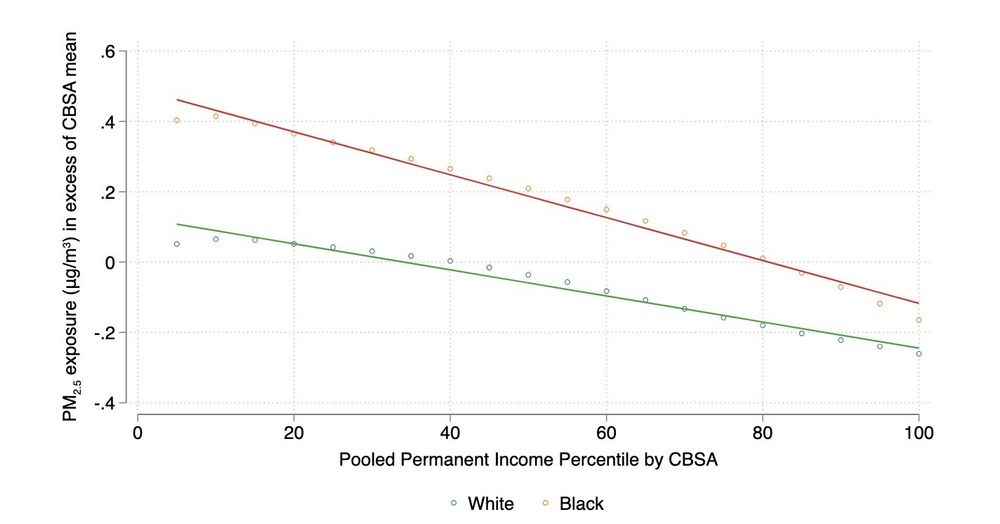
This pattern also holds within cities, and for other pollutants. The pollution-income gradients are slightly steeper, but still very inelastic. In 2016 a 1% increase in income for Black individuals is associated with a -0.0167% reduction in ambient air pollution.
Simple back-of-the-envelope calculations show that if we were to close the Black-White income gap (a 60% increase in income!) that the Black-White pollution gap would shrink by ~10%. That's not very responsive.