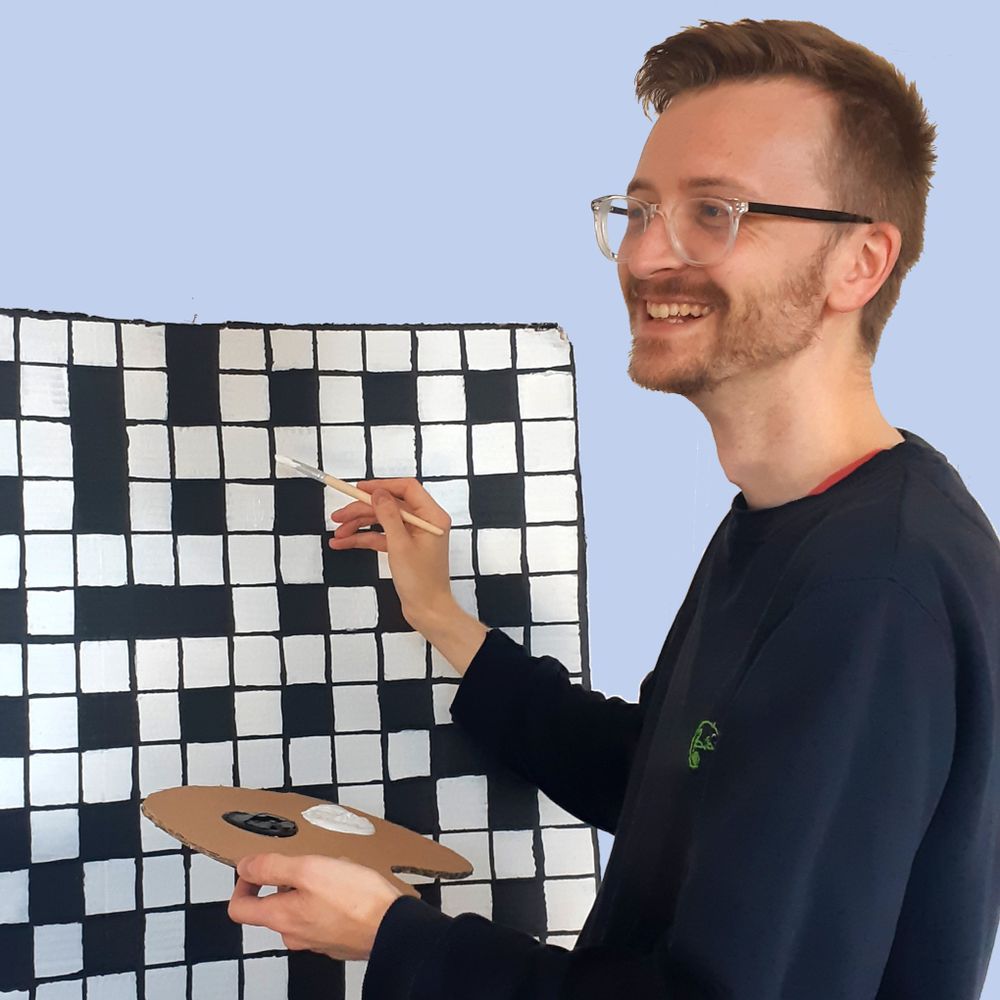
I've been unemployed for a few months. I now set myself pretend jobs to prevent the rot setting in. My son thinks this guy is funny, which is a good enough excuse to make something. Any requests?
03.03.2026 10:47
👍 866
🔁 290
💬 57
📌 37
Thank you Peak(e)
03.03.2026 20:28
👍 3
🔁 0
💬 0
📌 0
Flashbacks to early 2020...
03.03.2026 20:25
👍 2
🔁 0
💬 0
📌 0
The fatty owls are not what they seem
03.03.2026 19:04
👍 6
🔁 0
💬 2
📌 0
Anagrams seem less whimsical because it's applying a dictionary def of "drunk" figuratively, whereas "primarily" to seem to require a whole new def
28.02.2026 19:25
👍 1
🔁 0
💬 1
📌 0
What if you make "first" mean something like "first-ified" or "reduced to its first" though? Doesn't seem a million miles away from redefining "firstly" to me. (In fact the redefinition of "firstly" almost implies a corresponding redefinition of "first"!)
28.02.2026 19:23
👍 2
🔁 0
💬 1
📌 0
That's modifying "walking" rather than the street though isnt it?
28.02.2026 18:50
👍 0
🔁 0
💬 1
📌 0
I agree on "first XYZ", I just don't see the clear justification for "firstly" if there are no IRL cases where "firstly [list]" or "firstly [thing]" would mean first list item/component
28.02.2026 10:11
👍 2
🔁 0
💬 2
📌 0
True, but I think that's a figurative application of the dictionary def of "drunk", whereas "primarily" seems to be pretending it's got a different dictionary-meaning entirely. (Maybe)
28.02.2026 10:06
👍 1
🔁 0
💬 1
📌 0
I don't mind those particularly and don't find the arguments against them very convincing
27.02.2026 23:36
👍 2
🔁 0
💬 0
📌 0
(I'd defend "business leader" and probably "redhead" on the same basis - i.e. they use established ways of positioning words or word fragments together)
27.02.2026 20:11
👍 0
🔁 0
💬 0
📌 0
Maybe the difference is that getting "<adjective> <noun>" to refer to a part of that noun requires a fundamental change to *grammar*, whereas "firstly lady" uses established grammar ("<adverb> <noun>" as seen in "0.5 decimally") so just requires that we give "firstly" an invented *meaning*
27.02.2026 20:10
👍 0
🔁 0
💬 1
📌 0
People would say exactly the same thing in response to finger-wagging about "first lady", wouldn't they?
27.02.2026 19:48
👍 0
🔁 0
💬 1
📌 0
Well, fair point, but then our dialect of cluing *mostly* flows from a set of principles, but also includes some stuff which isn't really justified but is permitted because it's convenient - easy to see why some would ask why they can't just make convenient use of "first lady" in the same way
27.02.2026 19:44
👍 0
🔁 0
💬 1
📌 0
I don't think I'm assigning real-world meaning to the letters. Considering them purely as letters, "first of tech" makes sense because a teacher might ask a pupil to write "[the] first of TECH" on a blackboard, and "TECH primarily" doesn't the pupil wouldn't know what is meant
27.02.2026 19:39
👍 0
🔁 0
💬 1
📌 0
I might be. It's just that I like to think of cryptic grammar as a well-founded set of principles which it's worth learning about rather than a set of traps/shibboleths for new setters, but approving of "jobs oddly" while disapproving of "odd jobs" looks suspiciously like the latter, really!
27.02.2026 19:32
👍 2
🔁 0
💬 0
📌 0
Maybe? I'm not sure. A reference to how mathematicians might (but probably don't) talk about sets is a world away from the clarity of "first of technology", though, isn't it? It still feels like the adverbs are just a shorthand we've all agreed to use and not look at too closely
27.02.2026 19:27
👍 0
🔁 0
💬 2
📌 0
Surely mathematicians aren't using either "the set of square numbers, primarily" or "[1, 4, 9, 16 etc], primarily" to refer to the first member of the set?
27.02.2026 19:19
👍 0
🔁 0
💬 1
📌 0
I was only using actual houses/streets as a way to see whether there's a real-world use of adverbs to pick out individual components of an object. If there isn't really one I think non-Xims would be entitled to think we're arbitrarily including adverbial indicators and excluding adjectival ones!
27.02.2026 19:17
👍 1
🔁 0
💬 1
📌 0
Does that really work though? Is "select each string primarily" an intelligible instruction IRL? A street is a set or string of houses, but you're never going to hear "street, oddly" for the odd side of the street
27.02.2026 19:05
👍 1
🔁 0
💬 3
📌 0
Hmm... Is that really true though? When would "[thing], lastly" ever mean the last bit of the thing?
Best I can do is that "one half, decimally" means a particular version or rendering of "one half", so maybe "[fodder], lastly" means the fodder rendered in a "only-show-the-last-ified" manner.
27.02.2026 19:00
👍 1
🔁 0
💬 1
📌 0
Hmm... 🤔 Isn't that the bar "first lady" is accused of failing, though? (To be clear, I'm not trying to rule "first lady" in, I'm just wondering if "lady, primarily" is a bit hypocritical because it's a helpful fudge not supported by the IRL meanings of the words)
27.02.2026 18:55
👍 1
🔁 0
💬 1
📌 0
Do we just accept "<adverb> <fodder>" forms out of habit, or because they're less fragrantly divorced from non-cryptic English than "<adjective> <fodder>", or is there a way of properly justifying them I'm overlooking?
27.02.2026 18:45
👍 1
🔁 0
💬 0
📌 0
(I'm sure this has been touched on here before but I can't find the thread now)
Is there any real reason we're allergic to "primary/extreme/last [fodder]" etc but not "primarily/ultimately/extremely [fodder]", given that in normal life "primarily [thing]" wouldn't mean its first component either?
27.02.2026 18:41
👍 6
🔁 0
💬 6
📌 0

Because this video is long, I’ve included timestamps for easy navigation. Check it out if interested:
youtu.be/NzMYUdteLpI?...
Thanks.
25.02.2026 18:02
👍 9
🔁 2
💬 2
📌 2
I tend to call these punny defs in my annotations
25.02.2026 16:12
👍 3
🔁 0
💬 1
📌 0
Congratulations!
24.02.2026 09:07
👍 1
🔁 0
💬 0
📌 0
Yeah it's definitely fair, but I'm the same with misleading capitals where I think the setter having plausible deniability to say "ohhh, you read the word at the start of the clue as a proper noun?! That must have been really inconvenient for you 😇" is still neater/purer
20.02.2026 17:44
👍 2
🔁 0
💬 1
📌 0
I actually think the Guardian's style (no italics or quotes, just: e.g. Jaws ) is the best for cryptics. If you use itals/quotes when you're genuinely referring to a title, then you also have to (dishonestly) use them when you're not really referring to a title
20.02.2026 16:59
👍 3
🔁 0
💬 1
📌 0
Lee Mack as the Invisible Man next
19.02.2026 00:34
👍 2
🔁 0
💬 0
📌 0