
@niobsidian.bsky.social as lead author...
14.05.2025 13:40
👍 0
🔁 0
💬 0
📌 0
@niobsidian.bsky.social as lead author...

See here for the original paper: www.sciencedirect.com/science/arti...

Good to see this coverage of our recent paper in Live Science
www.livescience.com/planet-earth...

Still time to apply to our session on #contourites in #activemargins (or a more generic 'sister' proposal on contourites) at the upcoming ISC conference in New Zealand. Deadline on the 16th of May! See the links below...
confer.co.nz/isc2026/down...
confer.co.nz/isc2026/call...
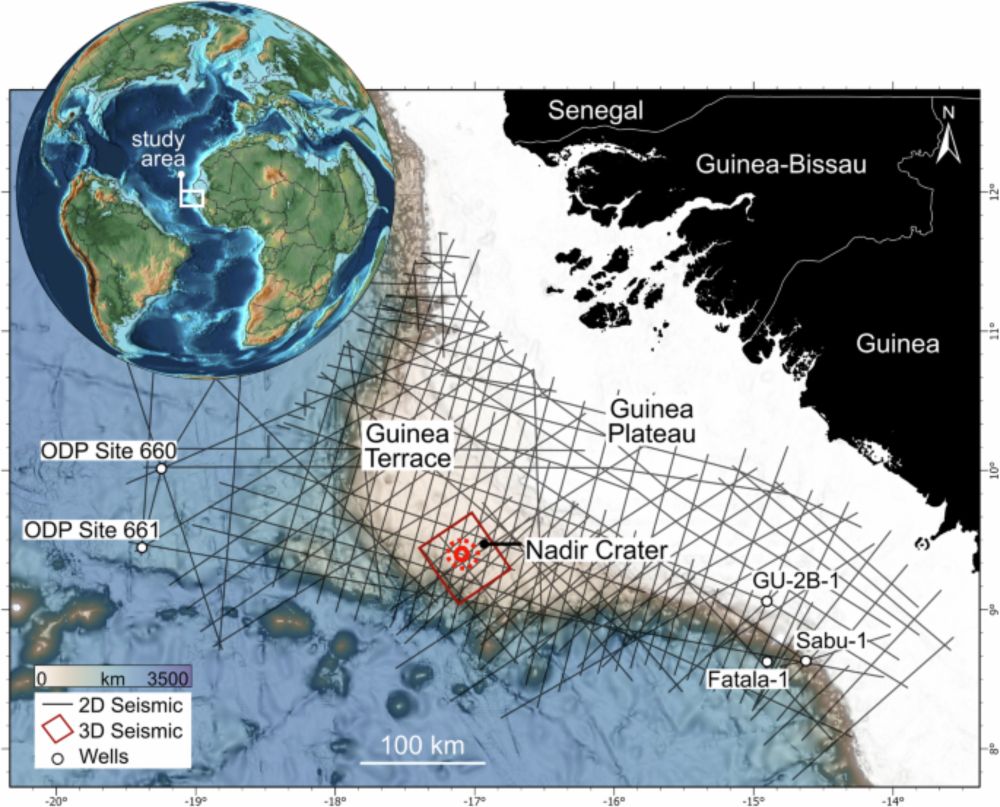
See below for a link to the original paper - mind-blowing seismic images, structural geology on a 20-second timescale...
www.nature.com/articles/s43...

Great to see that our paper on the 3D anatomy of the Nadir Crater was in the top 25 most successful (impactful?) papers in 2024 in Comms Earth & Environment!
Huge thanks also to our colleagues Elisabetta Erba and Cinzia Bottini in Milan for their exceptional work in re-dating sediment cores for this work - would not have been possible without them

Map of the reconstruction below!
Lots more to come on this in future years, especially if our #IODP drilling proposal is scheduled any time soon!

This pushes back the age of initial opening of the opening of the gateway to the mid-Aptian, around 117 million years ago. This also suggests that this early opening impacted global climate, with black shale deposited in these new, narrow basins leading to short-lived global cooling.

Seismic reflection profile showing large sediment waves that formed during the Early Cretaceous period
In this area, we see evidence for incredible, multi-km scale sediment waves in the seismic data, that document saline waters flowing out from the restricted equatorial basins, into the Central Atlantic - similar to the Mediterranean Outflow Water in the present
This study uses seismic reflection data to reconstruct overflow conditions and the marine connection from the earliest stage of opening of the Equatorial Atlantic Gateway, the new ocean connection that formed following the separation of Africa and South America in the Cretaceous Period

Delighted to see this new paper led by my recent postdoc, Debora Duarte, published in Global and Planetary Change!
#sedimentwaves, #contourites, #gateways
www.sciencedirect.com/science/arti...
The paper uses seismic reflection data to reconstruct the stratigraphic evolution of the Guinea Plateau, with emphasis on the Equatorial Atlantic Gateway - a critical link between north and south Atlantic during the Cretaceous

New paper in this Geological Society SP collection by my recent PhD student, Ben. The first from his PhD - well done Ben!
www.lyellcollection.org/doi/full/10....

The Science Evaluation Panel (SEP) is central to the success of IODP3 and is responsible for the evaluation and selection of the best and most relevant proposals for development of expedition schedules. Be a part of it iodp3.org/call-for-app...
officially the most beautiful place on Earth, seen from the sky...

Map with the location of all the studies that are part of the special issue.
All the people out there interested in deep-ocean currents and contourites, should not miss this great compilation of articles in Marine Geology:
doi.org/10.1016/j.ma...
Thanks @uisdeannicholson.bsky.social and all other collaborations for making this happen.

