From @bdpedigo.bsky.social: a super efficient, highly reliable, and very generalizable method for mesh structure classification, applied here to spine detection across basically every synapse onto a cell in the MICRoNS dataset.
20.02.2026 21:30
👍 14
🔁 7
💬 0
📌 0

Spine-neck electrical bottlenecks tune temporal precision and inhibitory gating in cortical pyramidal neurons: A connectomics-based biophysical study
www.biorxiv.org/content/10.6...
18.02.2026 07:45
👍 2
🔁 0
💬 0
📌 0

We are going to Society for Neuroscience 2025! #SfN25
🗓️ Mark the date November 15-19
📍 San Diego Convention Center - #Booth3631
🌐 www.openbraininstitute.org/sfn-2025
@sfn.org
#OpenBrainInstitute #ComputationalNeuroscience #SimulationNeuroscience #DigitalBrainModels #DigitalBrains
30.10.2025 10:36
👍 4
🔁 2
💬 0
📌 0

Our paper reconstructing hydras endodermis published in @currentbiology urldefense.com/v3/__https:/...
29.10.2025 15:16
👍 2
🔁 2
💬 0
📌 0
Dendrites have been under the microscope, since 1888. We took it further and put dendrites under 3 different microscopes (ExM, STED, EM) and reconstructed entire branches to reveal fine nanoscale details. #SuperResolution #ElectronMicroscopy #Morphology
https://doi.org/10.1101/2025.07.18.664460
19.07.2025 05:23
👍 2
🔁 3
💬 1
📌 0

What makes human pyramidal neurons uniquely suited for complex information processing? How can human neurons’ distinct properties contribute to our advanced cognitive abilities?
01.08.2025 10:30
👍 36
🔁 9
💬 2
📌 3
Nanoscale dendritic shaft constrictions shape synaptic integration in fine caliber principal neuron dendrites https://www.biorxiv.org/content/10.1101/2025.07.18.664460v1
18.07.2025 16:15
👍 1
🔁 1
💬 0
📌 0

Join Us for Hands-On Tutorials and Demos at CNS*2025!
📅 Saturday, July 5, 2025
⏰ 09:00 - 16:00 CEST
📍 Firenze Fiera - Room 4
Full day of interactive sessions, live demos, and guided tutorials showcasing the Open Brain Platform
🔗 Program & Details: cns2025florence.sched.com/event/25kRZ/...
18.06.2025 11:31
👍 2
🔁 2
💬 0
📌 0
Large-scale 3D EM connectomics dataset of mouse hippocampal area CA1 https://www.biorxiv.org/content/10.1101/2025.04.04.647285v1
06.04.2025 00:15
👍 3
🔁 1
💬 0
📌 0

The calcitron: A simple neuron model that implements many learning rules via the calcium control hypothesis
Author summary Researchers have developed various learning rules for artificial neural networks, but it is unclear how these rules relate to the brain’s natural processes. This study focuses on the ca...
Now out in PLOS CB!
We propose a simple, perceptron-like neuron model, the calcitron, that has four sources of [Ca2+]...We demonstrate that by modulating the plasticity thresholds and calcium influx from each calcium source, we can reproduce a wide range of learning and plasticity protocols.
19.02.2025 16:46
👍 12
🔁 4
💬 1
📌 0
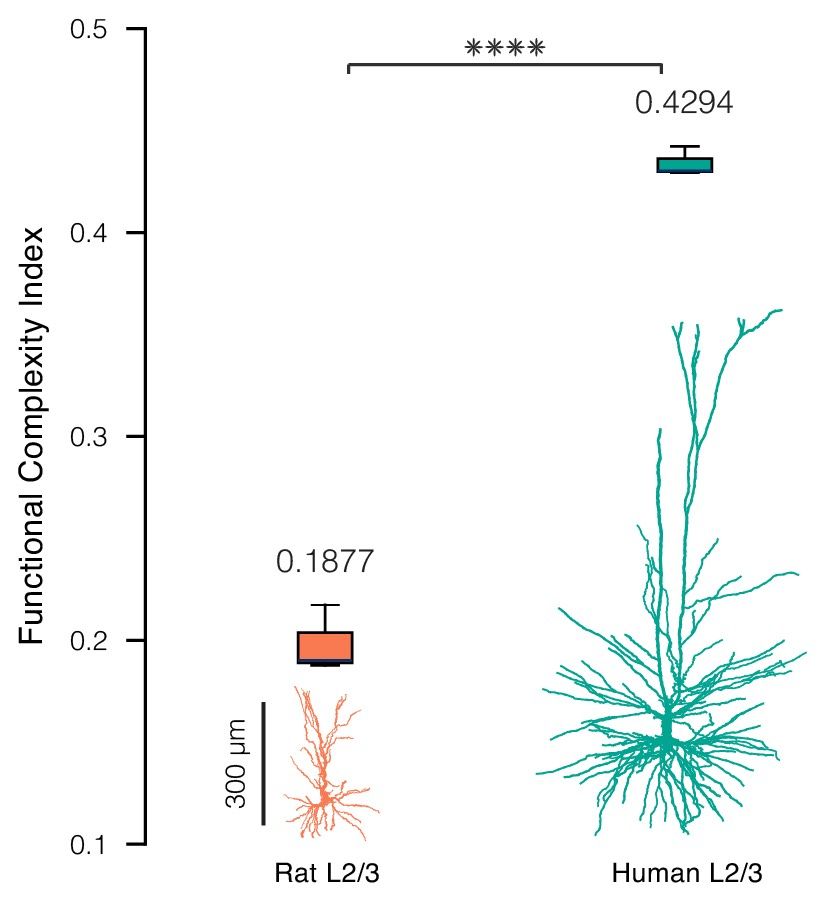
Human cortical pyramidal neurons are larger, with more elaborate branching, and distinct nonlinear biophysical properties compared to rat cortical pyramidal neurons.
Are they more functionally complex? Could that boost the human brain’s computational power? and is that what makes us human? (1/11)
26.12.2024 17:31
👍 204
🔁 61
💬 7
📌 4
