📆 A week from today 📆 - @andrewlea.bsky.social will be speaking at Corner Society! Register to attend in person or on Zoom here: www.raom.org/event-6469091
18.02.2026 19:17
👍 2
🔁 2
💬 0
📌 0
@andrewlea
physician-historian professing at the university of rochester. book: DIGITIZING DIAGNOSIS (jhu press), order: https://bit.ly/diagnosis-lea. working on next book, AID TO THOUGHT, a history of the peripheral brain in medicine.
📆 A week from today 📆 - @andrewlea.bsky.social will be speaking at Corner Society! Register to attend in person or on Zoom here: www.raom.org/event-6469091

In case you missed it, please check out the shortlisted titles for @aahmhistmed.bsky.social's 2026 George Rosen Prize! It was an honor to serve on the selection committee. There's nothing more energizing than reading so much pathbreaking #histmed scholarship. histmed.org/2026-george-...

The AAHM is pleased to share the 2026 shortlists for the George Rosen Prize and the William H. Welch Medal. View the complete shortlists on the AAHM website (www.histmed.org).
Congratulations to all the finalists on this significant achievement!

GEORGE WASHINGTON CORNER SOCIETY FOR THE HISTORY OF MEDICINE Who's in Whose Pocket? Reference Tools, Industry Interests, and the Quest for Therapeutic Reform Wednesday, February 25, 2026 5:30 pm Lecture 6:30 - 7:15 pm Social Gathering Physicians have carried practical guides for centuries. These tools—variously called “manuals," “handbooks,” “pocket remembrancers,” or more commonly, “vade mecums” (Latin for “go with me”) — served as on-the-go memory stimuli. Nineteenth-century manuals, such as Robert Hooper’s The Physician’s Vade-Mecum sought to “compress” for the busy physician the vast expanse of descriptive medical knowledge into a useful companion. This act of compression resulted in a knowledge bottleneck: with such limited space, including certain kinds of information invariably came at the expense of other types of information. The vade mecum would therefore become a contested site over what counted as “appropriate,” “important,” and “rational” medical knowledge. This lecture explores these themes by focusing on the American Medical Association’s Council on Pharmacy and Chemistry (CPC), which, in the early 1930s, created a vade mecum to counter the excesses of proprietary drug manufacturers and inculcate a rational approach to medical therapeutics. Andrew Lea is an assistant professor of health humanities and bioethics at the University of Rochester and a general internist at the Strong Memorial Hospital. His research explores the history of artificial intelligence, communications media, and information technology in medicine and has appeared in leading historical and medical journals, including Isis and the New England Journal of Medicine. His first book, Digitizing Diagnosis, examined early efforts to computerize medical diagnosis and decision-making. He is working on his second book, Aid to Thought: A History of the Peripheral Brain in Medicine. Register here: https://www.raom.org/event-6469091
Corner Society is back for the spring semester!
This month's speaker is our very own @andrewlea.bsky.social - come out to the Rochester Academy of Medicine (or watch on Zoom) to hear his talk "Who's in Whose Pocket? Reference Tools, Industry Interests, and the Quest for Therapeutic Reform"

“The ultimate effects of AI on the cognitive practices of health care professionals will depend on the decisions we make in integrating the technology within the social world of medicine.” Perspective “Cognitive Aids, Artificial Intelligence, and Deskilling in Medicine: The History of an Enduring Anxiety” by Andrew S. Lea, M.D., D.Phil.
A new Perspective situates contemporary concerns about AI-driven cognitive offloading within a long history of debates over how reference tools — from early medical handbooks to digital systems — reshape viewpoints on clinical expertise. Learn more: nejm.ai/49gfudj
@andrewlea.bsky.social
we're hiring in STS @fasosmaastricht.bsky.social!
deadline coming up soon (February 8). focus is the social science-y corners of STS preferably w/ some interest in sustainability & environment - but interpreted broadly.
vacancies.maastrichtuniversity.nl/job/Maastric...
Incredible. Congratulations!

Click here to listen to a *phenomenal* interview from Marsha Wittink on med-psych units, patient perspectives, and the health humanities. Co-hosted with our med student and hist med PhD Michael Healey
Second episode of the this season of "In the Same Vein" now live!
open.spotify.com/episode/7EZO...

Image: A variation on Benjamin Franklin’s “Join, or Die” engraving, originally published in the Pennsylvania Gazette in 1754. Each segment of the snake has the name of a university sent Trump’s “compact”: Texas, AZ, Vanderbilt, USC, Dartmouth, UVA, Brown, Penn, MIT.
Shared courtesy of my Penn History colleague, Ben Nathans
We are hiring! Prospective PhD students in environmental history, history of science, history of technology and STS interested in the climate and environmental impacts of AI look here. Please share in your networks. #envhist #histsci #AI #anthropcoene

#Job #PhilSci #HPS
Fully funded PhD-position at Bielefeld University, Philosophy of the Biomedical Sciences), deadline Oct 30, 2025
Job ad: uni-bielefeld.hr4you.org/job/view/451...
On the program: blogs.uni-bielefeld.de/blog/isosnew...

Curious policy for a store where the average pharmacy pickup time seems to exceed 30 minutes…
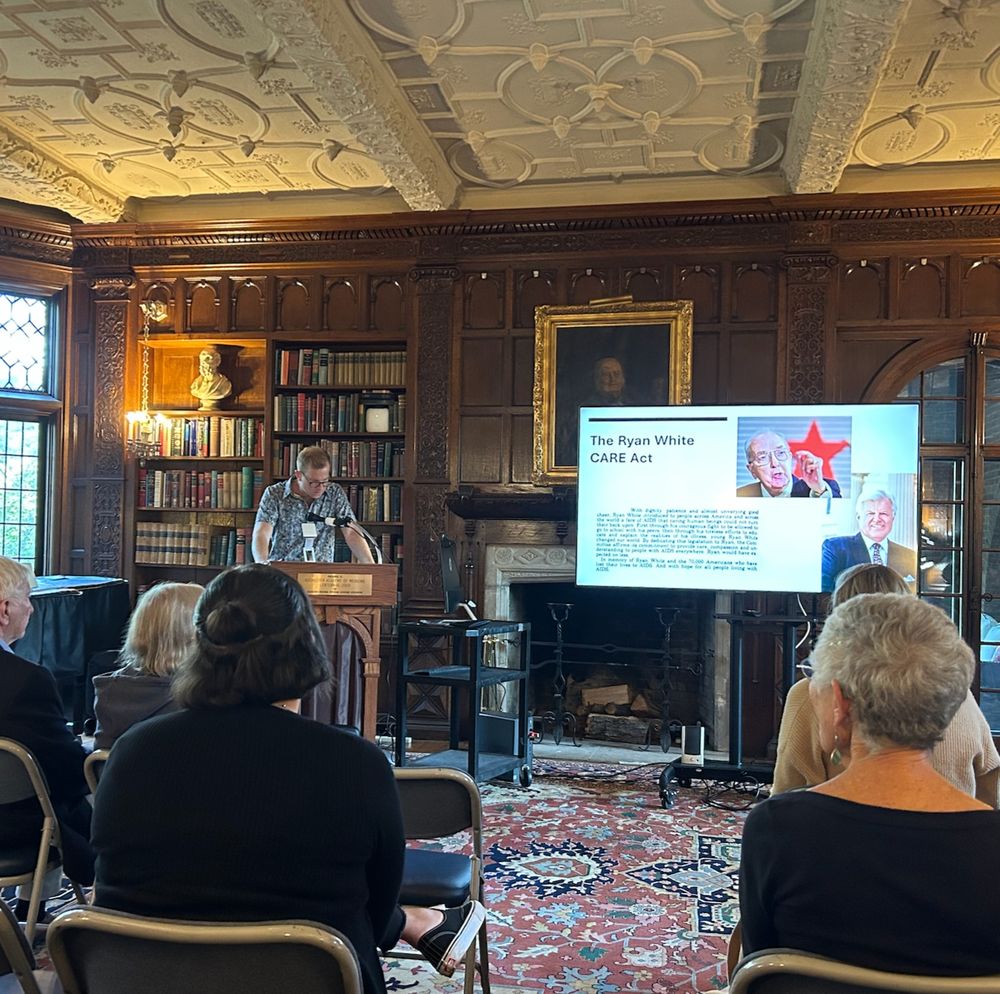
Thanks to @renfro.bsky.social for a wonderful discussion of his new book THE LIFE AND DEATH OF RYAN WHITE (@uncpress.bsky.social) at the Corner Society for the History of Medicine & Rochester Academy of Medicine!

Excited to be giving Grand Rounds at URMC on Sep 9! I'll be discussing the evolving tools doctors have used to grapple with information overload in medicine: from pocket guide to artificial intelligence. Come by the Class of 62 Auditorium if you're in Rochester, or tune in via Zoom if you're not.

New York Times story with profiles of researchers whose grants were terminated.
[Gift Link]
www.nytimes.com/2025/08/24/o...

Amia Srinivasan wrote an essay review in LRB in the earlier days. Characteristically sharp! www.lrb.co.uk/the-paper/v3...

1. "'Trusting the experts is not a feature of either a science or democracy," Kennedy said."
It's literally a vital feature of both science and of representative democracy.
I've written a fair bit about trust in expertise as a vital mechanism in the collective epistemology of science.
I increasingly believe that having that much money distorts one's human interactions such that billionaires are in a constant state of progressive moral decay. The option to avoid this fate by philanthropically disposing of your gross excess assets is permanently available yet rarely exercised.
When I say "technology" I mean the textual means by which experimentalists create virtual witnessing (h/t Steven Shapin).
When I say “technology” I mean the codex

Paper from "Policy: Issues and Actions," vol. 9, no. 3 (September 1996): Zondi Masiza and Chris Landsberg, "FISSION FOR COMPLIMENTS? South Africa and the 1995 extension of nuclear non-proliferation"
Well, everyone, I've found it: the academic paper with the worst pun title possible. The search can finally end. This cannot be beat.

GEORGE WASHINGTON CORNER SOCIETY FOR THE HISTORY OF MEDICINE "Ryan White, Hemophilia, and the HIV/AIDS Epidemic" Wednesday, September 10 5:30 Lecture 6:30 - 7:15 Social Gathering Rochester Academy of Medicine 1441 East Avenue, Rochester, NY In the 1980s, as HIV/AIDS ravaged queer communities and communities of color in the United States and beyond, a straight white teenager named Ryan White emerged as the face of the epidemic. Diagnosed with hemophilia at birth, Ryan contracted AIDS through contaminated blood products. In 1985, he became a household name after he was barred from attending his Indiana middle school because he had AIDS. As Ryan appeared on nightly news broadcasts and graced the covers of popular magazines, he was embraced by music icons and well-known athletes, achieving a curious kind of stardom. This talk will focus on Ryan's experiences with hemophilia and AIDS, as well as the contested meanings of his life, death, and afterlives. Paul Renfro is an associate professor of history and an affiliate faculty member in the Women's Gender, and Sexuality Studies program at Florida State University. He is the author of Stranger Danger: Family Values, Childhood, and the American Carceral State (Oxford University Press, 2020) and The Life and Death of Ryan White: AIDS and Inequality in America (University of North Carolina Press, 2024), which earned an honorable mention in the general nonfiction category of the Florida Book Awards. For more information or to become a Corner Society member, please contact Christine Slobogin, PhD, at Christine_Slobogin@URMC.Rochester.edu.
Our first Corner Society lecture is taking place on Wednesday, September 10, at 5:30 pm at the Rochester Academy of Medicine!
@renfro.bsky.social will be giving a talk titled "Ryan White, Hemophilia, and the HIV/AIDS Epidemic"
You can register here: www.raom.org/event-6257176

Flyer for the: George Washington Corner Society for the History of Medicine 2025-2026 Season 5:30 Lecture 6:30 - 7:15 Social Gathering Rochester Academy of Medicine 1441 East Avenue Wednesday September 10 Paul Renfro Florida State University "Ryan White, Hemophiia, and the HIV/AIDS Epidemic" Wednesday, September 29 Courtney Thompson Mississippi State University "A Calculus of Compassion: Medicine, Emotion, and Identity in Nineteenth-Century America" Wednesday, November 19 Mary Fissell Johns Hopkins University "Savin, Sex, and Scandal: Rethinking Abortion in Early Modern Anglo-America" Wednesday, February 25 Andrew Lea University of Rochester "Who's in Whose Pocket? Reference Tools, Industry Interests, and the Quest for Therapeutic Reform" Wednesday, March 25 Ayah Nuriddin Yale University "Black Eugenics and the Struggle for Equality" Wednesday, April 15 Anna Arabindan-Kesson Princeton University "Case Notes: Art History's Medical Imaginaries" For more information or to become a Corner Society member, please contact Christine Slobogin, PhD, at Christine_Slobogin@URMC.Rochester.edu.
The new Corner Society schedule is live!
I'm so pleased to be able to welcome exciting history of medicine scholars to Rochester during this academic year.
Even if you're not in Rochester, each of these lectures will be available via Zoom (with free registration).
Friends don't let friends wear white-soled dress shoes. This fad cannot die out soon enough.
in which disciplines is the all-lower-case-email most prevalent?
Can someone tell him that by "War on Cancer" we don't mean a war on its behalf?

As a historian of injuries and product safety, this one feels personal.
The CPSC can’t do its job without independent commissioners.
Let’s review some of the cases that led to the establishment of the agency in the first place: