Pat and Pedro are wonderful collaborators and colleagues! Definitely give this book a read if you’re interested in conservation genetics in the context of the rich diversity of the Neotropics.
16.10.2025 22:36
👍 2
🔁 0
💬 0
📌 0
Now published in Cell! We found that ~15% of SNPs from divergent refs did not liftover as SNPs in the gray fox ref—half mapped to monomorphic sites, half failed to map. Co-authored with Matthew Genchev, @elliecat.bsky.social, and @jazlynmooney.bsky.social
www.sciencedirect.com/science/arti...
22.09.2025 17:41
👍 55
🔁 28
💬 2
📌 4
Our paper Genomic diversity of the African malaria vector Anopheles funestus was published in Science today! It features inversions, selection in action, museum specimens and putative new ecotypes. doi.org/10.1126/scie...
18.09.2025 18:45
👍 63
🔁 33
💬 3
📌 3
My first Perspective piece was just published in Science! I discuss the new findings by @amandalea.bsky.social and colleagues showing adaptations to water stress in the Turkana, and the implications of past adaptations for future disease risk.
19.09.2025 17:13
👍 5
🔁 2
💬 0
📌 0


I’m excited to be attending #ESEB2025 this week in Barcelona! If you’re interested in chatting about primate population genetics, come chat with me at my poster this evening - P01.275 Genomics of Brazilian howler monkeys reveals recent inbreeding and species-specific positive selection
18.08.2025 08:34
👍 5
🔁 0
💬 0
📌 0
Inside me there are two wolves. One of them has a 15 genome edits the other 20 genome edits. Neither of them is a dire wolf.
08.04.2025 13:56
👍 910
🔁 189
💬 12
📌 4
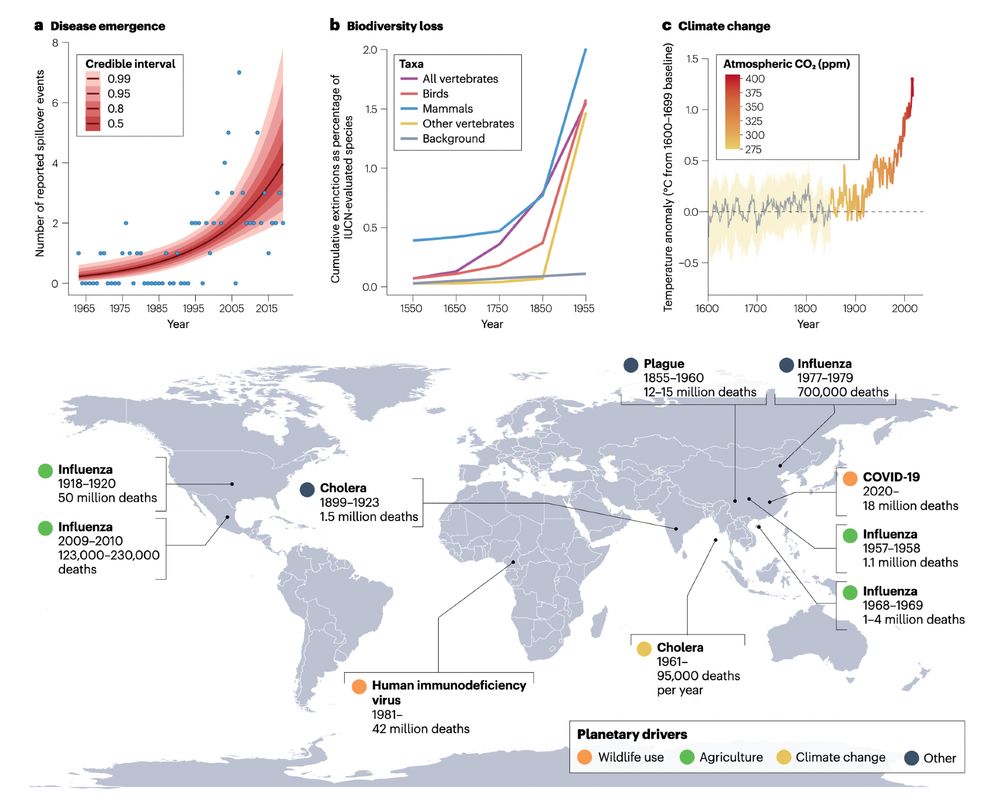
Top panels: graphs showing increases in spillover events, extinction rates, and temperature anomalies over the last few centuries. Bottom panel: a map of 10 pandemics since the year 1900. Four were linked to agriculture, two to wildlife use, and one to climate change.
🚨😷🧪 NEW: A growing body of evidence shows that pandemics, biodiversity loss, and climate change are part of a broader polycrisis - but there are no simple solutions. A sweeping overview of "Pathogens and planetary change" for the first issue of @natrevbiodiv.bsky.social, out now 🔓 rdcu.be/d6lHl
15.01.2025 14:16
👍 542
🔁 226
💬 17
📌 19
Absolutely loved hearing about this work at SMBE24 this past summer and subsequently leading a lab meeting discussion on the preprint. Fantastic to see it published!
12.01.2025 19:25
👍 7
🔁 0
💬 0
📌 0

Preprint is out! We investigated the genomic diversity and evolutionary history of Anopheles funestus mosquitoes, one of the main species transmitting human malaria across Africa. Here’s a visual summary. Art by @petrathepostdoc.bsky.social . 1/8 www.biorxiv.org/content/10.1...
18.12.2024 16:39
👍 38
🔁 19
💬 2
📌 7
Will do!!
19.12.2024 04:19
👍 1
🔁 0
💬 0
📌 0
Congrats to my fellow Duke EvAnth grad student Alisha Anaya 🎉 She put in so much effort scanning and recording this material, it’s great to see it come together!!
19.12.2024 03:09
👍 4
🔁 0
💬 1
📌 0
Being able to accurately identify physical interactions between host and receptor proteins is critical for research on host shifts/zoonoses as these interactions often mediate susceptibility. This type of research is important for future pandemics and research on treatment and vaccine development.
18.12.2024 20:15
👍 3
🔁 0
💬 0
📌 0
With the Crane Foundation & amazing co-authors, we analyzed 150+ years of genomic data, revealing whooping cranes have lost 70% of their genetic diversity and accumulated harmful mutations. Despite conservation successes, they remain vulnerable. We argue keeping their endangered status
18.12.2024 15:12
👍 15
🔁 6
💬 1
📌 0
Fantastic to see this research come together! These questions can be addressed with significantly higher certainty using pathogen paleogenomics as shown here.
18.12.2024 19:51
👍 4
🔁 1
💬 0
📌 0

Nearly five years after publication, and after 4,000 retractions, the paper that sparked the use of hydroxychloroquine for COVID-19 has been retracted.
The publisher cites a range of scientific and ethical concerns.
I have some thoughts 1/n
17.12.2024 23:08
👍 384
🔁 126
💬 6
📌 20

Using hair found in the teeth of the infamous lions named the "Tsavo Man-Eater's," scientists uncover their diet consisted of humans, giraffes, and more. @currentbiology.bsky.social
www.cell.com/current-biol...
18.12.2024 02:10
👍 11
🔁 3
💬 0
📌 0

A New Approach to Predicting Malaria Drug Resistance
Researchers at UC San Diego analyzed the genomes of hundreds of malaria parasites to determine which genetic variants are most likely to confer drug resistance.
Beautiful paper from the Elizabeth Winzeler laboratory at UC San Diego out today in Science building a predictive model of malaria drug resistance by analyzing the genomes of 724 parasite genomes evolved in the lab to resist one of 118 different antimalarial compounds
today.ucsd.edu/story/a-new-...
10.12.2024 20:49
👍 240
🔁 39
💬 5
📌 3
Host specificity can be a super complex phenotype so to see such a clear example of a single mutation driving the shift is both fascinating and worrying!
06.12.2024 03:23
👍 4
🔁 0
💬 0
📌 0
Excited to share a new preprint with @jnovembre.bsky.social ! We use a combination of population genetic theory, simulation, and data analysis to ask: how does study design in genetic studies (including biobanks) impact the discovery of rare, deleterious variants?
04.12.2024 17:17
👍 74
🔁 30
💬 2
📌 5
Love to see genomics and linguistics analyzed together! Cool paper importantly demonstrating how ancient DNA can answer questions in other disciplines. #aDNA
03.12.2024 01:38
👍 10
🔁 3
💬 0
📌 0
Work by PhD student @jayatirsharma.bsky.social on how grouping Hispanic/Latino participants into a single group can obfuscate substantial substructure, leading to false conclusions.
We show how heterogeneity by background group wrt genetic ancestry and environment can affect genetic risk models.
02.12.2024 19:09
👍 23
🔁 9
💬 0
📌 0
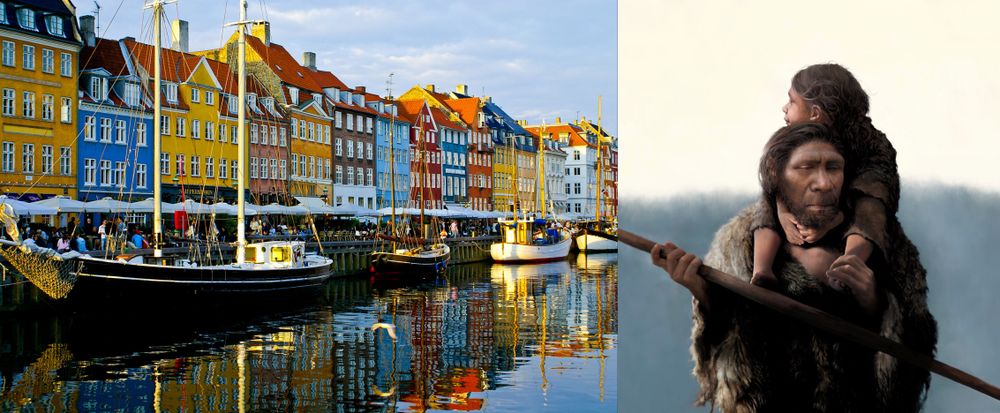
Very excited (and a bit nervous) to announce that I will be hiring two Postdocs for my new group(!) in Copenhagen to study the Neanderthal and Denisovan DNA which survives in present-day humans. Retweet will be much appreciated :)
Link for application:
candidate.hr-manager.net/ApplicationI...
02.12.2024 12:46
👍 418
🔁 287
💬 9
📌 9
Great opportunity and sounds like a fascinating project, can’t wait to read the results!
02.12.2024 01:25
👍 5
🔁 0
💬 0
📌 0
First major paper from the lab! The work was led by super talented postdoc Maria Akopyan. She explored how reference bias skews estimates of diversity, demography, divergence & recombination rate with help from @elliecat.bsky.social
& awesome ungrad Matthew. Full thread coming soon 🤓
01.12.2024 02:52
👍 133
🔁 56
💬 6
📌 2