I'm thrilled and honoured to join this extraordinary community. Congrats to all! Looking forward to many excellent discussions 😀
19.06.2025 00:48
👍 4
🔁 0
💬 1
📌 0
If there’s one message we would like people to take away from this piece, it's that SWEAT AND THE SKIN MICROBIOME ARE NOT THE ONLY SOURCE OF HUMAN ODOR—nor are they even necessarily the most important source!
23.04.2025 00:14
👍 2
🔁 1
💬 1
📌 0
If you do not have access and would like to read the review, please DM me for a PDF.
22.04.2025 23:39
👍 0
🔁 0
💬 0
📌 0

Sebaceous origins of human odor
The compounds that make up human body odor have been catalogued by researchers in many fields. Yet few are aware of exactly where these molecules come…
Read the review for the full story and for more cool tidbits about skin biology! E.g., did you know that…
…acne is unique to humans?
…when you smell something “metallic” you are actually smelling your own skin oils that reacted with the metal ions?
Enjoy! www.sciencedirect.com/science/arti...
22.04.2025 23:39
👍 2
🔁 0
💬 1
📌 0
We ended up pulling together close to a century of research from dermatology, lipid biochem, volatilomics, mol bio, evolution, atmospheric chem, and many other fields, drawing surprisingly clear new insights from old data. So I guarantee there will be something new here for everyone!
22.04.2025 23:39
👍 2
🔁 0
💬 1
📌 0
I started researching this topic on a whim during COVID lockdown when I couldn’t go to the lab. At the time I never guessed how deep the rabbit hole went. It’s a good lesson in reserving time to think, read, and indulge the curiosity that makes us love doing science in the first place ❤️
22.04.2025 23:39
👍 2
🔁 0
💬 1
📌 0

a silhouette of a human surrounded by six bubbles representing the fields of medical diagnostics, vector biology, cosmetics and personal care, forensics, indoor air quality, and search & rescue
Why do we have such odd sebum? It might have evolved in part to help protect our naked skin from UV radiation. ☀️
Sebum and its volatiles are incredibly understudied, but further work could have wide-ranging applications, from vector biology to forensics.
22.04.2025 23:39
👍 1
🔁 0
💬 1
📌 0
For example, one of the most evolutionarily peculiar sebum compounds we have—sapienic acid—breaks down into distinctive long-chain aldehydes. Incidentally, those aldehydes are key compounds used by human-specialist dengue mosquitoes to find humans (Zhao et al. 2022 Nature). 🦟
22.04.2025 23:39
👍 2
🔁 0
💬 1
📌 0
You probably think body odour comes from sweat and bacteria. (Sure, some does.) But actually, a lot of it comes from sebum (skin oils) broken down by abiotic oxidation. Turns out humans have very strange sebum, which in turn gives us a very strange scent!
22.04.2025 23:39
👍 1
🔁 0
💬 1
📌 0
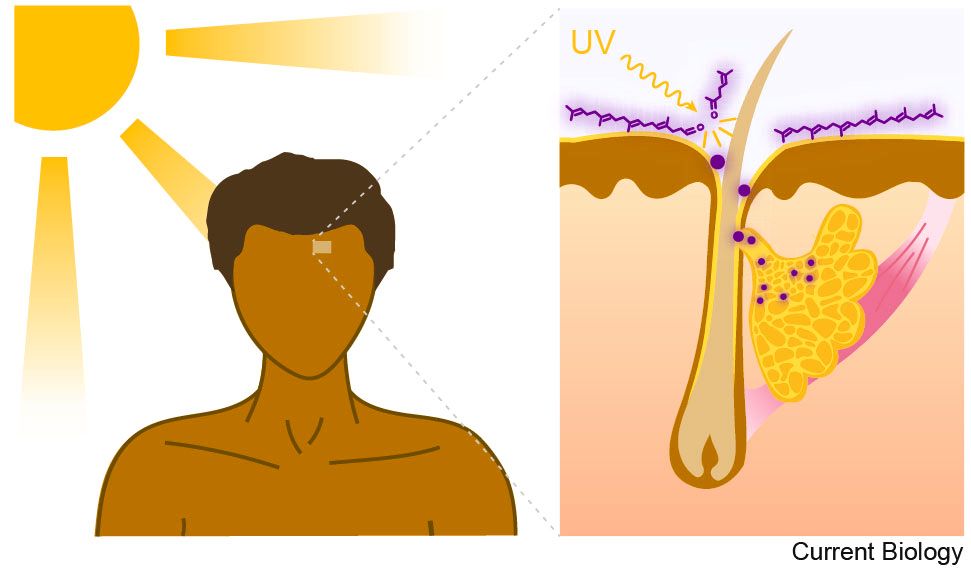
a diagram showing a cross-section of human skin, showing that sebaceous compounds are broken down under UV radiation
Kicking off my Bluesky account by sharing a new review I wrote with @lindymcbr.bsky.social for @currentbiology.bsky.social! If you’ve ever wondered about the source of your stank or just want to learn why humans smell weird (it's true!), then this review is for you! 👃🧪🤔 doi.org/10.1016/j.cu...
22.04.2025 23:39
👍 36
🔁 11
💬 1
📌 5