

02.03.2026 14:50
👍 9
🔁 2
💬 0
📌 0

Comparison of the frondose features in the Dongpo Formation with uninterrupted chevron marks (A−D) and the Ediacaran Charnia for comparison (E). (A) Uninterrupted chevron marks from the Carboniferous Gull Island Formation, Ireland (modified from Doyle and Hoey, 2022); (B) and (D) frondose forms from the Dongpo Formation (modified from Wang et al., 2026); (C) uninterrupted chevron marks from the Lower Silurian Aberystwyth Grits, Wales (modified from Dżułyński and Walton, 1965); (E) Charnia ewinoni from the Ediacaran of Newfoundland (modified from Pasinetti et al., 2025). All scale bars are 1 cm. Portions of the branch-like structures highlighted in (B-D), primary branches in (E) are offset not opposite and have second (red) and third order branches (green) highlighted as is typical of Ediacaran rangeomorphs.
Earlier this year there was an article on the beautiful new #Ediacaran #Dongpo Biota in China, it has some lovely fossils in it. Well worth a look!
There were also some things interpreted as fronds that we consider to be abiogenic uninterrupted Chevron marks. doi.org/10.1016/j.pr...
Not quite a cm long.
If you zoom in on the upper right circle, you can see two of them. Before this, they were too small to get good pictures with my phone camera.
You can buy them in most toy stores, or Amazon carries them if you want to get them online.
A small tank of artemia - sea monkeys - that I set up over the summer.

ovoid Aspidella terranovica with central groove next to 3 lobed Triforillonia

Chambered branching protistan fossil Palaeopascichnus left and a bulbous, discoidal Nemiana sp bottom
This #FossilFriday, how about a little look forward in the #Ediacaran to the post Kotlin Crisis extinction event strata in in Newfoundland. doi.org/10.1130/G542...
The post-extinction biotas are dominated by discs such as #Aspidella terranovica and the giant protistan #Palaeopascichnus.

Here is a writeup of our work on #Aninoides and how it helped us to uncover a little bit of Beothuk astronomy. Obviously :-)
With huge thanks to @julialaite.bsky.social
gazette.mun.ca/research/dig...
A big post this #FossilFriday, folks! We've just published our paper describing the age of the #Ediacaran Inner Meadow fossil site in #Newfoundland, and it has VERY important ramifications about what we (think we) know about extinction in the Ediacaran...

branching leaf like fronds and a double tire track like form with transverse bars right
Happy #FossilFriday we just got page proofs of our paper on the diversity and geochronology of our #InnerMeadow site so let’s celebrate by sharing the first #Erniettomorph from the #Ediacaran of Newfoundland, #Phyllozoon (right) with a bonus #Bradgatia top left.
Wow. 😳

This #FossilFriday, we travel to Bay St. George, #Newfoundland for #Carboniferous plants: Lepidodendron tree elements and an unidentified fern.
From the exhibits at @johnsongeocentre.bsky.social.
#FossilFriday at its best!!
This #FossilFriday: a wonderful new piece of research based on the #Ediacaran fossils of #Newfoundland. The name Aninoides is derived partly from the language of the Beothuk, the indigenous people of Newfoundland. Please read below to learn more!

ediacaran frond with long first order branches like the tail of a comet the disc at the base is accidental

small specimen of a new Ediacaran rangeomorph genus, leaf shaped with long primary branches and no basal disk

seafloor reconstruction of the Ediacaran showing a procumbent frond growing along the seafloor among microbial matground fabrics. Depicting the darkness of the deep marine, in the distance are charniodiscus procerus with their procumbent stem and upright cone like frond
This #FossilFriday I am teasing some images of a forthcoming new Ediacaran genus. It is a relative of #Charnia which has hogged attention these last 3 years. My PhD student Simon is lead author. It lived on the deep dark ocean floor of the #Ediacaran Fermeuse Formation in Nfld (Inner Meadow).

❓ Did you miss our recent public talk by Dr Duncan McIlroy on Charnwood Forest's newest fossil?
🌟 We've got you covered - watch the recording on our Youtube channel and discover the wonders of our fossil, Charnia brasieri!
🌐 youtube.com/live/poR8iv7...


This #FossilFriday, another beautiful #Newfoundland fossil: an orthocerid nautiloid from #Ordovician rocks in western Newfoundland. It's a great teaching specimen, as it shows both the internal chamber walls (septae) and the central air/water canal (siphuncle).
Photos: Chris Brown

a comet shaped fossil on a bedding plane with cm scale bar. has an accidental disc on one end. it has very long branches at a low angle to the axis composed of smaller branches similar to #Charnia
This #Ediacaran #FossilFriday beauty was uncovered the 1st day Inner Meadow. We are so looking forward to sharing this one with the world. A new genus related to #Charnia (in press) it will be named for its comet-like shape, but the disc here is accidental (none of the other 9 specimens have it).

This #FossilFriday, here's the holotype of the #Ediacaran organism Charniodiscus concentricus from Charnwood Forest in the UK. The illustration and colour coding reveal how the organism's branches were actually preserved on different bedding planes. From doi.org/10.3389/fear...


#Fractofusus is the most common organism at many of the #Ediacaran fossil sites in #Newfoundland, and it's also one of the best preserved. Here we can see the complex branching they possessed, preserved in exquisite detail.
#FossilFriday #FractofususFriday
It’s #newspeciesday this #FossilFriday, and it’s a special one this time. A very happy day for the MUN Paleobiology research group! 😃❤️

fractal like branches in 3 rows attributed to #Beothukis mistakensis. Fossil is a latex mold so what the bottom of the organism would have looked like if you had pulled it off the seafloor. From Mistaken Point Newfoundland
A bit late on #FossilFriday but this Ediacaran Mistaken point specimen has been on my desk haunting me this last month. It is the paratype of #Beothukis mistakensis. All know specimens of this sp. on the E Surface are oriented nearly perpendicular to the palaeocurrent doi.org/10.3389/fear...

This #fossilfriday, we move in time to the #Permian when the #amphibian Seymouria sanjuanensis lived in what is New Mexico today. Clusters of large animals like this one are rarely found in the #fossil record, especially this well preserved.
Photo: Amy Henrici

two charnias lying in a matground the fronds are living reclined on the seafloor (procumbent) and have falcate primary order branches that we interpret as having curved up above the seafloor, becoming the classic charnia shape in 3D
This is such a beautiful fossil to work with. As soon the first specimen appeared i loved the architecture & pulled rank, calling dibs on working on it (which i seldom do). This is the artwork of our new #Charnia that i produced for the journal to go in the graphical abstract.
#sciart #paleoart

fossil with alternating falcate branched with 2 orders of smaller rangeomorph branches. it is a negative relief on top of a grey siltstone.
Happy #FossilFriday from the #Ediacaran of Newfoundland and our #InnerMeadow site, teasing this beauty of a #Charnia which will get a name any day now. This specimen was found just a couple of weeks ago (after acceptance of the paper) & is c. 35cm long & 8cm wide (before retrodeformation)…,,
❤️❤️❤️❤️
It probably lived a lifestyle similar to some modern crustaceans, yeah.
I like to think so. 🦐🍽️
This #FossilFriday: a spectacular 3D reconstruction of Waptia fieldensis, an arthropod from the 500 million year old (Cambrian) Burgess Shale, produced by Lars Fields.
To learn more, visit doi.org/10.1098/rsos.... 😃

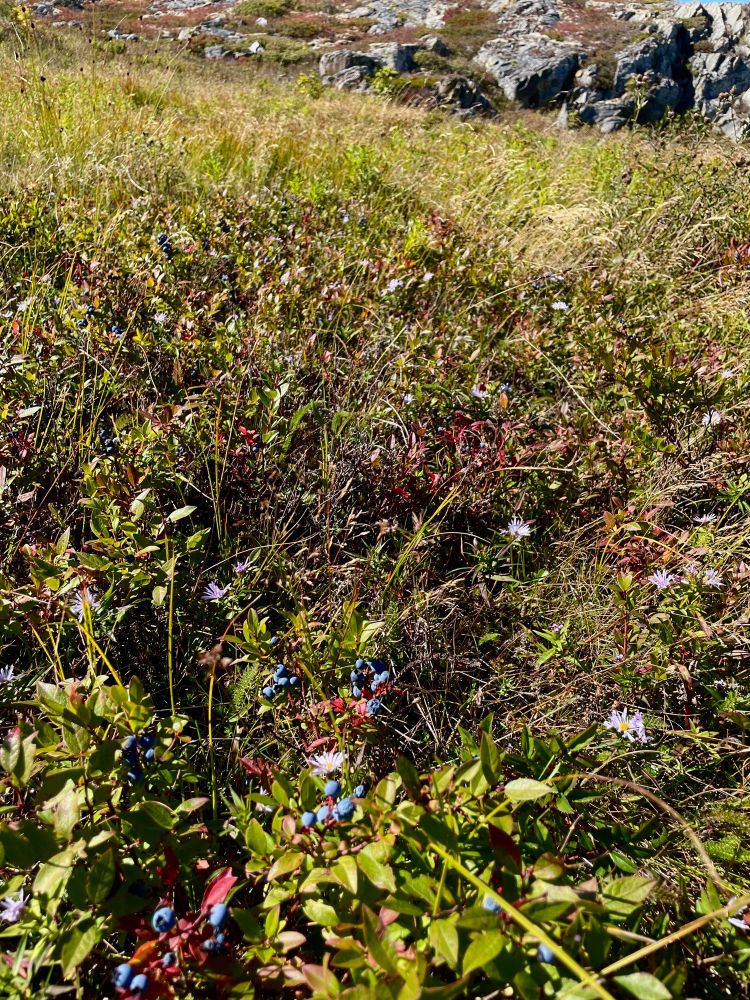
Happy #FossilFriday from the #Ediacaran of Inner Meadow in Newfoundland. The meadow is beautiful this time of year and it is great for the clearing work. Here is a newly exposed #Charnia masoni. The first masoni from this site, our faunal list is getting long!
