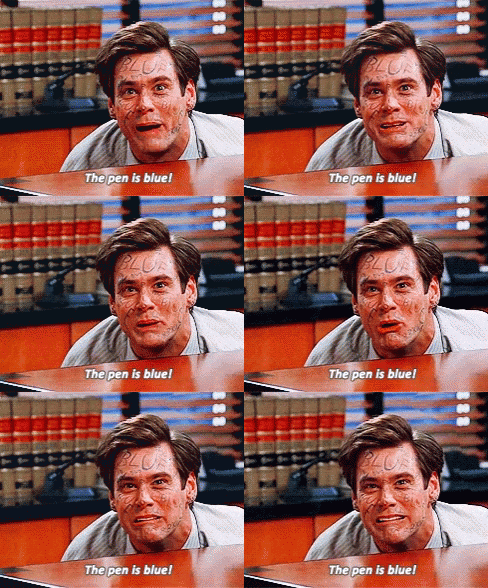
🤯
16.01.2026 20:56
👍 11891
🔁 643
💬 337
📌 64
🤯

Literally a publication for eight-year olds 40 years ago

you don't know me

I hope someone draws this wonderful story about Tom Stoppard's Arcadia and the power of the arts to help us see things differently, to the attention of our Education Secretary. Do read it, it will lift your spirits.

ON RESPECTABILITY IN DRESS Every once in a while, people here will get mad at me. And it often involves the same issue: respectability in dress. Or its related cousin: dress codes. Judging someone's deeper, more important qualities based on attire often feels so natural; people get upset when I refuse to engage in the same judgment. To them, it feels as though I'm denying something so obvious, I'm dishonest. I've written about dress respectability no fewer than half a dozen times in my 15 years of writing about menswear, but never so thoroughly and comprehensively on Twitter. This post will be long, but I hope it is engaging. And I hope you stay with me because I find this sentiment to be so noxious — so antithetical to any notion of "good," whether religious or secular — that I hope I can convince a few people to resist such temptations. What is respectability in dress? It's the idea that you can show respect through clothes, such as wearing a suit to a wedding. Or the idea that people in certain clothes are more deserving of respect, such as a man in a suit versus another man in a hoodie. I will address each in turn. I believe dress is a form of social language. And thus, you can signal certain things through clothes. For instance, if I were to attend a wedding, I would wear a suit as an outward expression of a sentiment in my heart (e.g., "I'm happy for my hosts and wish to honor them on this day"). The suit is simply a representation of my sentiment, which already exists, even if I was in jeans. However, if I arrived at a wedding and saw someone not wearing a suit, I would not judge the person's more important qualities based on their attire. Perhaps they didn't have time to buy a suit. Perhaps clothes shopping gives them great anxiety. Perhaps they can't afford a suit that fits. If I wanted to know whether that person is of good character, I would judge this off their more direct actions, such as how they treat the people around them. Are they genial to g…

In 1852, Cardinal John Henry Newman penned an essay, initially delivered as a university lecture, titled "Definition of a Gentleman." A gentleman, he says, is someone gentle and kind, considerate of others, humble in social relations, and respectful of boundaries. He compares a gentleman to "an easy chair or a good fire, which do their part in dispelling cold and fatigue." He writes: "The true gentleman in like manner carefully avoids whatever may cause a jar or a jolt in the minds of those with whom he is cast — all clashing of opinion, or collision of feeling, all restraint, or suspicion, or gloom, or resentment; his great concern being to make every one at his ease and at home. He has his eyes on all his company; he is tender towards the bashful, gentle towards the distant, and merciful towards the absurd; he can recollect to whom he is speaking; he guards against unseasonable allusions, or topics which may irritate; he is seldom prominent in conversation, and never wearisome. He makes light of favors while he does them, and seems to be receiving when he is conferring." There is notably nothing in his essay about clothes. It's impossible to judge a person's deeper, more important qualities based on clothes because people are often just following social conventions. To go back to the wedding example, many people wear a suit not because they hold a particular sentiment in their heart, but simply because a suit is protocol. A friend who works as a wedding photographer revels in telling me stories about suited guests getting into fistfights—certainly not a way to honor your hosts. The irony of dress codes is that the stronger the enforcement, the less you can tell about someone's character based on dress.

Let's now turn to the idea that people in certain clothes are more deserving of respect. The sharpest, most pointed counterargument for this is Pierre Bourdieu, who in his 1979 book Distinction, pointed out that our notions of "Good Taste" are often nothing more than the habits and preferences of the ruling class. Edward Carpenter, a gay British reformer in the late 19th century, understood this a century earlier. He hated suits. In an essay about the "simple life," he compared suits to coffins, as they have "stiff layers upon layers of buckram," which he believed prevented people from getting enough sunlight and air. But more importantly, he hated suits because he recognized that Victorian dress codes weren't about dress codes at all — they were about status signaling and social hierarchy. In May 1889, Carpenter wrote a letter to The Sheffield Independent about how 100,000 of the city's residents were struggling to find sunlight and air, enduring miserable lives, and dying of illnesses because of the thick, black cloud of smog arising out of factories like smoke from Judgement Day. Meanwhile, as Melton-clad plutocrats nattered on about proper dress codes, they concealed their cruelty and vulgarity under refined manners. They weren't concerned with virtue, but rather with showing their supposed higher moral status. And then those socially under them aped those manners to seem higher class. (A dynamic that German sociologist Georg Simmel recognized in his 1902 essay "On Fashion.) Our judgements of dress are often more about the person underneath the clothes, rather than the clothes themselves. We see this with the pre-war British Guardsmen, who dropped their Edwardian-inspired fashions as soon as they were adopted by the "ruffians" known as Teddy Boys (and some Teddy Gals). Or how the slacker hoodie became a symbol of meritocracy in the New Economy when (white) coders wore it in the early 2000s, but it symbolizes criminality when worn by black teens. Clothes ind…

I'm fundamentally opposed to any notion of respectability in dress, as I find it antithetical to a fundamental moral principle: you should treat everyone with respect unless they behave in a manner that suggests otherwise. And so, if John Fetterman lumbers through the halls of Congress in hoodies and shorts, you should object to him based on his politics, not his dress. If a student shows up at Oxford Union in sweats, you should consider his ideas, not his pants. I am perfectly fine with saying certain outfits are ugly. I'm deeply uncomfortable when people make moral judgments based on clothes. A person is not more or less deserving of respect based on dress; they can only do so based on more meaningful behavior. My guess is that you know this in your heart. As you travel through the world, look around you. Are your poorly dressed cousins and uncles bad people? Do shabbily dressed teachers or nurses on the train not actually serve society in positive ways? Do suited politicians not occasionally commit crimes? The idea that appearance doesn't always match character can be found more melodically in Fela Kuti's 1973 album "Gentleman." If you are already interacting with someone on a meaningful basis, you've hopefully already gotten enough information about them to form a judgement and thus can ignore dress. If you haven't interacted with them in meaningful ways, you can simply withhold judgement. I will end with an excerpt from Stuart Hall, a Jamaican-born British cultural theorist. In an essay about pluralism, he made a distinction between "common culture" and "common society," encouraging us to embrace differences. "It should not be necessary to look, walk, feel, think, speak exactly like a paid-up member of the buttoned-up, stiff-upper-lipped, fully corseted and free-born Englishman, culturally to be accorded either the informal courtesy and respect of civil social intercourse or the rights of entitlement and citizenship. Since cultural diversity is, increasi…
I wrote something about respectability in dress over on Twitter. The topic is nuanced for me, so unfortunately the post had to be long. Since Bluesky (reasonably) has character limits, I can't easily import the text here. So I'm including screenshots, if you would like to read it.
Let me tell you a beautiful story about this couch. 🧵
IG msviciousdesign

Kyle Kulinski on Twitter posts an illustrated image, where Laura Loomer tells Hasan Piker "WE'RE DEPORTING YOU BACK TO TURKEY." In the drawing, Hasan Piker replies: "I was born in New Jersey." Laura Loomer replies to Kyle: "The left has no sense of humor."
![On September 6, 2024, Laura Loomer posts a video, where she eats dog food. She writes on Twitter: "I just ate dog food. It's human grade. Which means you and your dog can share a taste, nutrient dense treat together. Order yours today at [link]"
I post a screenshot of this tweet and write: "i setup a fake dog food company last month, bought purina at the pet store, and paid laura loomer $100 for this post."](https://cdn.bsky.app/img/feed_thumbnail/plain/did:plc:ks3gpa6ftoyaq7hmf6c4qx4c/bafkreihsmjuml7n6odhpqrf553ysc6v7k23lrbxcwlgoylnxalahojrmgy)
On September 6, 2024, Laura Loomer posts a video, where she eats dog food. She writes on Twitter: "I just ate dog food. It's human grade. Which means you and your dog can share a taste, nutrient dense treat together. Order yours today at [link]" I post a screenshot of this tweet and write: "i setup a fake dog food company last month, bought purina at the pet store, and paid laura loomer $100 for this post."
not true

From Kafka’s diaries: August 2, 1914: Germany has declared war on Russia. Went swimming in the afternoon.
effective today, I have resigned from working with Ultimate Guard, as I can no longer support the company's creative or business decisions.
"I asked ChatGPT" "I asked Grok" ok well I asked Gandalf and he said he has not passed through fire and death to bandy crooked words with a witless worm
Israel is a criminal, fascist settler colonial state engaging in a genocide & bombing civilians in at least 5 nations right now. Any escalation into full blown war is both its aim & its fault & our continual sale of arms,- & frankly anything else, to them endangers the lives of everyone on Earth.
I used to love Mitch Hedberg. I still do, but I used to too

Gandalf! Has a convoluted infinite combo if I order my tutors right, but can also just make a million myr instead. It's interactive and consistent but doesn't tend to do anything super upsetting for lower power levels
moxfield.com/decks/hmix9h...
It was a creative and new take and the entrenched Star Wars fans hate that (see Last Jedi). If given another season I'm confident it would have really come together in an awesome way. Great fight choreo too
It's legible!!!

lyric comic to pink in the night, by mitski. page 1 text: and i know i've kissed you before, but i didn't do it right. scene 1: a little boy and girl are sitting in the rain. the boy wipes away tears, having tripped and scratched a knee. the girl leans forward to kiss the small wound. scene 2: the two friends are in elementary school, holding hands. the boy looks at a picture depicting a mom, dad, and child.

page 2 text: can i try again, try again, try again. scene 1: high school. they lie on the floor during a study session, but they only have eyes for each other. scene 2: college. the same couple, only now they are two girls, kissing in bed. scene 3: the girls are getting married, exchanging a sweet kiss in a field of flowers. sunset colors cast warm light onto their wedding dresses.

page 3 text: try again, and again, and again. scene 1: the girls are moving in together. one dozes off against an unpacked moving box as the other kisses her head. scene 2: disneyland. both wear minnie mouse ears as they take a selfie, laughing at the kiss mark one has left on her wife's cheek. scene 3: the childhood friends have grown older. one woman hides a bouquet behind her back as they kiss over breakfast.

page 4 text: and again, and again, and again? scene 1: the women wake up in bed together, hints of grey in their hair. one kisses the other's bare shoulder. scene 2: a winter walk. they kiss as their dog plays in the snow. scene 3: the shore of a beach. the wives have greying hair and fine wrinkles, but they're still just as in love. they hold each other close, laughing, full of affection.
pink in the night (2019)

I've gotten into Magic: the Gathering for the last couple of years now and decided to finally try my hand at some fan art. Couldn’t go past Archangel Elspeth - cool armor AND a big ass sword.
Love to see this Jake. Been a fan of your stuff for ages. Hope to see your art inside a card frame some day!!
Thanks for the reminder, Gazlowe
(Audio is from a clip by Northernlion)


This person has harassed myself and many others in the Magic community. His name is Adam Lowe. He goes by Adam Demonic/AdamDefiant on socials. This is going to be a long 🧵
I adore this art, well done!!
Back making silly #MTGCommander videos! Hoping to get back in the rhythm of it all. First one is about stax decks...
vt.tiktok.com/ZSrXV42qQ/

Born from Women who Loved Monsters
open.substack.com/pub/elektrat...
Thanks for making it Dan! Was a ton of fun to listen to. Best of luck with your next projects 🧡
🫣
OMG pleasssseeeee
I'm so sorry Nile, that really sucks
You folks are too kind 🧡
You know it!! 🤝