
Numerous tall trees lay on their sides in the park. Caldas da Rainha, Portugal.
So many trees uprooted after a visit from Depressão Kristin. Parque Dom Carlos I, Caldas da Rainha, #Portugal.
28.01.2026 16:55
👍 0
🔁 0
💬 0
📌 0

A small Roman bridge with its characteristic perfect circle of an arch. Viegas, Portugal.
Last photo from the bike tour of 2025. A little Roman bridge in Viegas, west of Alcanede, #Portugal.
27.12.2025 15:27
👍 1
🔁 0
💬 0
📌 0

The Roman bridge spans a creek in Alcanede, Portugal.
Ponte Romana de Alcanede, #Portugal.
23.12.2025 14:31
👍 1
🔁 0
💬 0
📌 0

A dirt road extends between two scorched hillsides in Portugal.
We cycled through a scorched landscape on our last day. There were some houses a little further beyond that appear to have escaped the flames. I hope everybody was okay. #Portugal
21.12.2025 19:48
👍 2
🔁 0
💬 0
📌 0

The aqueduct crosses the road and disappears into a hillside. Portugal.
On the very last day of our three-week bike tour, we rode under the Aqueduto do Alviela. #Portugal
20.12.2025 17:17
👍 3
🔁 0
💬 0
📌 0

A small chapel is built into a megalithic tomb, known as a dolmen or anta, in Pavia, Portugal.
Anta-Capela de São Dinis, Pavia, #Portugal.
14.12.2025 09:59
👍 2
🔁 0
💬 0
📌 0
Nice to have you here in Portugal. 🙂
12.12.2025 18:54
👍 2
🔁 0
💬 0
📌 0

The perfect blue sky makes a nice backdrop for the Castle of Arraiolos, Portugal.
Castelo de Arraiolos, #Portugal.
12.12.2025 15:23
👍 1
🔁 0
💬 0
📌 0

A cobblestone street runs next to the aqueduct. White homes with gold trim are built into its arches. Évora, Portugal.
Houses built into the arches of the aqueduct in Évora, #Portugal.
10.12.2025 21:54
👍 1
🔁 0
💬 0
📌 0

The outer wall of the castle of Viana do Alentejo, Portugal.
Castelo de Viana do Alentejo, #Portugal.
09.12.2025 16:18
👍 1
🔁 0
💬 0
📌 0

The Roman bridge disappears into the trees that line the Ribeira de Odivelas. Portugal.
Ponte de Vila Ruiva, of Roman origin but with several reconstructions, spans the Ribeira de Odivelas, #Portugal.
08.12.2025 18:55
👍 0
🔁 0
💬 0
📌 0

The castle keep reflects the last of the setting sun. Castle of Beja, Portugal.
Castle of Beja in the evening. #Portugal
07.12.2025 09:32
👍 0
🔁 0
💬 0
📌 0

The side of a home in Beja is adorned with a realistic portrait of a woman by artist Daniel Eime. Portugal.
Mural by Daniel Eime, Beja, #Portugal.
05.12.2025 14:40
👍 1
🔁 0
💬 0
📌 0

The Castle of Mértola dominates a hilltop in the distance. The sky in the background is blue, and the trees in the foreground are green. Portugal.
Castle of Mértola, #Portugal.
02.12.2025 08:49
👍 1
🔁 0
💬 0
📌 0

No traffic on this narrow paved road stretching through the Alentejo, Portugal.
This is my favorite sort of road to pedal along when bike touring. Near Mesquita, #Portugal.
30.11.2025 09:23
👍 1
🔁 0
💬 0
📌 0

Standing on a peak on the Alentejo side, looking down at the Vascão river valley. The Algarve is on the other side. Portugal.
That's the Vascão River down below, marking the border between the Algarve and the Alentejo. Somehow we crossed it with our bikes and scaled the steep hillside. By the time I looked back and took the photo, it was almost noon, we had drunk half our water, and had only traveled 4 km. #Portugal
28.11.2025 19:02
👍 0
🔁 0
💬 0
📌 0

A giant sculpture of an otter by Bordalo II. Constructed from brightly colored recovered trash. Alcoutim, Portugal.
"Lontra" by Bordalo II. Alcoutim, #Portugal.
27.11.2025 18:06
👍 2
🔁 1
💬 0
📌 0

The Arco da Vila tunnels through a building in downtown Faro, Portugal. A cyclist is riding away on the other side.
Our cycling route through Faro took us under three of the arches, and that is not even all of them. This is the Arco da Vila, Faro, #Portugal.
24.11.2025 18:57
👍 0
🔁 0
💬 0
📌 0

The skull of a Carmelite monk faces the camera, embedded in a wall of bones. Faro, Portugal.
The Chapel of Bones in Faro, #Portugal.
23.11.2025 15:52
👍 1
🔁 0
💬 0
📌 0

A small ferry is docked at the Península do Ancão very close to the campground. One group awaits boarding while another disembarks. Faro, Portugal.
The beach is quite far from the city of Faro, but there is an inexpensive ferry that looks like a nice ride. Alternatively, one could stay at the campground, and take the ferry to visit the city. What I really want to know is if they would let us bring our bike aboard. #Portugal
21.11.2025 16:06
👍 1
🔁 0
💬 0
📌 0

A colorful sculpture of a seahorse made out of recovered trash was created by artist Bordalo II. It extends along the height of the water tower base in the municipal campground of Faro, Portugal.
We pitched our tents in the municipal campground of Faro, and only then, looking up, did I see the giant seahorse right there on the water tower in the campground. A magnificent piece by Bordalo II. Praia de Faro, #Portugal.
18.11.2025 21:12
👍 2
🔁 0
💬 0
📌 0

On the Passidiços Loulé Litoral, a bit west of Faro, in the Algarve, Portugal.
My favorite part of our trip through the Algarve was riding through the Ria Formosa. #Portugal
17.11.2025 19:09
👍 0
🔁 0
💬 0
📌 0

In the background is Praia do Peneco, the beach of Albufeira. To the right is the Atlantic Ocean. In the foreground on the observation deck: my bike, fully loaded with bananas among other things. Portugal.
Approaching Albufeira from the west, there is a hidden observation platform with a view of Praia do Peneco, #Portugal.
16.11.2025 20:09
👍 1
🔁 0
💬 0
📌 0

A cyclist navigates through a herd of cattle on a quiet road in the Algarve, Portugal.
We encountered some slow moving traffic somewhere between Sagres and Vila do Bispo, #Portugal.
15.11.2025 20:52
👍 1
🔁 0
💬 0
📌 0
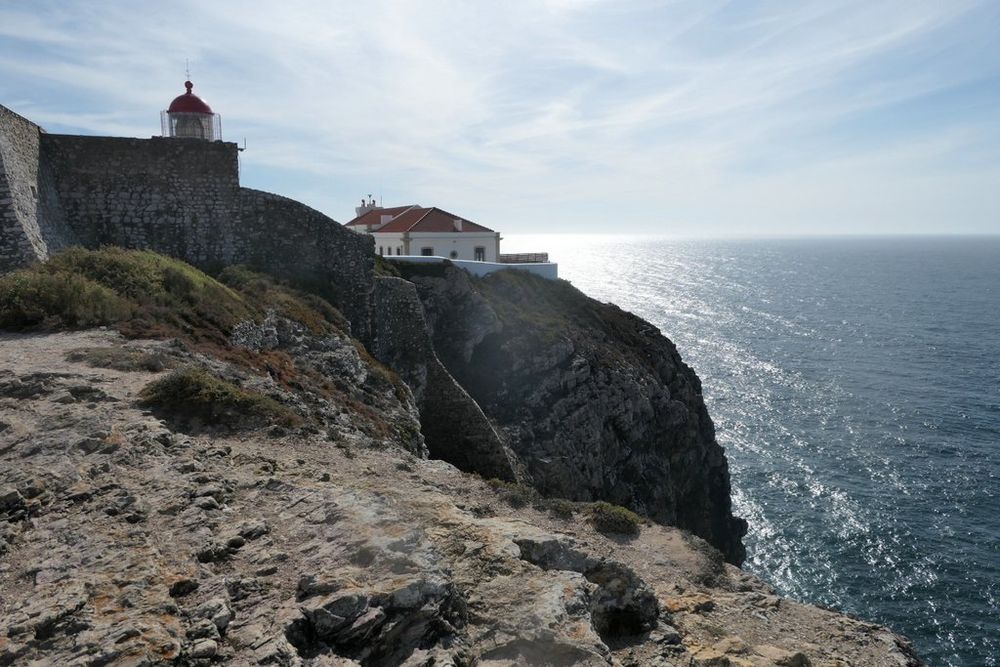
A lighthouse sits on the Cabo de São Vicente that juts out into the Atlantic Ocean from the southwestern corner of Portugal.
Cabo de São Vicente, #Portugal. It's not the southernmost point nor the westernmost point, but it doesn't get anymore southwestern than this on mainland Europe.
12.11.2025 20:32
👍 0
🔁 0
💬 0
📌 0

A large bottle of Sagres beer sits in a water bottle holder on my Scott Aspect bike. Sagres is brewed in Vialonga in the Lisboa district, Portugal.
Picked up a Sagres on the way to Sagres. Sagres is not really brewed in Sagres, but rather a long way ("via longa") away 😉. We were in Vila do Bispo, #Portugal.
08.11.2025 19:09
👍 0
🔁 0
💬 0
📌 0

The view of Bordeira Beach from the hills. The Atlantic Ocean is barely visible in the distance. Portugal.
Praia da Bordeira on the Algarve's west coast, #Portugal.
05.11.2025 17:51
👍 0
🔁 0
💬 0
📌 0

The cobblestoned road leads up the hill to the Castle of Aljezur, Portugal.
Castelo de Aljezur, #Portugal.
04.11.2025 08:44
👍 0
🔁 0
💬 0
📌 0

The Igreja da Misericórdia bathes in the bright sun as it overlooks Aljezur, Portugal.
The 16th century Igreja de Misericórdia, Aljezur, #Portugal.
01.11.2025 17:04
👍 0
🔁 0
💬 0
📌 0

A sign indicating the EuroVelo 1 route near Aljezur, Portugal.
The #EuroVelo 1 route follows the coast of #Portugal, but is rarely marked. That changed once we hit the Algarve, but even then the signs were usually pointing only in the direction from which we came.
30.10.2025 08:27
👍 1
🔁 0
💬 0
📌 0
