The Case That A.I. Is Thinking
ChatGPT does not have an inner life. Yet it seems to know what it’s talking about.
The best write up on the state of AI in a while, from James Somers, with input from my Princeton colleagues Ken Norman, Uri Hasson, Jon Cohen, and many others. Coding with LLMs was a striking moment for me too www.newyorker.com/magazine/202...
04.11.2025 15:09
👍 15
🔁 4
💬 1
📌 1

Checking out the Princeton trails on our lab retreat
03.11.2025 17:44
👍 28
🔁 1
💬 0
📌 0

There are still open desks in our new Human & Machine Intelligence lab at Princeton. Express your interest in joining us: lake-lab.github.io/apply/
22.10.2025 13:35
👍 22
🔁 3
💬 0
📌 0
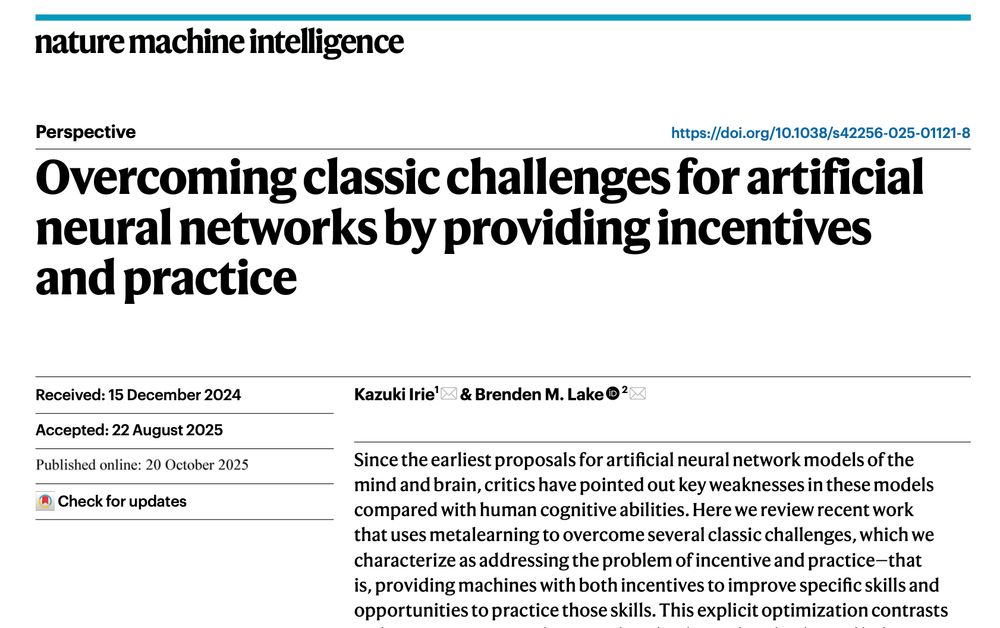
Today in Nature Machine Intelligence, Kazuki Irie & I discuss 4 classic challenges for neural nets — systematic generalization, catastrophic forgetting, few-shot learning, & reasoning. We argue there is a unifying fix: the right incentives & practice. rdcu.be/eLRmg
20.10.2025 13:18
👍 44
🔁 8
💬 0
📌 0
I am also trying something new: posting our current and future directions directly on the lab website. Interested in joining us or collaborating? Get in touch! (2/2) lake-lab.github.io/apply/
08.09.2025 13:59
👍 2
🔁 0
💬 0
📌 0

Our new lab for Human & Machine Intelligence is officially open at Princeton University!
Consider applying for a PhD or Postdoc position, either through Computer Science or Psychology. You can register interest on our new website lake-lab.github.io (1/2)
08.09.2025 13:59
👍 54
🔁 14
💬 1
📌 0

Whither symbols in the era of advanced neural networks?
Some of the strongest evidence that human minds should be thought about in terms of symbolic systems has been the way they combine ideas, produce novelty, and learn quickly. We argue that modern neura...
For much more, see the paper! arxiv.org/abs/2508.05776
By Tom Griffiths, Brenden Lake, Tom McCoy, Ellie Pavlick, and Taylor Webb (@cocoscilab.bsky.social, @brendenlake.bsky.social, @rtommccoy.bsky.social, Ellie Pavlick, @taylorwwebb.bsky.social)
9/9
15.08.2025 16:30
👍 11
🔁 1
💬 0
📌 0
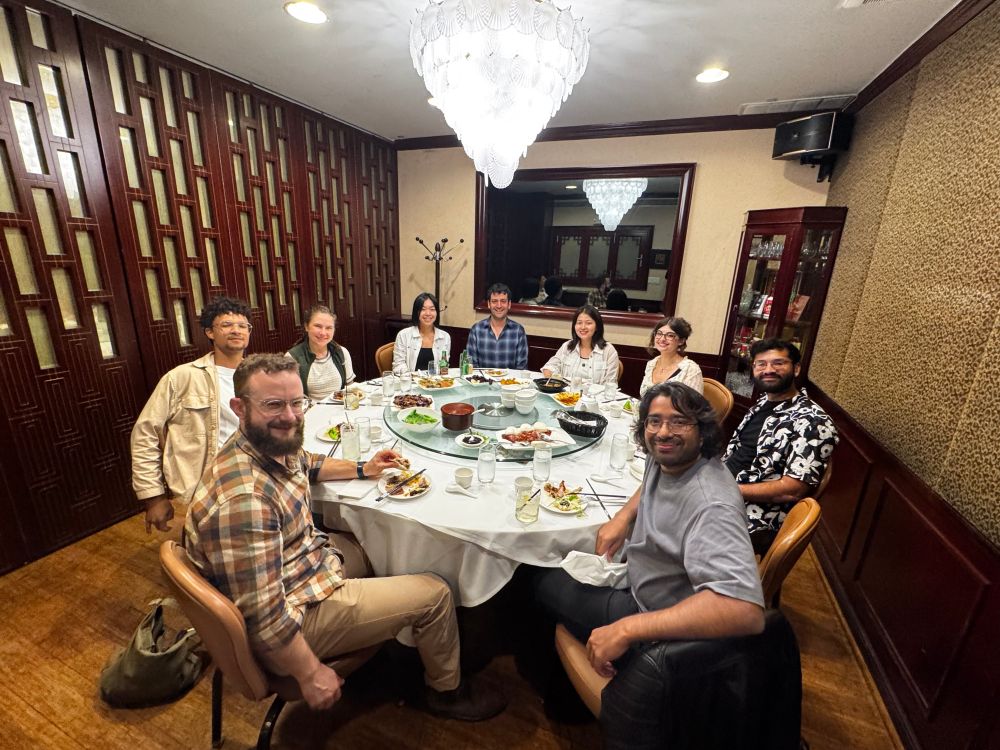
Getting the lab + alums together at CogSci!
01.08.2025 16:43
👍 13
🔁 0
💬 0
📌 0
Some exciting Princeton Initiatives:
Natural and Artificial Minds
nam.ai.princeton.edu
Princeton AI Lab
ai.princeton.edu/ai-lab
Princeton Language and Intelligence
pli.princeton.edu
12.06.2025 14:29
👍 3
🔁 0
💬 0
📌 0
It's hard to leave NYU. I'll miss my incredible colleagues and the community that's meant so much over the past 8 years. NYU has become the largest hub for computational cognitive science that I know — it's been a joy and a privilege to be part of that. Thankfully, Princeton isn't too far.
12.06.2025 14:29
👍 4
🔁 0
💬 1
📌 0
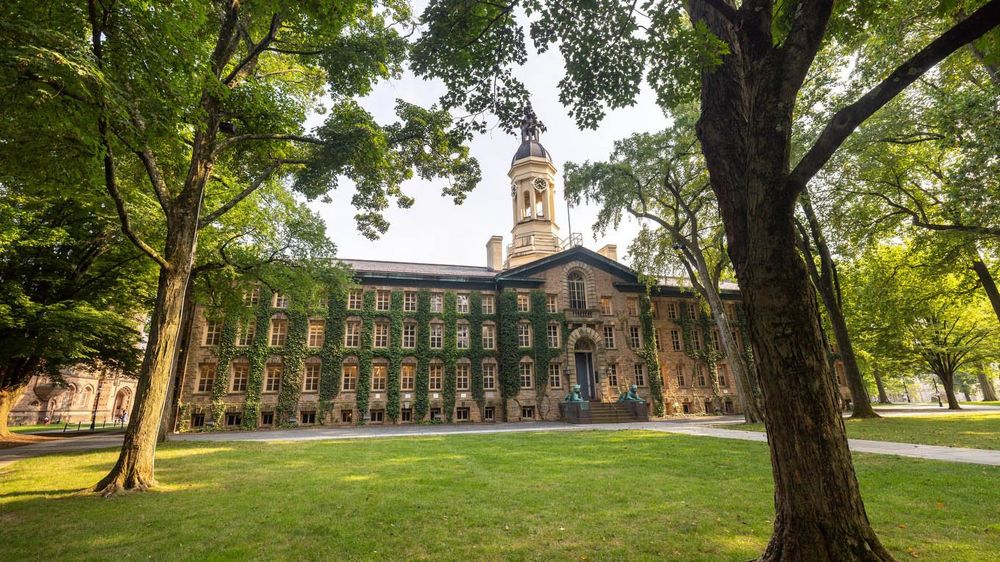
Nassau Hall. Photo credit to Debbie and John O'Boyle
I'm joining Princeton University as an Associate Professor of Computer Science and Psychology this fall! Princeton is ambitiously investing in AI and Natural & Artificial Minds, and I'm excited for my lab to contribute. Recruiting postdocs and Ph.D. students in CS and Psychology — join us!
12.06.2025 14:29
👍 47
🔁 2
💬 4
📌 0
Fantastic new work by @johnchen6.bsky.social (with @brendenlake.bsky.social and me trying not to cause too much trouble).
We study systematic generalization in a safety setting and find LLMs struggle to consistently respond safely when we vary how we ask naive questions. More analyses in the paper!
30.05.2025 17:32
👍 10
🔁 3
💬 0
📌 0
Failures of systematic generalization in LLMs can lead to real-world safety issues.
New paper by @johnchen6.bsky.social and @guydav.bsky.social, arxiv.org/abs/2505.21828
29.05.2025 19:17
👍 5
🔁 2
💬 0
📌 0
Before LLMs, neural nets were task-specific (while humans were task-general). Shockingly, LLMs changed that. How do LLMs represent a task, and do different prompts lead to the same task rep.? Love this by @guydav.bsky.social, and the function vectors of @ericwtodd.bsky.social @davidbau.bsky.social
23.05.2025 20:24
👍 4
🔁 0
💬 1
📌 0
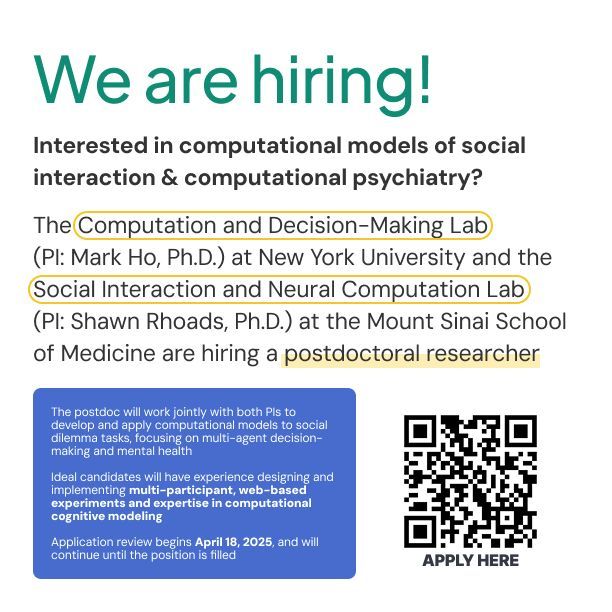
We are hiring! Interested in computational models of social interaction and computational psychiatry?
🤔 Interested in models of social interaction and computational psychiatry?
🤗 If so, @shawnrhoadsphd.bsky.social and I are seeking a highly motivated and talented postdoc to work on these topics!
Please share widely!
apply.interfolio.com/165809
04.04.2025 14:52
👍 37
🔁 23
💬 0
📌 0
Despite the world being on fire, I can't help but be thrilled to announce that I'll be starting as an Assistant Professor in the Cognitive Science Program at Dartmouth in Fall '26. I'll be recruiting grad students this upcoming cycle—get in touch if you're interested!
07.05.2025 22:08
👍 143
🔁 24
💬 17
📌 4
Amazing, congratulations Fred!!
13.05.2025 18:23
👍 2
🔁 0
💬 0
📌 0

What is a Goal? Advancing Machine Agency While Understanding Human Goal Creation
New CDS research models how people understand and formulate goals — knowledge that could improve AI alignment
New work in Nature Machine Intelligence by @guydav.bsky.social, @brendenlake.bsky.social, Todd Gureckis, Graham Todd, and Julian Togelius models how humans develop goals—research that could help bridge the gap between human intentions and AI systems.
nyudatascience.medium.com/what-is-a-go...
10.04.2025 19:43
👍 12
🔁 4
💬 0
📌 0
I snuck a moment with my son Logan (2.5), ever the creative goal generator, into Fig. 1: "Papa, I made a Truck Carrier Truck!"
How do people compose existing concepts to create new goals? Can models generate and understand goals too?
nature.com/articles/s4225
21.02.2025 18:41
👍 17
🔁 1
💬 0
📌 0

@solimlegris.bsky.social and Wai Keen Vong estimated that average human performance on ARC is about 64%(public eval set). Thus, o3 is clearly better than the average crowd worker tested. Note that almost all tasks were solvable by at least one person who tried it on MTurk. arxiv.org/abs/2409.01374
20.12.2024 19:14
👍 18
🔁 1
💬 0
📌 2
I'm new here. I heard bluesky is like science Twitter back in the day, and there are fewer posts from Elon Musk. Did I come to the right place?
19.12.2024 18:26
👍 14
🔁 0
💬 2
📌 0