

Amazing colloquium talk by Christa Schleper from @univie.ac.at @archaea-vienna.bsky.social on how archaea use protrusion to crawl on surfaces!
#archaea #loki
@istaresearch.bsky.social
15.12.2025 11:42
👍 11
🔁 1
💬 0
📌 0
From the point of view of how we conduct our day-to-day work, I definitely agree. But we are also, technically, building a model described by equations and then solving (using a computer) these equations.
29.10.2025 18:44
👍 1
🔁 0
💬 1
📌 0
theorist. I think it's quite interesting, I've discussed it with colleagues doing agent-based simulations and analytical theory and some seem to consider the first aspect more important, whereas others focus on the second one. 2/2
29.10.2025 18:41
👍 1
🔁 0
💬 0
📌 0
Yes, that's an important distinction and I agree with you. However, even when doing agent-based simulations, I think that while the day-to-day work is very close to that of an experimentalist, conceptually one is still solving equations, which makes it close to the work of an analytical 1/2
29.10.2025 18:41
👍 0
🔁 0
💬 1
📌 0
Something I was recently discussing with some colleagues: is the work of computational scientists closer to the one of experimentalists or to the one of theorists working on analytical models?
28.10.2025 16:13
👍 2
🔁 0
💬 2
📌 0
I tried it -- very impressive!
A caveat, however -- it might make you feel as if your published papers aren't as good as you thought 😅
17.10.2025 12:21
👍 9
🔁 1
💬 2
📌 0

Temporal and spatial coordination of DNA segregation and cell division in an archaeon | PNAS
Cells must coordinate DNA segregation with cytokinesis to ensure that each daughter
cell inherits a complete genome. Here, we explore how DNA segre...
Our paper on chromosome segregation in the archaeon Sulfolobus Acidocaldarius has been published in PNAS! This has been a great collaboration with @joeparham19.bsky.social and the rest of @buzzbaum.bsky.social's team. Stay tuned for more to come!😉 @istaresearch.bsky.social
doi.org/10.1073/pnas...
16.10.2025 08:53
👍 39
🔁 16
💬 0
📌 3
Just noticed a mistake in the paper reference in the slide: the last two authors should be Šaric and Baum, not vice versa!
03.10.2025 18:40
👍 0
🔁 0
💬 0
📌 0
It has been a great workshop! Thanks to @romanstano.bsky.social, Peter, Emanuela and Christos for giving me the opportunity to present my work :)
12.09.2025 11:30
👍 4
🔁 1
💬 0
📌 0
Super excited that our group will be supported by an ERC Starting Grant!
In project "InfoFate" we will study how cells use information in dynamical, neighborhood & mechanical signals to make decisions.
We'll have PhD and Postdoc positions available, please get in touch if interested!
04.09.2025 11:27
👍 145
🔁 15
💬 25
📌 1
Huge congrats!! 👏🏼👏🏼👏🏼 Super well deserved!
06.09.2025 18:09
👍 1
🔁 0
💬 1
📌 0
I know two of the authors, this paper was a huge hit in the media 😁
06.09.2025 17:38
👍 1
🔁 0
💬 1
📌 0
@istaresearch.bsky.social
06.09.2025 17:36
👍 0
🔁 0
💬 0
📌 0
@istaresearch.bsky.social
06.09.2025 17:35
👍 1
🔁 0
💬 0
📌 0

Nonequilibrium Remodeling of Collagen IV Networks in Silico
Active bond remodeling enables collagen IV networks to have a range of responses to strain while maintaining their mechanical integrity.
Our paper on the nonequilibrium mechanics and remodelling of collagen-IV networks is finally out on @prxlife.bsky.social! It has been a long and exciting scientific journey, led by @billiemeadowcroft.bsky.social! @ivnpla.bsky.social @yanlanmao.bsky.social
journals.aps.org/prxlife/abst...
06.09.2025 17:35
👍 27
🔁 9
💬 1
📌 0
Sally Rooney books are kinda neat until you read a couple and realize that all the plots and characters are exactly the same...
24.08.2025 12:11
👍 1
🔁 0
💬 0
📌 0

Sass de Putia, Dolomites!
22.08.2025 18:08
👍 3
🔁 0
💬 0
📌 0
Of course! Maybe we can even meet there, that would be great :)
20.08.2025 08:58
👍 1
🔁 0
💬 1
📌 0


A stambecco (ibex) with her baby 🐐
20.08.2025 08:03
👍 5
🔁 0
💬 0
📌 0

Scientific curiosity at IMBA inspired this year's art series, created from research images. Today's kaleidoscope is based on an artistic rendering of the spiral staircase model of the mitotic chromosome, produced by the Goloborodko lab using new tools for analyzing 3D chromosome structure.
12.08.2025 13:17
👍 5
🔁 2
💬 1
📌 0
And it's finally published on @prxlife.bsky.social! Thanks to Paul Robin (Hannezo lab) , @ivnpla.bsky.social (Šaric lab), @aharmendariz.bsky.social (Cuylen lab). It's been a very stimulating and highly satisfying journey! 🧬
journals.aps.org/prxlife/abst...
13.08.2025 16:54
👍 17
🔁 3
💬 1
📌 0


Sass dla Crusc in the Dolomites 😊
11.08.2025 06:50
👍 3
🔁 0
💬 1
📌 0
So satisfying when the last round of proofs for your paper comes back the day before you leave for vacation! 😊
08.08.2025 09:09
👍 3
🔁 0
💬 0
📌 0
Is it just me or Google search results got significantly worse recently?
23.07.2025 10:07
👍 2
🔁 0
💬 0
📌 0
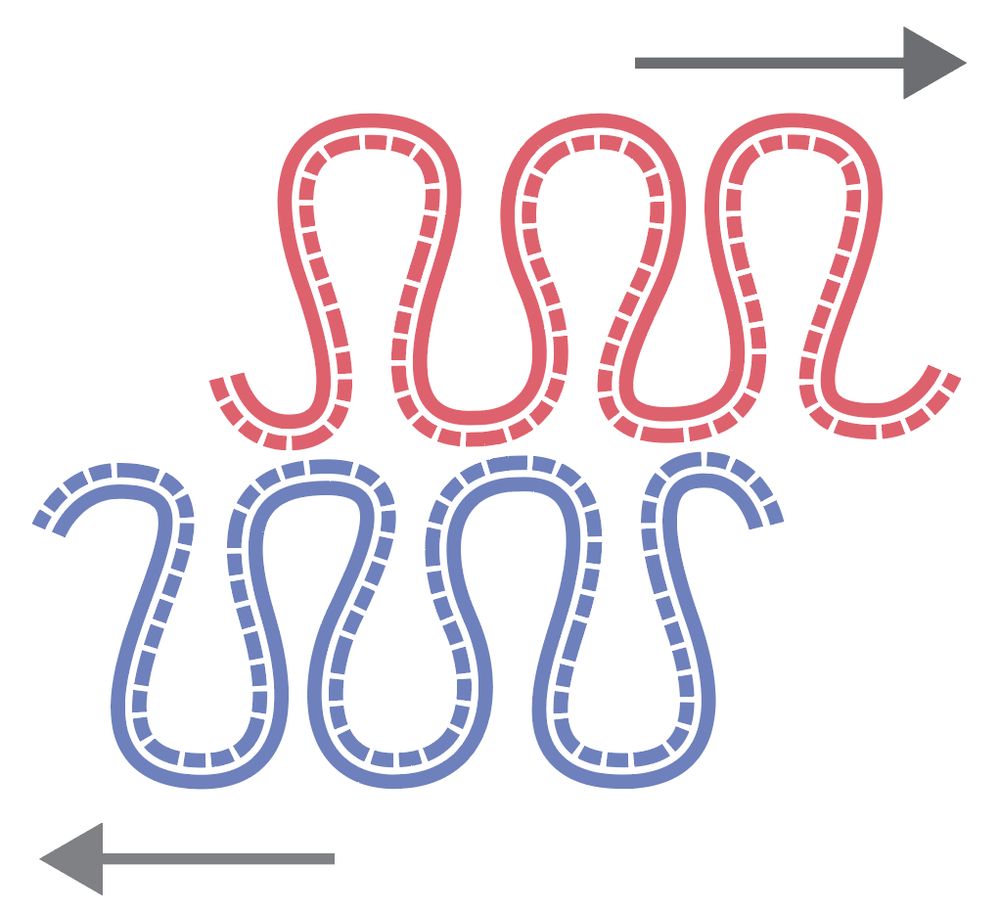
We found a new asymmetry in the large-scale chromosome structure: sister chromatids are systematically shifted by hundreds of kb in the 5′→3′ direction of their inherited strands! The work was led by Flavia Corsi, in close collaboration with the Daniel Gerlich lab.
www.biorxiv.org/content/10.1...
1/
15.07.2025 08:11
👍 115
🔁 59
💬 3
📌 7
Wow!! This is super cool!
25.06.2025 07:50
👍 2
🔁 0
💬 0
📌 0
![5-panel comic. (1) [teacher with long hair next to whiteboard] TEACHER: I’m supposed to give you the tools to do good science. (2) [teacher addressing students] But what *are* those tools? Methodology is hard and there are so many ways to get incorrect results. What is the magic ingredient that makes for good science? (3) TEACHER: To figure it out, I ran a regression with all the factors people say are important: [embedded list in sub-panel, cut off at end] Outcome variable: correct scientific results. Predictors: collaboration; skepticism of others’ claims; questioning your own beliefs; trying to falsify hypotheses; checking citations; statistical rigor; blinded analysis; financial disclosure; open data (4) TEACHER: The regression says two ingredients are the most crucial: 1) genuine curiosity about the answer to a question, and 2) ammonium hydroxide. (5) STUDENT: Wait, why did *ammonia* score so high? How did it even get on the list? LONG HAIR: ...And now you’re doing good science!](https://cdn.bsky.app/img/feed_thumbnail/plain/did:plc:cz73r7iyiqn26upot4jtjdhk/bafkreigzaphhj4mfgfrxddlvdmw47335gnwzqbfqvrnff5x4oovgpf36nq@jpeg)
5-panel comic. (1) [teacher with long hair next to whiteboard] TEACHER: I’m supposed to give you the tools to do good science. (2) [teacher addressing students] But what *are* those tools? Methodology is hard and there are so many ways to get incorrect results. What is the magic ingredient that makes for good science? (3) TEACHER: To figure it out, I ran a regression with all the factors people say are important: [embedded list in sub-panel, cut off at end] Outcome variable: correct scientific results. Predictors: collaboration; skepticism of others’ claims; questioning your own beliefs; trying to falsify hypotheses; checking citations; statistical rigor; blinded analysis; financial disclosure; open data (4) TEACHER: The regression says two ingredients are the most crucial: 1) genuine curiosity about the answer to a question, and 2) ammonium hydroxide. (5) STUDENT: Wait, why did *ammonia* score so high? How did it even get on the list? LONG HAIR: ...And now you’re doing good science!
Good Science
xkcd.com/3101/
12.06.2025 20:28
👍 3521
🔁 628
💬 24
📌 33


