My take on the impact of climate change on Somalis in today’s @newrepublic.com article by @eshirin.bsky.social.
04.03.2026 21:28
👍 2
🔁 1
💬 0
📌 0

@lisathalheimer
Oxford trained climate scientist visiting @hsph.harvard.edu. Interested in the climate-health impacts of AI infrastructure and data centers. Also at @iiasa.ac.at studying extreme weather impacts on society.
My take on the impact of climate change on Somalis in today’s @newrepublic.com article by @eshirin.bsky.social.

For so long, fossil fuel projects have said their contribution to climate change is "negligible".
Turns out that's wrong.
Our research in NPJ Climate Action proves it.
Every tonne of CO2 matters.
@21stcenturyweather.bsky.social
@minderoo.bsky.social
#climatechange
www.nature.com/articles/s44...

In 2022, flooding displaced millions of people in Pakistan. An international team of researchers used open data and tools to help understand differences in vulnerability to floods and better predict displacement in the future.
Read more 👉 iiasa.ac.at/news/sep-202...
@lisathalheimer.bsky.social

Connecting the Dots: How Climate Detectives Link Human-Caused Environmental Change to Migration
Attributing migration to human-caused climate change isn’t as simple as you might think
@lisathalheimer.bsky.social walks through the detective work involved on our podcast, Changing Climate, Changing Migration. Find it wherever you get your podcasts

@lisathalheimer.bsky.social and I are looking forward to a great panel discussion on Wednesday at the #MR2025 conference on the use of quantitative models and data to inform policy on climate-induced migration (8.30am, Geffen Hall room #320).

Interested in learning how to warn vulnerable groups ahead of floods and drought through digital tools? I'll present joint work with @ununiversity.bsky.social & others today @egu.eu:
📍Room 1.31/32
🕟 01 May, 17:30–17:40 (CEST)
🔗 meetingorganizer.copernicus.org/EGU25/EGU25-...
@iiasa.ac.at #EGU25
Thank you, @mongabay.bsky.social for featuring our @natcomms.nature.com paper on involuntary immobility. Open access paper: www.nature.com/articles/s41...
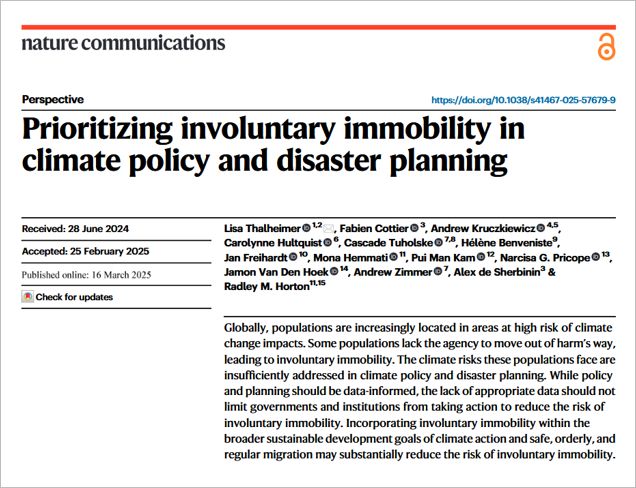
Title, authors’ names, and abstract from a paper about climate policy and disaster planning, particularly about the inability of people to move from high risk areas
#ClimateChange impacts “can force people to stay in place” resulting in involuntary immobility due to various obstacles, e.g., political & social. As @lisathalheimer.bsky.social et al. note, a lack of data & knowledge inhibits policy & planning to address this growing problem doi.org/10.1038/s414...

Flooded refugee camps. Heat-stricken urban communities. Displacement isn’t always a choice—many people want to leave but can’t.
"Leaving isn’t an option, and staying is increasingly dangerous." – @lisathalheimer.bsky.social, IIASA.
#scicomm #climatechange #refugees

As climate risks intensify, many communities are forced to relocate, but what about those who can’t move? A new Nature Communications study led by IIASA researcher @lisathalheimer.bsky.social highlights the struggles of populations trapped in high-risk areas 🌊🌪️🌩️
👉 iiasa.ac.at/news/mar-202...

📢 We're hiring: Climate & Migration Researcher! 🌍📊
Join the Migration & Sustainable Development Research Group to study how climate impacts migration. We seek a postdoc with expertise in statistics, modeling (R, STATA, Python), and large-scale climate & migration data. iiasa.ac.at/employment/j...
📣 #Postdoc opportunity with the brilliant Roman Hoffmann and me on modeling climate migration to and within Europe.
🔎 Please see details below.
Join the wonderful @lisathalheimer.bsky.social and Roman Hoffmann as a post-doc at @iiasa.ac.at in our joint project on climate migration to and within Europe: iiasa.ac.at/projects/ccm...

Join us @iiasa.ac.at as a Researcher/ Postdoc on climate migration modeling to and within Europe as part of our #FFG project CCMIG-EU.
iiasa.ac.at/employment/j...
cc @sarahnash.bsky.social, @mtzatzanis.bsky.social, @ununiversity.bsky.social, @columbiaclimate.bsky.social, @smconstantino.bsky.social
Attributing climate change to drought severity in 2021-2022 in the Horn of Africa region. Our new study shows classic attribution results and the role of vulnerability and humanitarian needs for addressing drought impacts before conditions become dire. doi.org/10.1016/j.wa...
Whether and to what extent does climate change impact migration to and within Europe? @sarahnash.bsky.social, Roman Hoffman and I (@iiasa.ac.at) are asking exactly this question in the @ffg.bsky.social -funded CCMIG-EU project. More info here: iiasa.ac.at/projects/ccm...
Confusing title - it sends a *wrong* signal that people can migrate under future warming. Heat and other extremes force people to stay in disaster areas. We discuss some of these involuntary immobility challenges in our upcoming publication. Stay tuned.

Graph with blue and red bars which represent temperature departures from the reference time period (1850-1900). the first year is 1850 and the last year (which coincides with the highest value) is 2024.

graph with blue and red dots which represent temperature departures from the reference time period (1850-1900). the first year is 1850 and the last year (which coincides with the highest value) is 2024.
2024 is almost history and the global temperature forecast for the remaining few days is rock solid now. Time to wrap up.
In most datasets, 2024 will be 0.1 degree C warmer than 2023. Also, 2024 will be the 1st individual year above the 1.5 degree Paris warming threshold in all datasets.
(1/10)

Disaster is a function of three things: exposure, vulnerability, and hazard.
As climate change pushes up the hazard rates for wildfire, flood, hurricane & more, lack of adaptation and maladaptation on the part of both public and private entities is increasing vulnerability.

Join me in an hour for a discussion around compound events. I will present key findings from the 10NICS 2023/24.
Register here: lnkd.in/drVd5K2D
@iias.bsky.social @compoundnet.bsky.social @futureearth.bsky.social
