
Something's cookin' in my kitchen....
07.05.2025 05:10
👍 5
🔁 0
💬 0
📌 0

@drewsmithxian
Professor of Foreign Languages at Northwest University of China (西北大学). Interests: Translation of Marxist Texts, Mao-Era China, CPC History, General Chinese History. Current translation project: "Ecological History of Qin and Han Dynasties." Marxist
Something's cookin' in my kitchen....
Watching this while eating dinner right now and highly enjoying it.
www.criterion.com/films/29220-...

Happy International Workers Day!
劳动节快乐!
ལཱ་བའི་དུས་ཆེན་སྤྲོ་སེམས་ཆེ་!
خەزمەتچىلەر بايرىمىڭىزغا مۇبارەك بولسۇن!
Хөдөлмөрийн баярын мэнд хүргэе!
C Днем международной солидарности трудящихся!
Teaching my students how to sing The Internationale in English today in class


My vintage RCPUSA "Mao More Than Ever" shirt that I inexplicably found on Taobao of all places came in the mail. Feels like college all over again....
Here is one of his (very short) essays that was promoted by the Party about 10 years ago.
theory.people.com.cn/n/2015/0611/...
One of my current projects, translating Peng Shuzhi's (彭树智的) book "人类文明交往的历史观念" has been a tough but rewarding endeavor. I'm SO excited that Chinese Marxist historiography is coming to English language audiences by my hand!!!
imes.nwu.edu.cn/info/1011/27...

同志们周末快乐!!!上课~~~
Have a great weekend comrades.

#China has identified eight more Chinese People's Volunteers martyrs among the remains returned from South Korea, bringing the total number of identified heroes to 28, according to the Ministry of Veterans Affairs. bit.ly/4ljCnjH
A nice little (and by that I mean 8,000+ documents) database of documents from the Cultural Revolution and other Mao-era campaigns and movements... I'm sure many scholars here will appreciate.
ccrd2024.github.io/TXT/0/index....


The Silent Army of Qin Shi Huang This image captures the awe-inspiring grandeur of the Terracotta Army, unearthed in Xi’an, China. Hundreds of life-sized clay warriors stand shoulder-to-shoulder, frozen in eternal formation, their expressions detailed and distinct. Created over 2,000 years ago to guard the tomb of China’s first emperor, Qin Shi Huang, each figure was meticulously sculpted—no two are exactly alike. The warriors are arranged in deep pits, stretching back into the distance under a protective hangar that now shields this once-hidden marvel from the elements. The sheer scale and craftsmanship reflect the emperor’s unyielding quest for power in life and protection in the afterlife. Discovered on March 29, 1974, by farmers digging a well, this site reshaped global understanding of ancient Chinese civilization. It revealed not only artistic and engineering mastery but also the authoritarian reach of an emperor who unified China through conquest and codified law. The Terracotta Army is part of a larger necropolis estimated to span nearly 38 square miles—symbolizing an emperor’s earthly kingdom replicated underground. The figures include infantrymen, archers, charioteers, cavalry, officials, and even acrobats and musicians—each crafted with remarkable detail, down to the laces on their boots. This archaeological revelation became one of the most significant finds of the 20th century, drawing millions of visitors and scholars to Xi’an. It stands today not just as a relic of imperial ambition, but as a monument to the forgotten artisans whose hands shaped a timeless army from earth. Their silence speaks volumes about history, mortality, and the belief that legacy must be guarded—eternally.

Portrait of Qin Shi Huang, the First Emperor of China This image is a stylized historical portrait of Qin Shi Huang, the first emperor of a unified China, whose legacy is inextricably tied to the creation of the Terracotta Army. Depicted in traditional Chinese brushwork, the emperor wears an elaborate robe embroidered with swirling cloud patterns, symbolizing authority and divine power. Atop his head rests a ceremonial crown with jade bead tassels, a symbol of imperial status and cosmological order. His arched eyebrows, long mustache, and focused gaze evoke both wisdom and stern command. Qin Shi Huang—born Ying Zheng—ascended to the throne of the Qin state at age 13 and became emperor in 221 BCE after conquering six rival states. Under his rule, China saw sweeping reforms: standardized weights and measures, currency, writing systems, and even the width of cart axles. Though a visionary unifier, his reign was also marked by ruthless authoritarianism. He burned books, buried scholars alive, and drove his people into massive construction projects—including the early Great Wall and his vast underground mausoleum. This image, while idealized, reflects the duality of his reign: order and oppression, ambition and fear. His obsession with immortality led to failed elixirs and, ultimately, the construction of a tomb meant to mimic heaven and earth—a domain guarded by thousands of life-sized Terracotta soldiers, rediscovered in 1974. Qin Shi Huang died in 210 BCE, but his impact on China’s identity endured. This portrait serves not only as a visual anchor to the man behind the clay army but also as a reminder that great power often comes at a monumental human cost. His legacy, etched in stone and painted scroll, bridges myth and memory, power and paranoia.
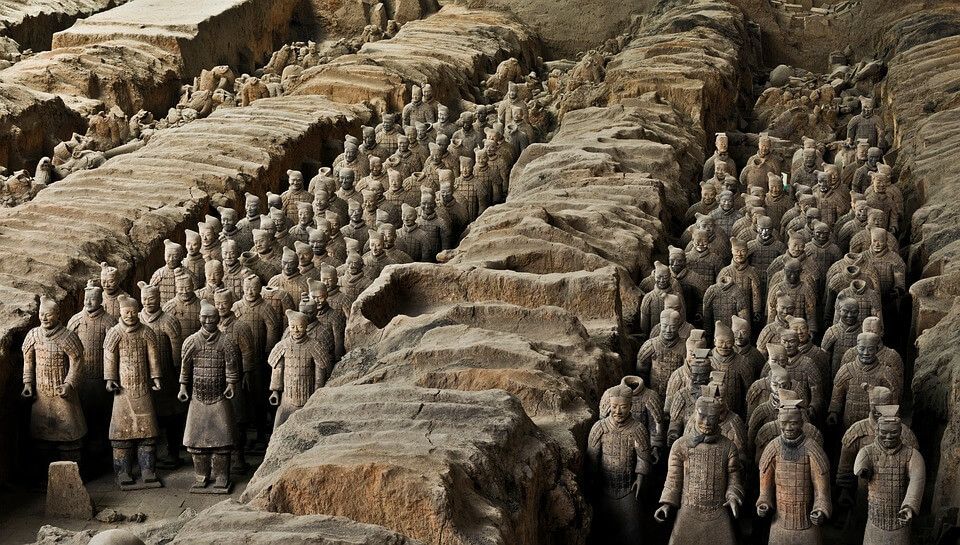
Terracotta Army in Excavation Pit – Rows of Eternal Guardians This image captures a breathtaking view inside one of the excavation pits at the Terracotta Army archaeological site near Xi’an, China. Stretching back into the shadows, rank upon rank of life-sized clay soldiers stand in precise formation, flanked by earthen walls that once concealed them for over 2,000 years. The figures—each uniquely crafted with distinct hairstyles, facial expressions, armor, and posture—represent a fully mobilized imperial force frozen in time, guarding the tomb of Qin Shi Huang, the first emperor of unified China. The orderly lines reflect both the military discipline of the Qin dynasty and the logistical mastery required to construct such a vast funerary complex. Buried in 210 BCE, these warriors were meant to serve the emperor in the afterlife, a testament to his ambition and belief in eternal rule. The image highlights not just the artistry of the ancient craftsmen—who molded and painted each figure by hand—but also the architectural complexity of the site, which includes underground stables, command posts, and chariot divisions. Though faded with time, the figures’ silent expressions echo a powerful cultural truth: Qin Shi Huang intended to carry the full weight of his empire beyond death. When local farmers accidentally unearthed fragments in 1974, they opened a window into a world of ritual, hierarchy, and obsessive control. This moment transformed our understanding of early Chinese statecraft, illuminating a period where power, myth, and mortality converged underground. As excavations continue, many mysteries remain—how many figures are still buried, what secrets lie in the unopened central tomb, and how the army’s original colors might have once dazzled viewers. This photo is not just a document of clay statues—it is a moment suspended between past and present, where ancient China speaks in the language of stone.

Restoring the Past – Archaeologist Reconstructs a Terracotta Warrior This image captures an archaeologist in the midst of restoring one of the famed Terracotta Warriors, deep within the excavation site near Xi’an, China. With gloved hands and careful precision, he reattaches the fragmented head of a life-sized clay soldier, surrounded by the reddish-brown earth of the burial chamber. The dim lighting, focused on the warrior’s torso and shattered pieces, evokes a solemn atmosphere—one of reverence, concentration, and meticulous care. The figure being restored is clad in detailed armor, each ridge and stud shaped by ancient artisans more than 2,000 years ago. This hands-on restoration process embodies the extraordinary challenge of preserving a vast and fragile archaeological treasure trove: more than 8,000 figures, many broken, buried, and weathered by centuries underground. Discovered in 1974 by farmers digging a well, the Terracotta Army was part of Emperor Qin Shi Huang’s colossal mausoleum complex, meant to secure his rule in the afterlife. Each soldier was crafted with individual features—no two are identical—representing a full military hierarchy including archers, infantry, cavalry, and charioteers. But the discovery wasn’t just about quantity—it was about unprecedented craftsmanship and cultural symbolism. The restoration process seen here is an act of historical resurrection, allowing us to glimpse ancient China’s imperial ambition, spiritual beliefs, and technological innovation. The archaeologist’s role is part detective, part artist—piecing together history from scattered remnants. And with every warrior restored, the narrative of the Qin dynasty is rebuilt, offering new insights into the origins of one of the world’s oldest civilizations. This image doesn’t just document a moment of repair—it symbolizes humanity’s enduring drive to reclaim, protect, and understand its past, one fragment at a time.
On March 29, 1974, farmers in Xi’an, China, unearthed the Terracotta Army—thousands of life-sized clay soldiers buried to guard Emperor Qin Shi Huang. A dig for water became one of history’s greatest discoveries.
#StayCurious #Skystorians #DiveIntoDiscovery
Does anyone have access to the Chinese University of Hong Kong's Cultural Revolution Database? Pretty pleaaaaseeeee...
Reminder to show you guys this past weekend's outing of 2 major Daoist temples in Xi'an for my upcoming paper on Daoism's origins in Shaanxi Province.... Beautiful stuff, really!
This place is like a tumbleweed rodeo but I find the discourse easier to avoid
Solidarity with the masses in the streets in Turkey! Chairman Mao teaches us IT'S RIGHT TO REBEL!!!

August 1977, Beijing. #china #socialism
You forgot to add the "BASED AND TRAD"
Upgraded my laptop to the Honor MagicBook 14 Pro, my first Chinese computer (I've been a Huawei phone fan since I first got here) ever. It's very smooth and light!


Having a Friday night outing at Qiulin food court to enjoy some Shaanxi and Beijing cuisine!
Happy Friday everyone! Tonight I'm gonna go get Beijing roast duck with the missus and our two best friends... but first... I'm gonna record a podcast episode!
Have a great one guys!
It was a large Soviet militaria, history, roleplaying, and communism message board that was around from 1999 to about 2010. It was a very strange place with a lot of kids who played way too much Red Alert. I was one of the few on there who was active offline
They killed Rosa Luxembourg you know
Hey fellow GSU Tree alumnus, what institution are you affiliated with these days? Hope things are well, I know they are here at Northwest University! -Drew
What are some good Chinese culture accounts to follow on here? One of the few things I'll miss about Twitter is the amount of interesting Chinese hanfu, calligraphy, cuisine, etc. accounts.
I was a mod on Soviet-Empire in the mid-2000's. I was one of the primordial Russaboos before you can even begin to comprehend it. I remember when the CPUSA official website took 5 minutes to load and was hosted on hartford-hwp.com
Just clocked a 10.5 hour day. Paperwork, research, back to back faculty meetings, meeting with my Party secretary about the next phase of my mass work...
....I'M SO TIRED.

To quote Chuck Tingle: "We all know this classic Way"
