Pour chaque vie, la science agit. Le Pasteurdon, c’est maintenant ! Soutenez la recherche et celles et ceux qui la font avancer. Faites un don sur pasteurdon.fr
Pour chaque vie, la science agit.
Le Pasteurdon, c’est maintenant !
Soutenez la recherche et celles et ceux qui la font avancer ↘️ pasteurdon.fr
#Pasteurdon
08.10.2025 08:55
👍 21
🔁 22
💬 0
📌 3
💊 🧬 Insightful dive into in-host bacterial evolution under antimicrobial pressure, a work from @csavin.bsky.social and @pierrelebury.bsky.social in our lab at @pasteur.fr
23.09.2025 06:22
👍 6
🔁 3
💬 0
📌 0
Great collaboration with @csavin.bsky.social at @yersiniaunit.bsky.social in @pasteur.fr, as well as @julmini.bsky.social @chrudetours.bsky.social @univparissaclay.bsky.social @cea.fr @ap-hp.bsky.social
📖 Out in @natcomms.nature.com @natureportfolio.nature.com 👇
www.nature.com/articles/s41...
23.09.2025 06:30
👍 12
🔁 4
💬 0
📌 0
8/8 🙏 Many thanks to all the contributors of this study !
@csavin.bsky.social @julmini.bsky.social
@yersiniaunit.bsky.social @pasteur.fr @chrudetours.bsky.social @univparissaclay.bsky.social @cea.fr @ap-hp.bsky.social @natureportfolio.nature.com @natcomms.nature.com
01.07.2025 18:04
👍 0
🔁 0
💬 0
📌 0
7/8 - Conclusion
💊 A fascinating case of in-host bacterial evolution — and a warning about long-term antibiotic exposure.
01.07.2025 18:04
👍 0
🔁 0
💬 1
📌 0

6/8 - Selection
🚫 We also identified positive selection signals:
- a truncation in the phosphate transporter PitA which probably impairs its activity
- an amino acid substitution interfering with the active site and diminishing the catalytic activity of the acyl-CoA thioesterase II TesB
01.07.2025 18:04
👍 0
🔁 0
💬 1
📌 0

5/8 - Metabolic adaptation
🍔 Omics analysis also unraveled:
- a progressive genome reduction
- metabolic changes in amino acid and carbon utilization
- a disturbed stringent response
which could contribute to the observed slower growth and antibiotic tolerance preceding resistance.
01.07.2025 18:04
👍 0
🔁 0
💬 1
📌 0
4/8 - Antibiotics resistance mechanisms
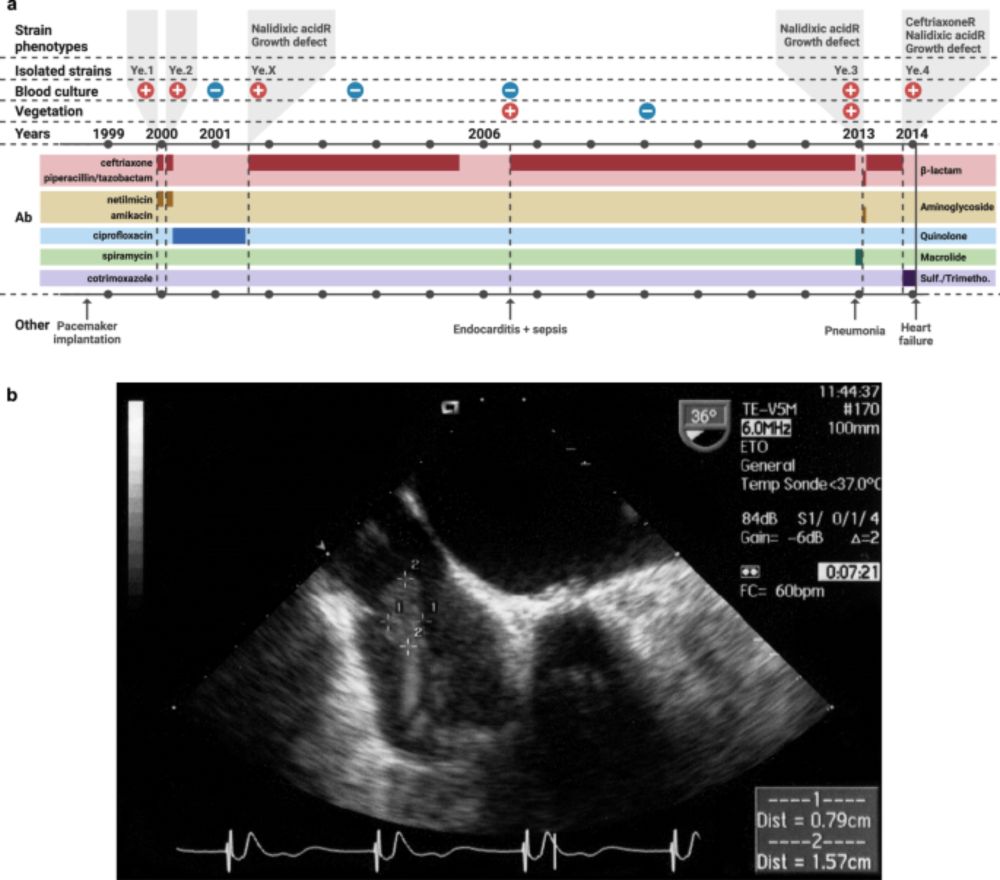
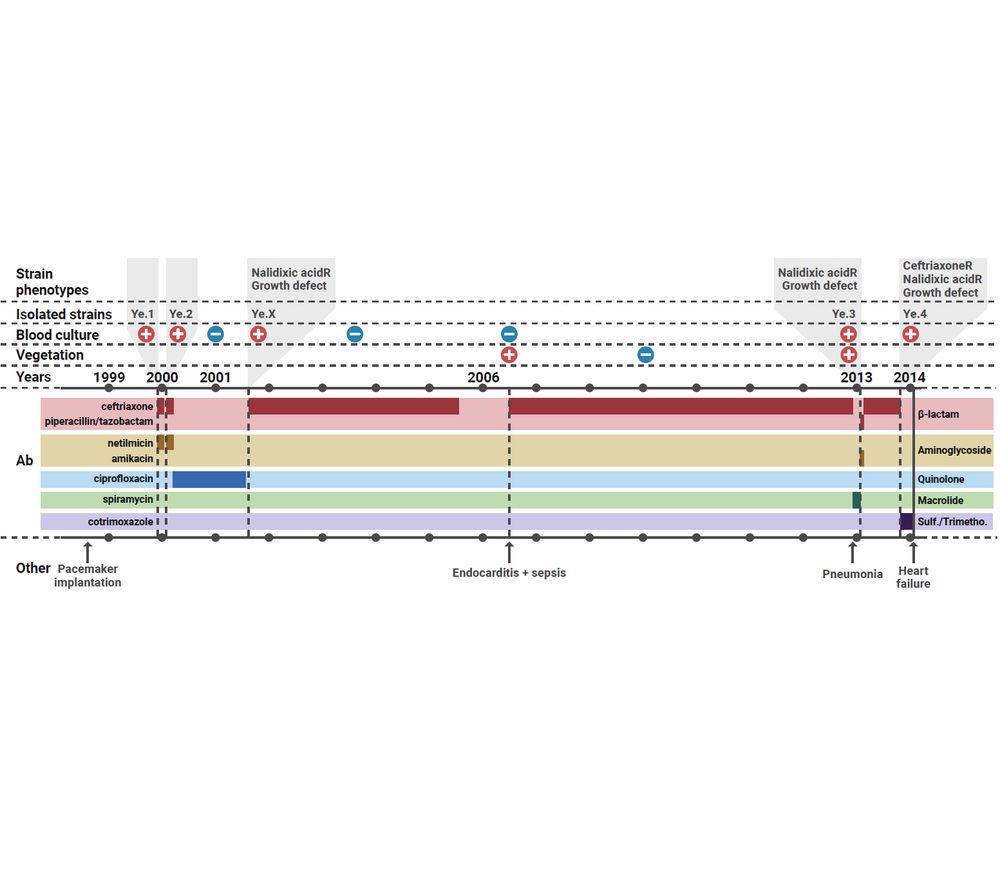
🧪 By analysing Ye.1 to Ye.4 genomes and proteomes, we could identify:
- a novel gyrA mutation leading to quinolone resistance
- ceftriaxone resistance via OmpF loss and β-lactamase activity
01.07.2025 18:04
👍 1
🔁 0
💬 1
📌 0

3/8 - Phylogenetic reconstruction
🧫 Ye.1 to Ye.4 belong to the Ye genotype 4 (bioserotype 4/O:3) and a form a unique clade separated from other Ye strains, strongly suggesting that the patient suffered from a chronic infection due to a unique evolving Ye 4/O:3 strain.
01.07.2025 18:04
👍 3
🔁 0
💬 1
📌 0
2/8 - Clinical case
🏥 Thanks to the National Reference Center for Plague and other Yersiniosis in @pasteur.fr, we collected 4 clinical isolates — Ye.1 to Ye.4, which evolved antibiotics tolerance and resistance — from a rare chronic infection in an elderly patient from @chrudetours.bsky.social.
01.07.2025 18:04
👍 1
🔁 0
💬 1
📌 0
Very clear explanation by @alicelebreton.bsky.social of our article about plague virulence reduction, in Le Monde (in French)!
18.06.2025 16:43
👍 1
🔁 0
💬 0
📌 0
Additional disclaimer: we did not SOLVE a mystery, it is just another small brick added on the top of all the knowledge accumulated since then...
31.05.2025 09:20
👍 2
🔁 0
💬 0
📌 0
Picking up our publication on Black Death and plague pandemics: here are interesting historical thoughs about the well known but deceptive (not so) medieval plague doctor costume
31.05.2025 08:38
👍 3
🔁 1
💬 1
📌 0
IIDR researchers have discovered that a single gene in Yersinia pestis — the bacteria that causes bubonic #plague — was responsible for keeping pandemics like the Black Death burning for hundreds of years. Learn more about this evolutionary phenomenon in our all-new explainer video. #IDSky
29.05.2025 18:05
👍 4
🔁 1
💬 0
📌 0
Two great papers in @science.org this month on the #evolution of #vector-borne #pathogens
1 #Yersinia pestis attenuates virulence over 3 pandemics
2 Ancient #Borrelia genomes trace the rise of louse-borne relapsing fever
Fascinating reads (links below)
30.05.2025 11:58
👍 11
🔁 4
💬 1
📌 0
Evolution of the Black Death (and its genes)
YouTube video by Popular Science Podcasts
A short animation to better understand our paper:
www.youtube.com/watch?v=o8nf...
30.05.2025 08:47
👍 0
🔁 0
💬 0
📌 0

New in 𝘚𝘊𝘐𝘌𝘕𝘊𝘌:
Plague Plays the Long Game
As plague pandemics decimated rodent populations, 𝘠𝘦𝘳𝘴𝘪𝘯𝘪𝘢 𝘱𝘦𝘴𝘵𝘪𝘴 adapted
Virulence gene 𝘱𝘭𝘢 lost late in outbreaks ➡️ strains with reduced lethality ➡️ pathogen can persist, spread across highly fragmented host networks
www.science.org/doi/10.1126/...
29.05.2025 21:51
👍 9
🔁 3
💬 2
📌 0
More details here 👇https://bsky.app/profile/pierrelebury.bsky.social/post/3lqdcuo5gwk2v
30.05.2025 08:26
👍 0
🔁 0
💬 0
📌 0
12/12 🙏 Many thanks to the contributors of this study!
@ravneetksidhu.bsky.social @gmasfiol.bsky.social @bbolker.bsky.social @yersiniaunit.bsky.social
#ScienceResearch
29.05.2025 18:10
👍 0
🔁 0
💬 1
📌 0
11/12 - Impact
Our study highlights the importance of reservoir dynamics and structures to better understand virulence evolution of a zoonotic pathogen.
29.05.2025 18:10
👍 1
🔁 0
💬 1
📌 0

10/12 - Conclusion
Pla depletion may reflect adaptive evolution during declining host populations throughout a pandemic, while full virulence remains crucial for long-term survival in sylvatic reservoirs between pandemics.
29.05.2025 18:10
👍 0
🔁 0
💬 1
📌 0
9/12 - Our hypothesis
💡 Y. pestis is typically transmitted during late-stage, fatal bacteremia: a lower mortality should reduce transmission. However, in structured rodent populations, delayed host death may help spread Y. pestis across dispersed groups, enabling longer epidemic persistence.
29.05.2025 18:10
👍 0
🔁 0
💬 1
📌 0

8/12 - Wet lab findings
🧪 Pla enzyme activity scales with pla gene dosage. pla-depleted strains remain virulent but cause slightly lower mortality and delayed death in bubonic plague.
29.05.2025 18:10
👍 0
🔁 0
💬 1
📌 0

7/12 - Genomic findings
🧬 pla depletion is mediated by integration of the high-copy-number pPCP1 plasmid into low-copy replicons. This is combined with pla excision from the high-copy-number pPCP1 possibly via Xer recombination sites.
29.05.2025 18:10
👍 0
🔁 0
💬 1
📌 0

6/12 - Phylogenomic findings
🌍 pla copy number reduction occured during the 1st, the 2nd but also during the 3rd pandemic.
29.05.2025 18:10
👍 0
🔁 0
💬 1
📌 0