Assuming known environments or costs is reasonable in engineered systems, but maybe less so for intelligent agents in complex worlds.
A year later, I see this as clarifying how unobserved objectives and dynamics interact to produce a continuum of explanations, and which perturbations are needed.
18.12.2025 17:54
👍 5
🔁 0
💬 0
📌 0

One of my favorite equations, after assumptions, details how the system dynamics (A) and control cost (Q) interact with the closed-loop dynamics (F).
This reveals a continuum of environment-objective pairs consistent with behavior. Inverse RL / IOC typically lies at one end of this continuum.
18.12.2025 17:54
👍 4
🔁 0
💬 1
📌 0
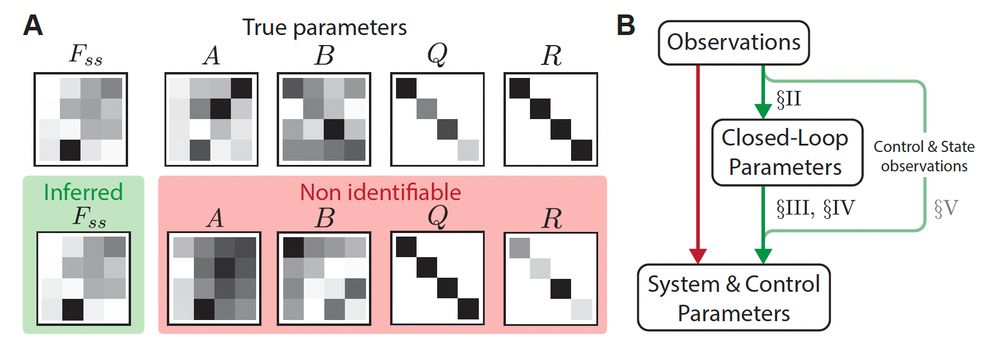
(A) Recovery from observations of the system {A,B} and cost
function {Q,R} parameters in the infinite horizon setting is limited to
identification of the closed-loop dynamics Fss. We plot the inferred Fss
using EM, as well as a combination {A,B,Q,R} that yields this same
Fss. (B) Parameter inference can be reduced to closed-loop identification
with probabilistic methods, followed by an investigation of the interaction
between the different parameters in setting the closed-loop dynamics.
We show that the joint problem boils down to two steps:
1. Infer closed-loop parameters (which can be done efficiently with SSM methods ✅)
2. Derive equations relating the parameters of interest in setting the closed-loop dynamics.
See our paper (also on arXiv, link above) for details!
18.12.2025 17:54
👍 1
🔁 0
💬 1
📌 0
Inferring both the system dynamics *and* the control objective from partial observations is inherently ill-posed. Characterizing the exact (non-)identifiability and identifying how to perform inference was the challenge!
18.12.2025 17:54
👍 2
🔁 0
💬 1
📌 0
This was a theory project spearheading a longer program on neural substrates of cognitive control, with the amazing Juncal Arbelaiz and Harrison Ritz (@hritz.bsky.social), and with great guidance from Nathaniel Daw (@nathanieldaw.bsky.social), Jon Cohen and Jonathan Pillow (@jpillowtime.bsky.social)
18.12.2025 17:54
👍 5
🔁 0
💬 1
📌 0

A neural population of dynamics x_t, the "system", is subject to control via inputs u_t. These inputs may come from the population itself or some other unobserved system. We only get partial observations y_t of the system in x_t, in the form of neural recordings.
In a system subject to unobserved control, can you infer both the underlying dynamics and the control objective? 🤔
A year ago, I was presenting our work at IEEE CDC on solving this problem for stochastic LQR.
arxiv.org/abs/2502.15014
Short 🧵 on the results, and how I think about them a year later.
18.12.2025 17:54
👍 20
🔁 6
💬 1
📌 1
In all, CLDS bridges classic LDS and modern nonlinear models:
- Interpretable: linear dynamics conditioned on task variables
- Expressive: parameters vary nonlinearly over conditions
- Efficient: closed-form and fast inference, and shares statistical power across conditions. [6/6]
03.12.2025 17:44
👍 1
🔁 0
💬 0
📌 0

We demonstrated CLDS on a range of synthetic tasks and datasets, showing how to link dynamical structure to behaviorally relevant variables in a transparent way. [5/6]
03.12.2025 17:44
👍 1
🔁 0
💬 1
📌 0
Because CLDS is linear in x given u and uses GP priors over u, we have:
✅ Exact latent state inference with Kalman filtering/smoothing;
✅ Tractable Bayesian learning via closed-form EM updates using “conditionally linear regression”, a trick in a basis-function space. [4/5]
03.12.2025 17:44
👍 0
🔁 0
💬 1
📌 0

CLDS = linear dynamical system in latent state (x), whose coefficients depend nonlinearly on task conditions (u) through Gaussian processes (GP)
CLDS leverages conditions to approximate the full nonlinear dynamics with locally linear LDSs, bridging the benefits of linear and nonlinear models. [3/5]
03.12.2025 17:44
👍 1
🔁 0
💬 1
📌 0
Modeling Neural Activity with Conditionally Linear Dynamical Systems
Neural population activity exhibits complex, nonlinear dynamics, varying in time, over trials, and across experimental conditions. Here, we develop *Conditionally Linear Dynamical System* (CLDS)...
This is joint work with amazing collaborators: Amin Nejatbakhsh (@aminejat.bsky.social), David Lipshutz (
@lipshutz.bsky.social), Jonathan Pillow (@jpillowtime.bsky.social), and Alex Williams (@itsneuronal.bsky.social).
🔗 OpenReview: openreview.net/forum?id=xgm...
🖥️ Code: github.com/neurostatsla...
03.12.2025 17:44
👍 9
🔁 2
💬 1
📌 0
At #NeurIPS2025!
🎉 Excited to present Conditionally Linear Dynamical Systems (CLDS). We leverage the dependence of neural dynamics on task covariates to yield an interpretable, flexible model of dynamics.
Come meet and check it out!
📍: Poster #2209, Hall C,D,E on Thu Dec 4, 11 am–2 pm, PST.
🧵/6
03.12.2025 17:44
👍 19
🔁 5
💬 1
📌 1
Thanks @hritz.bsky.social ! We published this work at NeurIPS, currently there to present it.
🔗: openreview.net/forum?id=xgm...
03.12.2025 17:26
👍 6
🔁 1
💬 0
📌 0

