

Corona Discharges Glow on Trees Under Thunderstorms
agupubs.onlinelibrary.wiley.com/doi/10.1029/...
27.02.2026 00:12
👍 0
🔁 0
💬 0
📌 0
Corona Discharges Glow on Trees Under Thunderstorms
agupubs.onlinelibrary.wiley.com/doi/10.1029/...
this is amazing measurement. So cool.

For half a century, researchers suspected treetops on Earth might glow because of thunderstorms. But the phenomenon, an electric outburst called a corona, has only ever been spotted in the lab--until now. Cool story from @hannah-richter.bsky.social for @science.org
thanks!
Our former postdoc, Taka's nice work appeared in bioRxiv. We propose that a "dynamic response trait," calculated based on time series, better predicts fish species range shift:
www.biorxiv.org/content/10.6...

Urbanization and Spatial Aggregation Impair Multifunctionality in Urban Vacant Lots
onlinelibrary.wiley.com/doi/full/10....

Exploring causal factors of coastal chlorophyll-a dynamics and their potential contributions to near future forecasting
www.biorxiv.org/content/10.6...
Our new preprint! We used qPCR and µCeta eDNA metabarcoding for detecting the finless porpoises in Hong Kong.
"Detecting the Indo-Pacific finless porpoises (Neophocaena phocaenoides) in Hong Kong waters using environmental DNA"
www.biorxiv.org/content/10.6...

ASICS Hong Kong Half-Marathon
Finished in 1:49!
Another video. There were at least 5-6 individuals.
Went to a field survey and sighted several Chinese white dolphins again! They must have released lots of eDNA into the seawater.
慣行農法と無施肥無農薬の圃場では、生物群集(周辺雑草や微生物)にはっきりした違いが見られて、それらがイネの生育にいくらか寄与してそう、ということを野外モニタリング(生物採集・観察・環境DNA)と時系列解析で明らかにしました
さきがけ時代にやっていた京都のリアル田んぼでのモニタリング研究の論文が Agriculture, Ecosystems & Environment 誌から発表されました。
doi.org/10.1016/j.ag...
We have posted our second Hong Kong paper on bioRxiv! We developed species-specific qPCR primers and a TaqMan probe for detecting Chinese white dolphins. The specificity and sensitivity were meticulously tested.

Our first Hong Kong paper was published in Environmental DNA! onlinelibrary.wiley.com/doi/10.1002/...
We developed cetacean-specific eDNA primers, named µCeta. Please try it if you are interested in cetacean eDNA metabarcoding!
Contrasting ecological communities in rice paddy fields under conventional and no-fertilizer farming practices https://www.biorxiv.org/content/10.1101/2025.08.12.669982v1

Ecosystem-based reservoir computing. Hypothesis paper
sciencedirect.com/science/arti...
🙏 And just as an addition: don‘t use these primers for bulk sample metabarcoding. There others are ways better (we recommend fwhF2/fwhR2n as a good solution; further solutions like BF2/BR3 or mlCOI with dgHCO exist)

Plastic bag bans and fees reduce harmful bag litter on shorelines. www.science.org/doi/10.1126/...

先週、日本にいましたが、ついに「研究のために潜る」を達成しました。海綿探してます
Recovering historical fish eDNA from museum-preserved Antarctic filter feeders via non-destructive metabarcoding. https://www.biorxiv.org/content/10.1101/2025.06.07.656140v1
Contrasted effects of human pressure on biodiversity in the UK: a multi-taxonomic assessment using airborne environmental DNA https://www.biorxiv.org/content/10.1101/2025.05.01.651649v1
随分前に受理されていたリザバー計算の和文総説(+生態リザバーの紹介)、ようやく公開されました!
jstage.jst.go.jp/article/seit...
Flexible Methods for Species Distribution Modeling with Small Samples https://www.biorxiv.org/content/10.1101/2025.04.03.647025v1
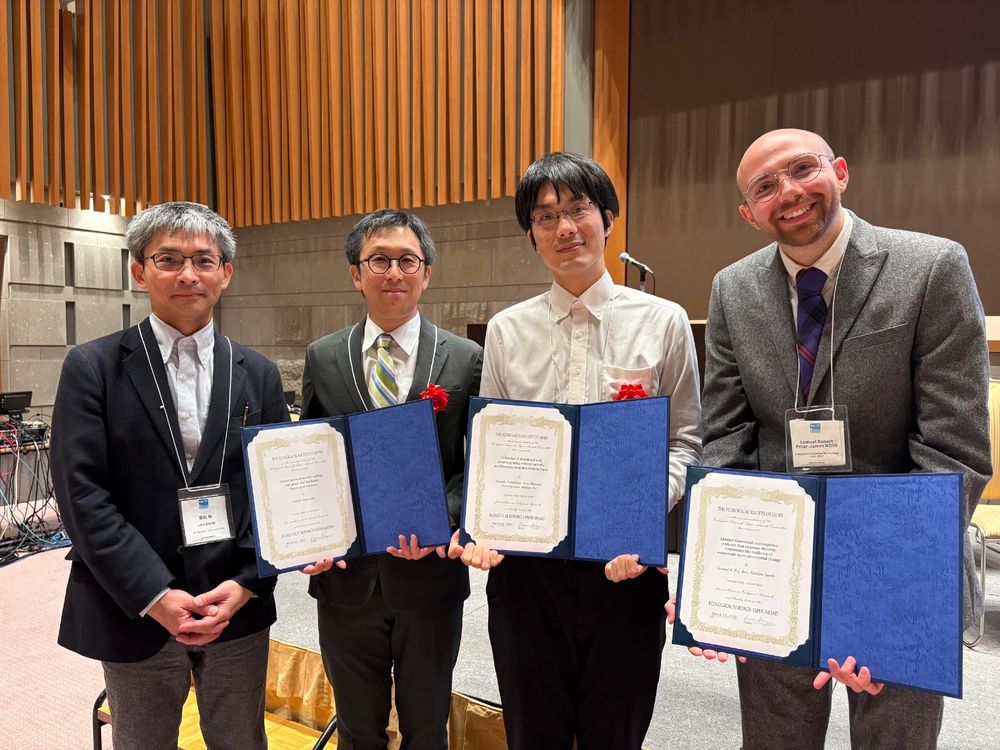
We were honored to celebrate with our Awardees at the ceremony. Congratulations to all!👏
From left to right: Hiroshi Tomimatsu (EiC of Ecological Research @hrstm.bsky.social ), Kohmei Kadowaki, Naoyuki Nakahama @naoyukinkhm.bsky.social, Samuel R. P.-J. Ross
#ESJ72 #ERPaperAward
μCeta: a set of cetacean-specific primers for environmental DNA metabarcoding with minimal amplification of non-target vertebrates https://www.biorxiv.org/content/10.1101/2025.03.19.644246v1

Our new preprint published! (My first Hong Kong paper!)
We developed a new eDNA primer set, named µCeta, to detect cetaceans. It can avoid amplification of non-target eDNA such as human and fishes, enabling more sensitive and efficient detection of cetacean eDNA. www.biorxiv.org/content/10.1...
The information of our symposium at The 11th EAFES (July 2025 in Tokyo) is now open: eafes2025.com/symposia.htm...
There are four available oral presentation slots in our symposium. Please submit your eDNA talk to our symposium!
This is a ‘lickometer’.
Researchers have used it to understand how the rodent brain might be coding kinematic, reward, and difficulty parameters, particularly while moving around.
buff.ly/jDxn0DX


