
New ExoMol database:
exomol.com/exoatom/
@exomol.bsky.social
09.02.2026 10:46
👍 2
🔁 1
💬 0
📌 0

We are lucky to host Professor Suzanne Aigrain at UCL with an Astro group seminar “Finding and characterising nearby Earth analogues with PLATO and the Terra Hunting Experiment”.

Zuckerman: mysteries of WD to be understood , Ben wants the audience to read

Zuckerman: here is a mistery of Be in WD. I'm order to have such spectrum the abundance of Be must be 100000s times larger than in any astronomical objects

Zuckerman: periodic table of elements discovery around WD , i.e. from accredited material

Zuckerman: history of elements discovery from accredited material with Li and Be the most recent

Zuckerman: Fe line in two cases that.ust have elongated gas discs to have such broadening .

Zuckerman: something like that happened ? 😲


The most abundant elements on Earth are O, Si, Al. Here is a WD spectrum. This is unusual containing Al.
Best agreement is with Earth like mixture of 30 % crust and 70% mantle

Zuckerman: rocky composition, Oxides . As we speak the WD community debates if asteroids around WD are wet or dry. Ben is not involved in these debates.

Zuckerman: the composition of rocky planets orbiting WDs is amazingly similar to the Earth


Zuckerman: WD spectroscopy enables measurement of the bulk composition of accreted objects.
Important is that we learned the composition is very similar to Earth . Can we now answer Q if Earth is normal.

Zuckerman: typical spectra of WD


Zuckerman: typical WD system

Zuckerman: a nickel history of pollution of dwarfs by accretion from surroundings

Zuckerman: here is another recent evidence

Zuckerman: two absorption lines are the first observation evidence of planet around a WD from 1917

Zuckerman: the only reasonable application is comets

Zuckerman: WD heavy elements should be cleansed but they show up anyway, they must be coming from a different source

Ben Zuckerman (UCLA), who will be passing through London is giving a seminar at UCL on “The nature of rocky exoplanets via study of white dwarf stars”
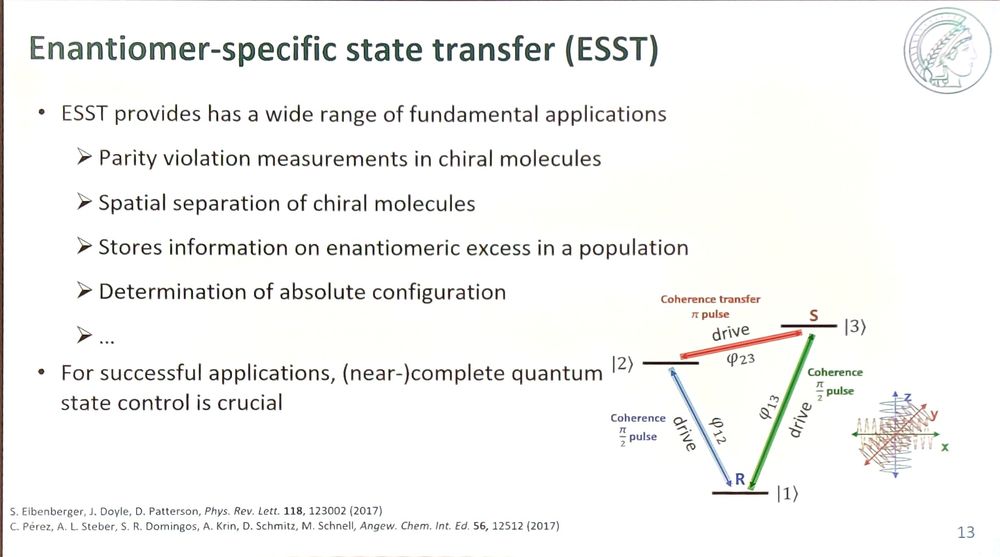
Eibeberger-Arias: The method goes amazing advantages but difficult because it requires accurate control of the system .
#HRMS2025

Eibeberger-Arias: This change of direction can be accessed via the triple product of 3 dipole components (AxB)xC
#HRMS2025
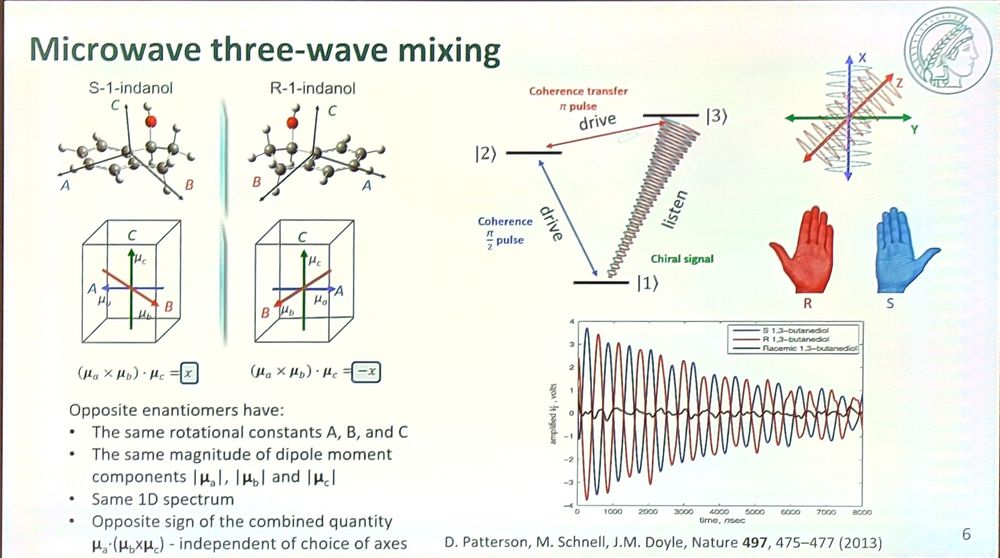
Eibeberger-Arias: This slide shows how the very cool experiment of 3-wave mixing works. It can sample relative orientation of the molecular dipole components, which are different for two enantiomers , or two mirror images of the molecule
#HRMS2025

Sandra Eibeberger-Arias: Coherent control of chaliral molecules.
In this talk using the 3-wave mixingethod
#HRMS2025

Can you find RyBr in this photo? 😉
#HRMS2025

Brady: result is that for high temperatures the photodissociation rates do depend on temperature
#HRMS2025


Brady: we use the dissociation efficiency defined as ratio of lifetimes to obtain the photodissociation part of the cross sections
#HRMSs2025
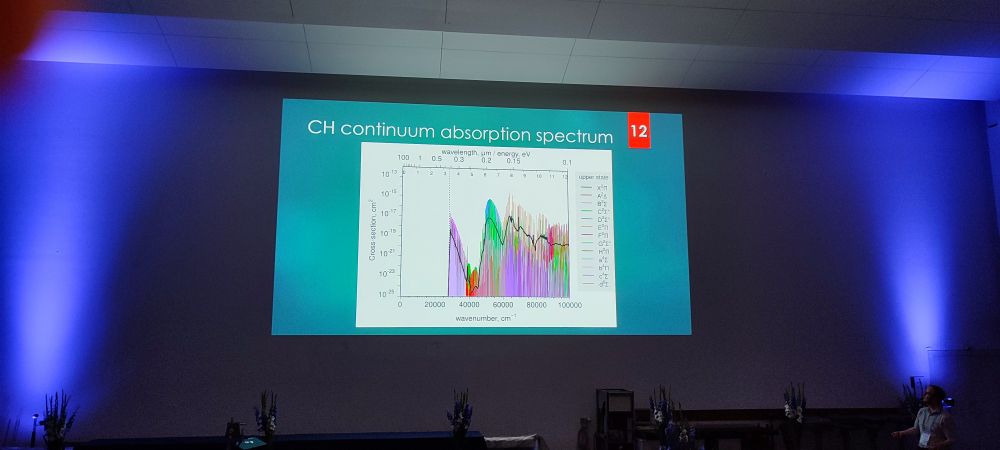
Brady: here is the result as a mixture of continuum and quasi bound
#HRMSs2025
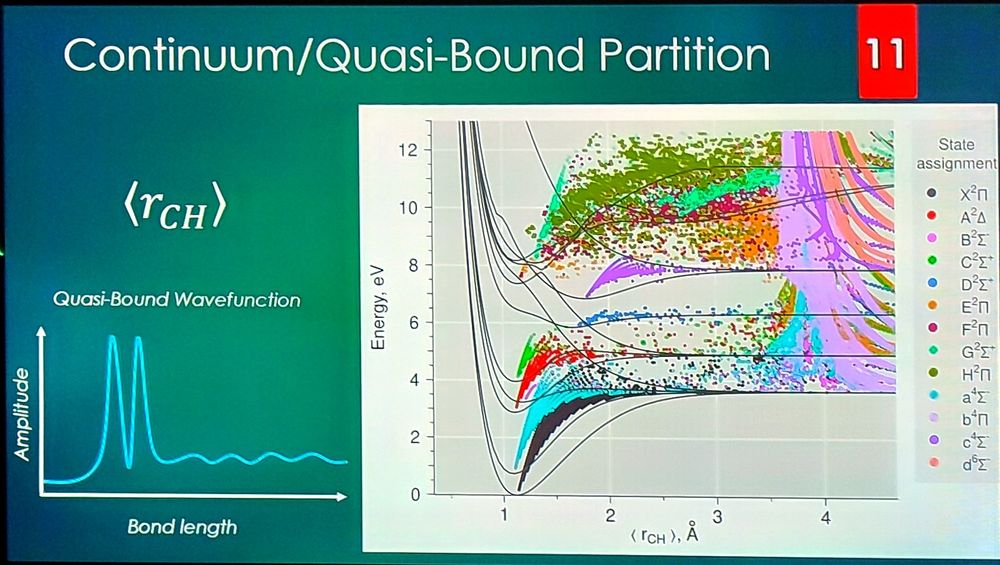
Brady: we study CH, taking the curves form a recent publication and use the Duo feature of expectation value of a bond length to separate continuum from bound states
#HRMSs2025

Brady: here is a mir interesting dissociation to a quasibound state
#HRMSs2025