Whenever you have it ready, we’re ready to go with it.
31.01.2026 11:11
👍 2
🔁 0
💬 0
📌 0
@studiesirishreview
Studies is a cultural journal of the Irish Jesuit province, founded and in continuous publication since 1912. It examines Irish social, political, cultural and economic affairs. www.studiesirishreview.ie Instagram: @studiesirishreview
Whenever you have it ready, we’re ready to go with it.
Nothing On Earth by Conor O'Callaghan - a ghost story in a ghost estate!
Literature advice, please!
I have Nesting by Róisín O'Donnell and I Want to Go Home by Róisín Lanigan - two Irish novels about the housing crisis. Is there a third option? If I can get a trifecta, then I could convince @studiesirishreview.bsky.social to take a triple review

Quotation from "Literature as Theology: A French Paradox" by Kevin Williams “Since 1882, religion has been excluded from the curriculum in French schools on the basis of France’s policy of laïcité: non-confessionalism or civic neutrality. The impulse behind the republican ideal of laïcité is to prevent the abuse of power. With civic neutrality, no established interest can curtail people’s choice of worldview and way of life. One reason for the extreme sensitivity in France to the potential of religion to be divisive is because religious beliefs are not universally shared in society, and therefore any civic affirmation of religion is incompatible with a polity that is conceived as indivisible and unitary. ..Somewhat ironically, and an indication of the pervasiveness of religion in the country, in France religion finds a high profile within the civic space...The art galleries of France reflect enormous religious influence. The musical repertoire of the country, from medieval times to the compositions of Olivier Messiaen, is imbued with Christian themes. The landscape of the country reflects this influence through its proliferation of church spires. The great cathedrals of France give dramatic expression of Christian faith. Indeed, the destruction by fire of Notre Dame in Paris was perceived as a national tragedy and its restoration a national triumph. ...Yet, despite this...the tradition of excluding religion from schools runs very deep in France. This means that it continues to be difficult for the religious themes that are part of common culture to gain purchase in the curriculum...Nonetheless, the French exclusion of religion as a subject from schools enables the indirect promotion of religious understanding. Teachers are required to explain religious references where they arise in teaching literature and other subjects such as history and philosophy. This gives rise to the unintended paradox of making possible serious encounters with religious belief.”

Quotation from Kevin Williams' article "Literature as Theology: A French Paradox" “Religious themes abound in many French literary works. This obviously applies to those who write from a committed Catholic perspective (Claudel, Mauriac, Bernanos, and Julian Green), but it also applies to the work of such authors as Balzac, Stendhal, Hugo, Maupassant, Flaubert, and Gide. Songs about the clergy and about God feature frequently in the oeuvre of the twentieth-century chansonnier/balladeer George Brassens, whose work is studied in schools. A recent special issue of the literary magazine Lire devotes almost a hundred pages to the theme ‘Jesus and Literature’. ...Literature has a special resonance in understanding religion because it shows how issues of faith gain purchase in people’s lives. Texts can show how religious beliefs are mixed into the molten material of how people experience life through thoughts, feelings, words, and actions. Rooted in imagined and real world experience, narrative allows us to enter very directly into the Lebenswelt of other people. The images generated by narratives can serve as a rich conduit of understanding of human practices, possibly more capable of reaching a wider audience than conventional theological discourse. This should come as no surprise, because many people connect more readily with stories than with theories. The images embedded in stories can exercise a powerful influence on our minds, and when most of what we have learned has dropped into the deep well of human forgetfulness, some images often endure in our consciousness. ...Of necessity there is a greyness in much theological work, but narrative does offer something of the ‘green’ of life’s ‘golden tree’. Literature communicates some of the pulse of human lives, and, despite the limitations imposed by laïcité, arguably permits a thicker encounter with religious belief than traditional instruction in religion.”
In his Winter 2025-2026 article, Dr Kevin Williams (@dcuioe.bsky.social) explores the contradiction between France's official policy of laïcité vs the prominence of religion in its public culture, assessing literature's role in the transmission of religious concepts as a live cultural resource:

This image contains a quote from Nuala King's article "Holding the World Together: Myth, Language, and the Reawakening of Kanyini in the Irish Imagination" from the Winter 2025-2026 issue of Studies: An Irish Quarterly Review.

This image contains a quote from Nuala King's article "Holding the World Together: Myth, Language, and the Reawakening of Kanyini in the Irish Imagination" from the Winter 2025-2026 issue of Studies: An Irish Quarterly Review.
In our current issue Nuala King recalls the Aboriginal Australian concept of Kanyini - a sacred principle of practicing responsibility for the land and all beings - and explores resonances with 'the deep ecological consciousness embedded in Irish myth and language’.
Read now at the link in bio ⬆️

This picture contains an extract from Liam Mac Amhlaigh's article "Influence in Transmission: Scéal an Deisceabail Tenga" from the current Winter 2025 - 2026 edition of Studies: An Irish Quarterly Review. The text in the image is as follows: "In the changing landscape of twenty-first century Ireland, where English continues to dominate public life, it takes a certain kind of person to live a life as if the Irish language were not just a heritage language but a daily, spiritual, intellectual, cultural force. Manchán Magan was such a person. Now lost to us too young, the Irish-language community has lost one of its most visible, creative, and committed practitioners, and, exceptionally, one whose visibility in the English-language community was also noteworthy. He was not only a broadcaster, a travel writer, and a documentary maker; perhaps above all, he was a ‘disciple’ of the Irish language in the wider world. In the broadest sense, he was a prophet of men shaping what loyalty to a minority language looks like in a world where such loyalty is constantly under pressure...I only encountered Manchán on a few occasions, but I always felt I was having a conversation with someone who was half with me and half in another world, a world that existed around us both but which he understood differently. He had reached a further threshold of understanding. ...One of his most significant projects to leave its mark on English-language media was No Béarla, the television series in which he travelled around Ireland trying to use only Irish – refusing to speak English in many settings that accept it as normal, even mandatory...It forced viewers to ask: How deeply has Irish receded from everyday life? And what would it take to live with it more fully?”
In his Winter 2025-2026 article, @liammacamhlaigh.bsky.social
describes the late Manchán Magan as a disciple of Irish - not only challenging the Irish people to reflect on their valuing of the language, but bringing it into conversation with other minority/indigenous cultures throughout the world:

We are back from our (longer than normal) holiday break with a blog from the archives, for a cold but sunny Saturday read: From 2014, Dr. Hana F. Khasawneh on the Irish oral tradition ⬇️
www.studiesirishreview.ie/2026/01/10/i...
Wishing all our readers and contributors a very Merry Christmas, and an early Happy New Year 🎄🌟⛄

The image contains an extract from Tom Casey SJ's article "The Fifth Province: A Tribute to Manchán Magan" included in the Winter 2025-2026 edition of Studies: An Irish Quarterly Review. Image text below: “There is, they say, a fifth province in Ireland: an Cúigiú Cúige. Although it is not found on any map, it is alive in the spirit of those who awaken to wonder. It is the province of soul, of silence, and of story. It is the realm that lies between the seen and the unseen, between the old language and the new world. And it is Manchán Magan who has opened that fifth province for us. He pointed to a doorway that we did not even know was there. And he invited us, gently, laughingly, and lovingly, to step through. I visited him a few days before he died. Frail, yes, but bríomhar fós, still full of life. Ruán, his ever-faithful brother, whispered to me, ‘Speak to him in French.’ So I did. And at the sound, he leapt, as though some spark from another world had caught fire in him again. We began a quiet duet. As he once wrote in Thirty-Two Words for Field: ‘Different languages dance differently in the world.’ And how he danced them! Irish, English, French: all were music to him, for he knew that language was not just an instrument for talking but a path for walking through the world. Manchán loved Ireland. But he loved the world as well. He was fíor-Ghael i gcroí is i gcnámh, a true Gael in heart and bone. But he had the vision of one who saw the sacred in every tongue, in every creature, and in every dawn...it was Aisling Rogerson, the love of his life, whom he married just weeks before his death, who helped him deepen and express this love for the world. She encouraged him not to limit himself to Ireland alone, but, without ever losing his roots, to open his heart to the whole world, to see home everywhere, and everywhere as home.”
![Manchán was in truth, a prophet. Not one who foretells the future, but one who tells forth into our present, who speaks with the voice of the spirit into the silence of our forgetfulness. His prophecy was not command but invitation. And his message for our time? It is as simple as it is seismic: if we do not walk the path of spirit, our footsteps will fade from the world...Manchán walked the spiritual path quietly, joyfully, and with a rare fidelity. He was both rooted and roaming. He travelled widely, yet his soul was anchored in ten acres of Westmeath, that green middle ground where the four provinces perhaps once met. There, near Lough Lene, in a grass-roofed house in an oak wood, he found home. And it was from that hearth that he reawakened for us an Cúigiú Cúige: the Fifth Province. In Irish, we call a province a cúige, a word born from cúigiú, meaning fifth. So, hidden in every province’s name is a whisper of another, unseen province, one beyond the map and beyond measure Yet, as every schoolchild learns, there are only four provinces: Leinster, Munster, Connacht, and Ulster. All of Ireland, it seems, is already accounted for. But still the word itself remembers that there is more. The word itself carries within it the memory of that fifth province, an Cúigiú Cúige, the province of the heart. Where is this fifth province?...It lies in the realm of the spirit, in the country of the imagination. It is the Ireland that cannot be conquered or divided, because it is the Ireland of the soul. It is a province where the Irish tongue rises again, ina n-éiríonn an Ghaeilge arís, not only in word, but in way...Manchán [showed] us that Ireland is not merely a land to inhabit but a mystery to enter. He reminded us that we are not only people of place, but people of presence. We cannot reach this fifth province by road or rail...We only reach it by kindness, by vision, and by faith, by walking softly on the earth and listening keenly to its song.](https://cdn.bsky.app/img/feed_thumbnail/plain/did:plc:kcl25ybccmxmujbbf42dh6sk/bafkreifwd64nzoxgowj3yfc7wp4rozfplw2nkj4ypd23fmomahkutibfru@jpeg)
Manchán was in truth, a prophet. Not one who foretells the future, but one who tells forth into our present, who speaks with the voice of the spirit into the silence of our forgetfulness. His prophecy was not command but invitation. And his message for our time? It is as simple as it is seismic: if we do not walk the path of spirit, our footsteps will fade from the world...Manchán walked the spiritual path quietly, joyfully, and with a rare fidelity. He was both rooted and roaming. He travelled widely, yet his soul was anchored in ten acres of Westmeath, that green middle ground where the four provinces perhaps once met. There, near Lough Lene, in a grass-roofed house in an oak wood, he found home. And it was from that hearth that he reawakened for us an Cúigiú Cúige: the Fifth Province. In Irish, we call a province a cúige, a word born from cúigiú, meaning fifth. So, hidden in every province’s name is a whisper of another, unseen province, one beyond the map and beyond measure Yet, as every schoolchild learns, there are only four provinces: Leinster, Munster, Connacht, and Ulster. All of Ireland, it seems, is already accounted for. But still the word itself remembers that there is more. The word itself carries within it the memory of that fifth province, an Cúigiú Cúige, the province of the heart. Where is this fifth province?...It lies in the realm of the spirit, in the country of the imagination. It is the Ireland that cannot be conquered or divided, because it is the Ireland of the soul. It is a province where the Irish tongue rises again, ina n-éiríonn an Ghaeilge arís, not only in word, but in way...Manchán [showed] us that Ireland is not merely a land to inhabit but a mystery to enter. He reminded us that we are not only people of place, but people of presence. We cannot reach this fifth province by road or rail...We only reach it by kindness, by vision, and by faith, by walking softly on the earth and listening keenly to its song.
An extract from Tom Casey SJ's article in the Winter 2025-2026 issue of Studies.
An extended version of the words he spoke at Manchán's funeral, he presents Manchán as a prophet – ‘not who foretells the future, but who...speaks with the voice of the spirit into the silence of our forgetfulness’.

This image contains a list of articles included in the Winter 2025-2026 edition of Studies: An Irish Quarterly Review. The articles are: Immigrants, Diasporas and Faith-Based Welfare by Bryan Fanning Literature as Theology: A French Paradox by Kevin Williams The Impact of Demography and Migration on Employment in Ireland by Martina Lawless and Tara McIndoe-Calder Life to the Full: The Experience of Returned Irish Missionaries by Carmel Gallagher Roman Catholicism at a Crossroads by James Kelly Catholicism, Motherhood, and Intergenerational Agency in Elaine Feeney’s As You Were by Kate Costello-Sullivan
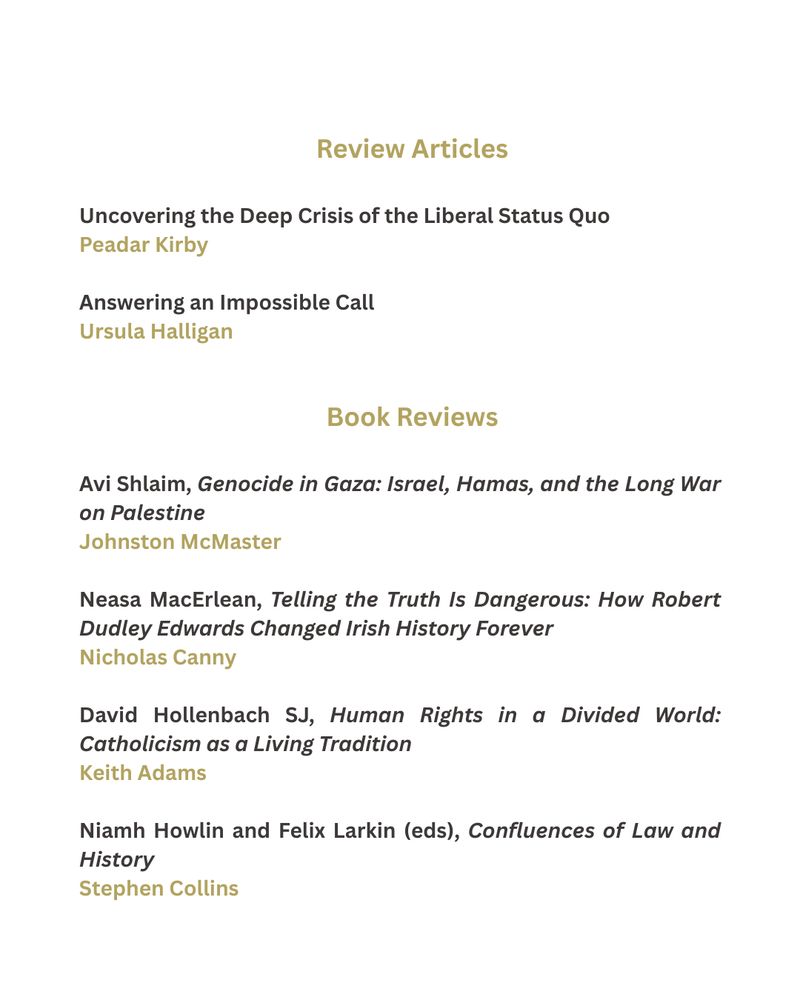
This image contains a list of the review articles and book reviews contained in the Winter 2025 - 2026 edition of Studies: An Irish Quarterly Review. They are: Uncovering the Deep Crisis of the Liberal Status Quo by Peadar Kirby Answering an Impossible Call by Ursula Halligan A review by Johnston McMaster of Avi Shlaim's book Genocide in Gaza: Israel, Hamas, and the Long War on Palestine A review by Nicholas Canny of Neasa MacErlean's book Telling the Truth Is Dangerous: How Robert Dudley Edwards Changed Irish History Forever A review by Keith Adams of David Hollenbach SJ's book Human Rights in a Divided World: Catholicism as a Living Tradition A review by Stephen Collins of Niamh Howlin and Felix Larkin (eds) book Confluences of Law and History
Studies Winter 2025-2026 issue has an extensive array of contributions from authors such as Bryan Fanning, Peadar Kirby (@kirbypeadar.bsky.social), Kate Costello-Sullivan (@costelkh.bsky.social), and Carmel Gallagher.
Available now from studiesirishreview.ie

An extract from Dermot Roantree’s editorial for the Winter 2025-2026 edition of Studies: An Irish Quarterly Review. Extract as follows: …it is not uncommon for scientists to be reductive – to regard a castle as really nothing more than the stones, roofs and furnishings that make it up; to view a landscape, for all the beauty we perceive in it, as merely a set of contiguous material forms: earth, water, rocks, plant life, and clouds, each with its own molecular makeup and all illuminated by photons. Whatever significance we find beyond these base elements, they may think, is of psychological interest indeed – as an expression, perhaps, of Freud’s ‘oceanic feeling’, that sense of being one with the external world – but it is not a significance that is in the things themselves. The world, on this view, consists only of brute ‘stuff’; any meaning it has is merely what we project onto it. …Language is key. The indigenous language of a place carries a wealth of memories and meanings that an imposed language may never fully access, a truth which holds in the Irish case as much as anywhere else in the colonised world. For Manchán Magan, the Irish author, documentary maker, and broadcaster whom we commemorate in this issue of Studies, this was a critical and inciting conviction. ‘An Ghaeilge’, he wrote in his hugely popular Thirty-Two Words for Field, is a complex and mysterious system of communication. It has encoded within it the accumulated knowledge of a people who have been living sustainably on these rocky, verdant Atlantic islands for millennia. As a result, it is profoundly ecological, with an innately indigenous understanding that prioritises nature and the land above all things.

An extract from Dermot Roantree’s editorial for the Winter 2025-2026 edition of Studies: An Irish Quarterly Review. Extract as follows: For Manchán, the Irish language has a ‘hidden wisdom’, just like so many other old languages that evolved ‘before the strictures of reason and rationality were imposed upon society’. These indigenous languages preserved that special relationship to place that made them repositories of an ancient knowledge which is threatened with extinction by present-day technological sophistication. The bond, then, between language and land is intimate. The language holds the means of articulating the wisdom, and the landscape acts as a kind of ‘mnemonic’6 – it helps us, as Manchán puts it in Listen to the Land Speak, ‘remember things that are often greater than the landscape itself’. The geographical features, he adds ‘are vessels for the history, beliefs and culture of our people, going back thousands of years’. At times Manchán wrote critically of Christianity’s contribution to the rupture between the Irish people and their land through its suppression of older systems of belief, but he acknowledged that Celtic Christianity also served to retain an intimate connection with the natural world through its unique form of ‘animistic Christianity’, one the monks then brought to Europe between the sixth and the ninth centuries: These oddball missionaries who wrote poems about the beauty of the blackbird’s call, or the whitethorn’s berries, or a midland lake at dawn, became beacons of light for a culturally slaughtered Europe. These were the likes of St Feargal from Co. Laois, who went to Salzburg, or St Killian from Cavan, who went to Würzburg, or the many other Irish monks who went to Italy and France to bring light to the darkness. Manchán Magan died on 2 October 2025. After just a few months of enduring an aggressive cancer, he was imithe, as his website now announces, ar shlí na fírinne. He was gone ‘on the path of truth’.
An extract from Dermot Roantree’s editorial for the Winter 2025-2026 edition, in commemoration of the life and work of the great Manchán Magan (@manchanmagan.bsky.social)
Available now from select bookshops and online at studiesirishreview.ie


The image explains the titles of the lead articles from the Studies: An Irish Quarterly Review, Winter 2025 - 2026 edition, which is titled 'Tributes to Manchán: Language, Spirit, Place'. The articles listed are: The Fifth Province: A Tribute to Manchán Magan, by Tom Casey SJ Influence in Transmission: Scéal an Deisceabail Teanga, by Liam Mac Amhlaigh Holding the World Together: Myth, Language, and the Reawakening of Kanyini in the Irish Imagination, by Nuala King Memories of Manchán, by Siobhán McNamara
Studies Winter 2025 - 2026 is available now, with lead articles from Tom Casey SJ, @liammacamhlaigh.bsky.social, Nuala King, and Siobhán McNamara.
Found at select bookstores and online at www.studiesirishreview.ie

Another Sunday evening read from the archives: from 2015, Dr Catherine Lawless on the origins and impact of the cult of St Anne
www.studiesirishreview.ie/2025/12/06/s...

Some bardic poetry for a rainy Monday - on the archival blog, two 1951 translations by Lambert McKenna - in the spirit of the upcoming Winter issue on language, the landscape, and the legacy of Manchán Magan.
www.studiesirishreview.ie/2025/11/30/t...

Another read from the archives this Sunday - from 1998, Joseph Feeney SJ on the origins of Martin McDonagh:
www.studiesirishreview.ie/2025/11/22/m...
Our thanks to Manchán's family for their gracious allowance of our use of the accompanying image.

The upcoming Winter issue of Studies will focus on 'Language and the Landscape', with a leading theme of the life and work of Manchán Magan and lead articles by @liammacamhlaigh.bsky.social, Siobhán McNamara, and Tom Casey SJ.

Enjoy some Sunday morning reading with a visit to our archives and a brief history of the deep connections between Ireland and the Camino de Santiago:
www.studiesirishreview.ie/2025/11/15/i...

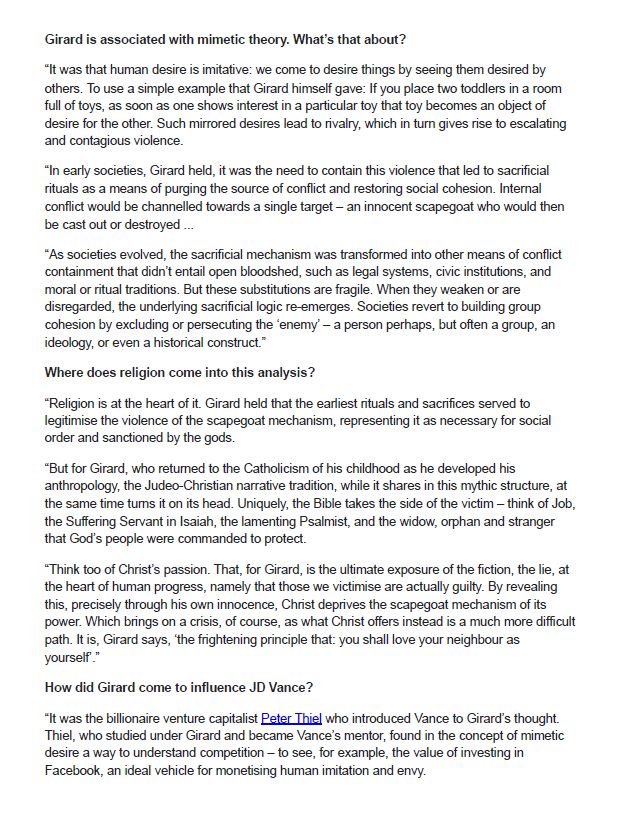

Studies' editor Dermot Roantree was the featured guest on Joe Humphreys' Unthinkable column in this week's @irishtimes.com, discussing JD Vance's misappropriation of the work of René Girard and the subsequent impact on Vance's Catholicism and politics

Taoiseach Micheál Martin has paid tribute to Sr Stanislaus Kennedy, describing the campaigner and advocate as a "true Christian who dedicated her life to helping those on the margins" www.rte.ie/news/ireland/2025/1103/1541852-sister-stan/

In honour of our outgoing President, this week's archival blog presents four poems by Michael D. Higgins:
www.studiesirishreview.ie/2025/10/28/m...
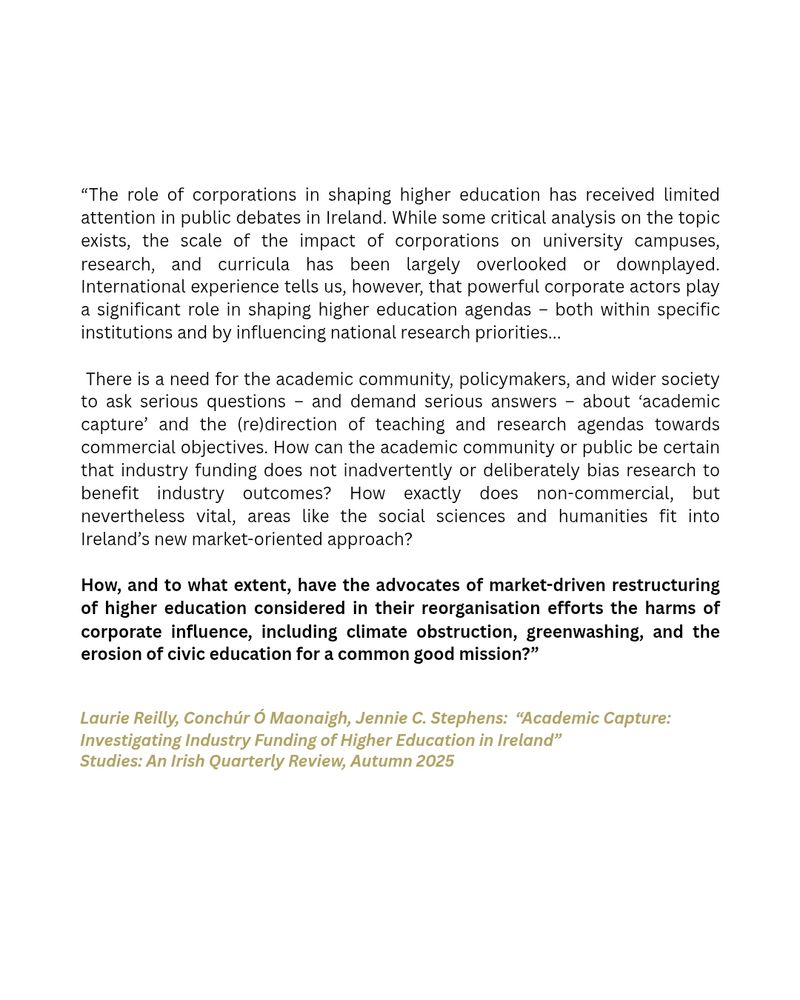

In Studies Autumn 2025, Laurie Reilly, Conchúr Ó Maonaigh & Jennie C. Stephens argue the impact of financially-motivated collaboration between universities & industry has led to - amongst other detrimental effects - prioritisation of research with commercial value over non-commercial research:
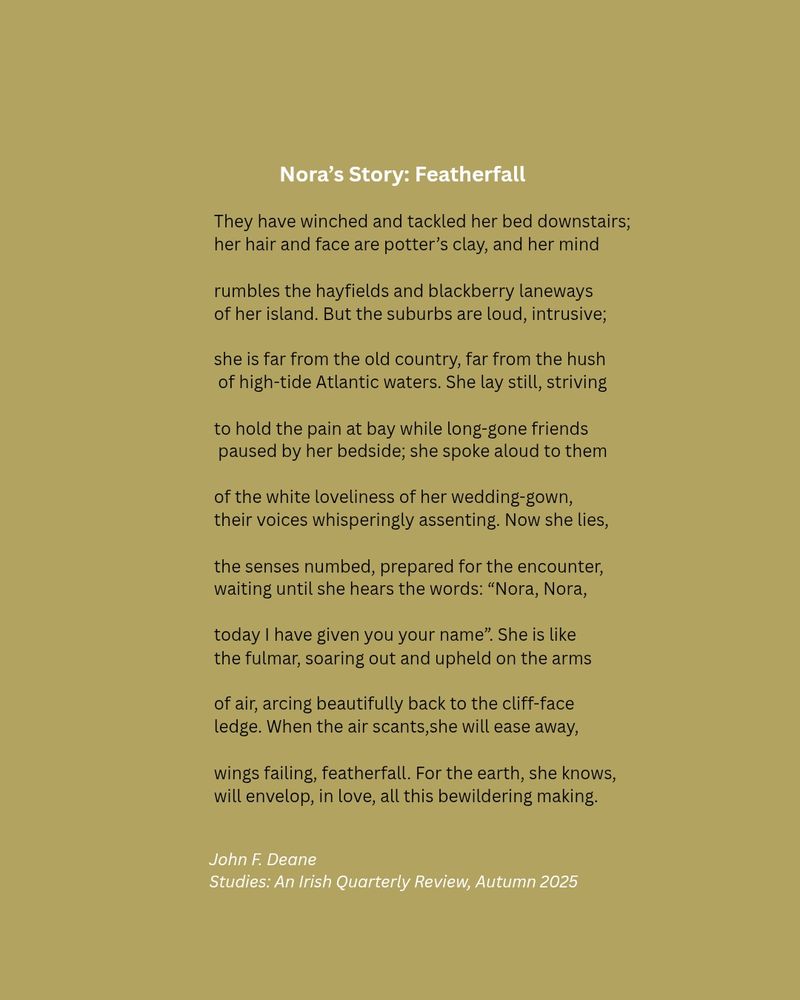
A poem by Irish poet John F. Deane, published in the Autumn 2025 edition of Studies: An Irish Quarterly Review. Title: Nora's Story: Featherfall They have winched and tackled her bed downstairs; her hair and face are potter’s clay, and her mind rumbles the hayfields and blackberry laneways of her island. But the suburbs are loud, intrusive; she is far from the old country, far from the hush of high-tide Atlantic waters. She lay still, striving to hold the pain at bay while long-gone friends paused by her bedside; she spoke aloud to them of the white loveliness of her wedding-gown, their voices whisperingly assenting. Now she lies, the senses numbed, prepared for the encounter, waiting until she hears the words: “Nora, Nora, today I have given you your name”. She is like the fulmar, soaring out and upheld on the arms of air, arcing beautifully back to the cliff-face ledge. When the air scants,she will ease away, wings failing, featherfall. For the earth, she knows, will envelop, in love, all this bewildering making.
One of four poems by John F. Deane published in our Autumn 2025 issue:

Tent at Gaza sculpture by John Behan
'Tent at Gaza' by John Behan RHA
Bronze, Unique, 8x18x12in
€6,250
Part of new works by John Behan, currently running in the gallery: shorturl.at/8dqjI

As someone raised in the diaspora and a past member of various bands, 🎸 I’m delighted to see my latest journal article (“Key Preoccupations in the Work of English Rock Artists of Irish Descent”) out in the latest issue of STUDIES: AN IRISH QUARTERLY REVIEW!:
www.studiesirishreview.ie/product/key-...

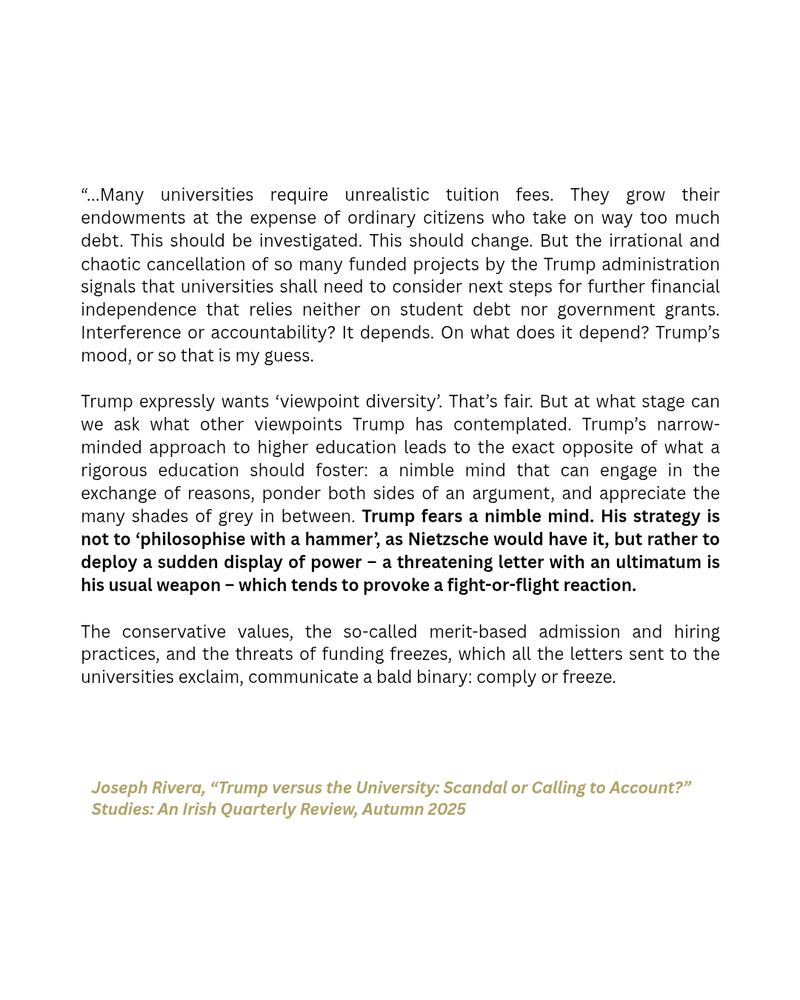
In our current edition Dr Joseph Rivera (of @dublincityuni.bsky.social) explores the attacks on higher education by the Trump administration, arguing that - despite widespread consequences for the sector - intellectually Trump's interference is little more than an assertion of conservative dominance
An event that may interest our readers, featuring contributor to our current edition @jenniecstephens.bsky.social

Image depicts a poem, 'What the Young Saint Said', by Dublin poet Gerard Smyth, which is published in the current Autumn 2025 edition of Studies: An Irish Quarterly Review. Poem below: for John F Deane Let God be God, the young saint said, not Roman, not Greek, or belonging only to pilgrim and conqueror but the God of all things: the Judas Tree and hornet’s nest, songthrush and garden slug. Let God be God, not the bearer of so many names or the judge who sits in the court of angels. Let him not be the gatekeeper at the Gates of Wrath, the tormenter of an innocent conscience. Let God be God, the young saint said, not the cause of holy wars or one who sends his proxies to rob our mirth but a God unbothered by heresies of dogma, His presence heard in the singer’s voice, sound of the orchestra, the iron gate when it creaks, the bells on Paternoster Street.
'What the Young Saint Said', one of two poems by Gerard Smyth published in Studies Autumn 2025
studiesirishreview.ie


Autumn 2025's opening article, from @jenniecstephens.bsky.social, is a stark challenge to the university sector that asks it to utilise its resources and influence for the public good, and move society towards 'a more just, ecologically-healthy, climate-stable future'
Available now @ link in bio.


What becomes a university in an Age of Crises?
Editor of Studies, Dermot Roantree, explores in his Autumn 2025 editorial: