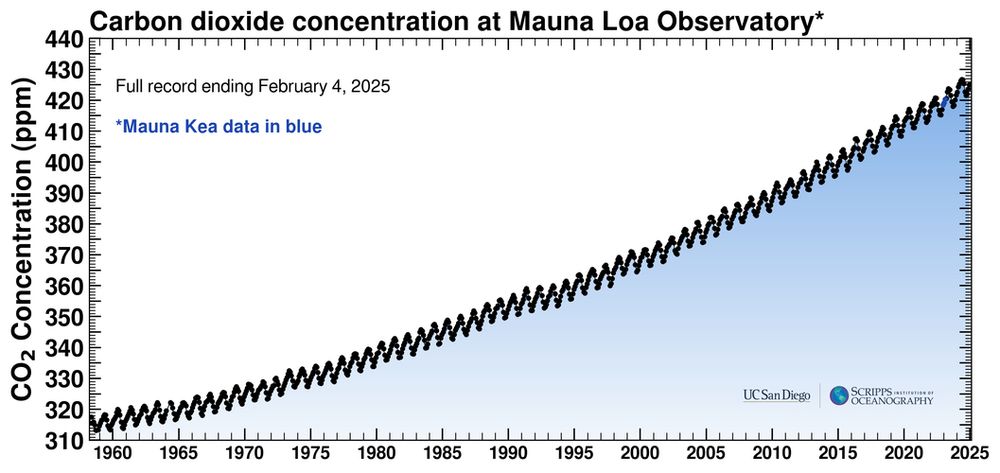
A graph of atmospheric carbon dioxide concentrations at the Mauna Loa observatory, Hawaii, from 1958 to 4th February 2025. It shows carbon dioxide levels rising at an accelerating rate over the decades. This is known to be due to emissions of carbon dioxide from human activity, mainly fossil fuel burning but also deforestation. The first CO2 concentration value in March 1958 was 315 parts per million (ppm). The latest daily value is 426 ppm. The graph also shows a seasonal cycle of a few ppm within each year, which is known to be linked to the growing season in the northern hemisphere causing a temporary uptake of carbon in spring and summer and release in autumn. The graph is produced routinely by the Scripps Institution of Oceanography, UC San Diego.
Although NOAA's page on atmospheric CO2 levels has vanished, you can still get this vital information from Ralph Keeling's team at the Scripps Institution of Oceanography, UC San Diego keelingcurve.ucsd.edu
Please follow bsky.app/profile/keel... for updates and share
Don't let science be hidden
05.02.2025 10:27
👍 1808
🔁 950
💬 44
📌 45
Are you interested in large scale biodiversity patterns, conservation, ecology, ecosystem functions... So you should consider connecting with researchers within the Global Ecology starter pack (DM @global-ecology.bsky.social if you want to be added).
27.01.2025 13:52
👍 4
🔁 0
💬 2
📌 0

<1 month to apply! Want to learn how to make the most of ecological data using supercomputers? Check out the projects. Our is especially cool ;) "Decoding biological colour: leveraging AI to analyse big data on animal images in a changing world" www.exageo.org/phd-student-... @lec-reefs.bsky.social
24.01.2025 10:56
👍 3
🔁 4
💬 0
📌 0

Coral Reef in the Ras Mohanned Marine Park, Egypt. Credit: Alex Mustard / Ocean Image Bank
NEW JOB: How does pelagic-reef connectivity vary across atolls and oceans?
2 year post-doc position based at research-intensive @lancasteruni.bsky.social, and part of the fantastic @lec-reefs.bsky.social team
Apply: hr-jobs.lancs.ac.uk/Vacancy.aspx...
#AcademicSky 🦑 🧪 🌊 🌍
23.01.2025 14:47
👍 77
🔁 46
💬 1
📌 7

NASA data shows that the rate of global warming over the past 15 years was about 9 times as high as between 1880 and 1970!
There is more and more evidence that the rate of global warming has doubled since 2010!
Visualization by the great Makiko Sato:
22.01.2025 19:56
👍 275
🔁 109
💬 17
📌 11

Great Barrier Reef fish evidence suggests shifts in major global biodiversity patterns
Life on the Great Barrier Reef is undergoing big changes in the face of climate change and other human-caused pressures, a new study reveals.
Fish communities on the Great Barrier Reef have significantly changed since the 1990s, with shifts in species diversity linked to coral composition changes, highlighting the impact of climate change and human pressures. doi.org/g8znds
13.01.2025 12:02
👍 2
🔁 1
💬 0
📌 0
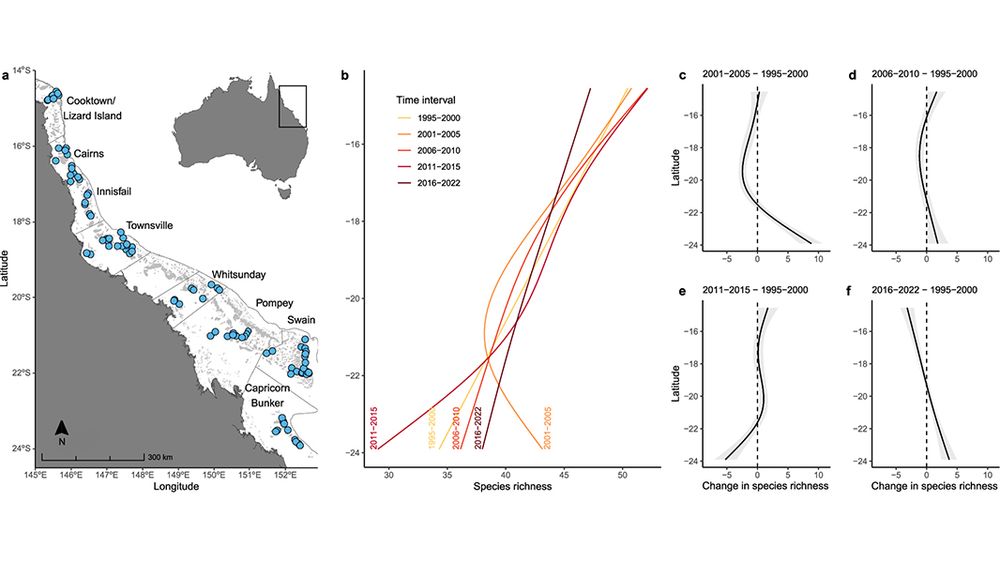
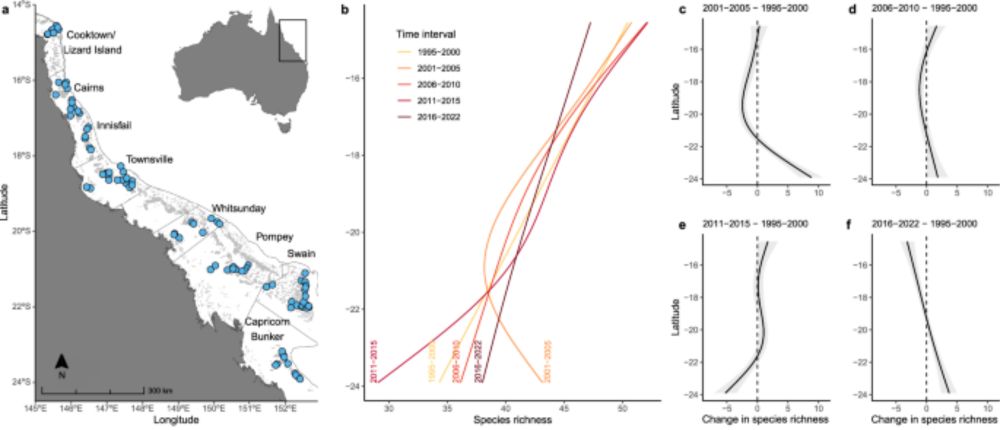
This is figure 1, which shows reef fish species richness (α diversity) across time and latitude.
Using long term data from the Great Barrier Reef, a study in Nature Communications finds that shifts in coral composition correlate more strongly with reef fish diversity changes than fluctuations in coral cover. https://go.nature.com/4g7mKIm 🧪
20.01.2025 23:36
👍 36
🔁 5
💬 0
📌 0

Fish diversity has changed dramatically on the Great Barrier Reef
The team found that the diversity of fish communities across the Great Barrier Reef (GBR) have changed dramatically since the 1990s.
Fish diversity has changed dramatically on the Great Barrier Reef: The team found that the diversity of fish communities across the Great Barrier Reef (GBR) have changed dramatically since the 1990s.
#GreatBarrierReef #FishDiversity #ClimateChangeImpact #CoralBleaching #EarthDotCom #Earth
15.01.2025 19:13
👍 3
🔁 1
💬 0
📌 0
@oceanographicmag.bsky.social
16.01.2025 15:28
👍 1
🔁 0
💬 0
📌 0
Can I be added, please?
15.01.2025 13:05
👍 1
🔁 0
💬 1
📌 0

3️⃣ La vida als anys 90: la biodiversitat de la Gran Barrera de Corall ha "canviat significativament":
Un nou estudi revela que les comunitats de peixos de la Gran Barrera de Corall avui són substancialment diferents de les dels anys 90. 🌊🐠
15.01.2025 10:51
👍 1
🔁 1
💬 1
📌 0
A short story of our paper in @naturecomms.bsky.social
AIMS: Great Barrier Reef fish evidence suggests shifts in major global biodiversity patterns
www.aims.gov.au/information-...
15.01.2025 09:03
👍 2
🔁 0
💬 0
📌 0
The paper represents the first chapter of my PhD.
Thanks to all my coauthors @nickajgraham.bsky.social., @salkeith.bsky.social, @remotereefs.bsky.social and the Australian Institute of Marine Science (AIMS) for their invaluable contributions and support throughout this enjoyable collaboration.
13.01.2025 10:55
👍 4
🔁 0
💬 0
📌 0

We found that these emergent patterns of reef fish diversity are more closely associated with shifts in coral community composition than fluctuations in coral cover 🐠 🪸
13.01.2025 10:55
👍 2
🔁 0
💬 1
📌 0

Altered diversity patterns are characterised by heterogeneous changes in reef fish trophic groups across the latitudinal gradient with reductions
in omnivores, planktivores, and herbivores in the northern GBR, and increases in the southern regions.
13.01.2025 10:55
👍 2
🔁 0
💬 1
📌 0

Reef fish turnover continuously increased over time at all latitudes of the Great Barrier Reef and did not show evidence of a return 🐟
13.01.2025 10:55
👍 2
🔁 0
💬 1
📌 0

We found that the most documented pattern of life on Earth - the Latitudinal Diversity Gradient - has changed in shape over the last three decades, raising questions about whether these patterns are decoupling from their original underlying drivers 🐠
13.01.2025 10:55
👍 3
🔁 0
💬 1
📌 0

1

2
2024 was the warmest year for all continents, except Antarctica and Australasia. In Europe, 2024 exceeded the 1991–2020 average by 1.47°C and the previous record from 2020 by 0.28°C.
Read the full Global Climate Highlights 2024 here: https://bit.ly/40kQpcz
#C3S #GCH2024
10.01.2025 09:30
👍 136
🔁 84
💬 5
📌 9

Diagram showing links between seabirds and various coral-reef monitoring outcomes.
Check out our new paper!
We compare indicators for monitoring the impacts of island restoration on coral reefs. Massive thanks to our huge list of collaborators, which enabled us to look at seabirds, nutrients, microbes, algae, corals, and fish! 🐦🦠🌱🪸🐠
www.sciencedirect.com/science/arti...
06.01.2025 17:18
👍 43
🔁 17
💬 3
📌 0