
A language model built for the public good
ETH Zurich and EPFL will release a large language model (LLM) developed on public infrastructure. Trained on the “Alps” supercomputer at the Swiss National Supercomputing Centre (CSCS), the new LLM ma...
A milestone for open AI: ETH Zurich and EPFL will release a fully open multilingual language model, trained on CSCS’s “Alps” supercomputer. Built for the public good, this model promotes transparency, inclusion, and innovation.
Read more:
09.07.2025 06:42
👍 49
🔁 20
💬 2
📌 3
Exciting new preprint from the lab: “Adopting a human developmental visual diet yields robust, shape-based AI vision”. A most wonderful case where brain inspiration massively improved AI solutions.
Work with @zejinlu.bsky.social @sushrutthorat.bsky.social and Radek Cichy
arxiv.org/abs/2507.03168
08.07.2025 13:03
👍 140
🔁 59
💬 3
📌 11

The interoceptive origin of reinforcement learning
Rewards play a crucial role in sculpting all motivated behavior. Traditionally, research on reinforcement learning has centered on how rewards guide l…
For the past couple of years I met weekly with 3 amazing younger scientists @lilweb.bsky.social @debyee.bsky.social @rikepetzschner.bsky.social to share ideas and teach each other. No agenda. It was often the favorite part of my week. Then we started writing. www.sciencedirect.com/science/arti...
11.06.2025 06:06
👍 17
🔁 6
💬 0
📌 2
Excited for our @rldmdublin2025.bsky.social workshop at the intersection of #NeuroAI and Aging. Tomorrow from 9 AM -1 PM in LTEE 3 in Hamilton Building, hope to see you there!
11.06.2025 10:26
👍 12
🔁 6
💬 0
📌 0
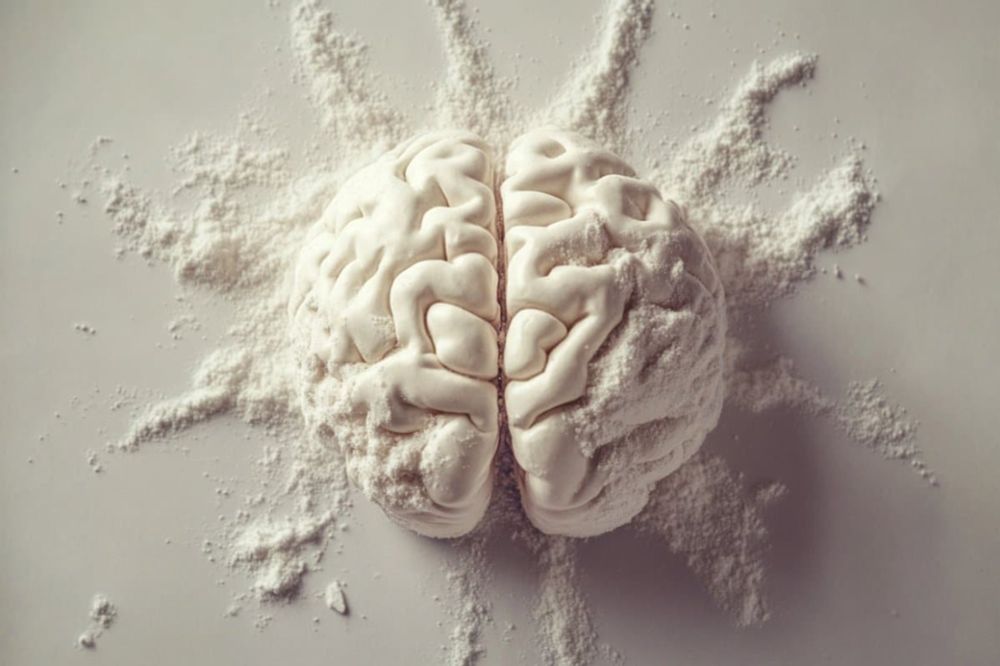
How Cocaine Hijacks the Brain - Neuroscience News
In a groundbreaking study, researchers have engineered fruit flies that voluntarily consume cocaine, creating the first fly model for cocaine addiction.
◽MedSky◽
For the first time, researchers have created genetically modified fruit flies that can become addicted to cocaine. The flies will self-administer cocaine if given the option.
03.06.2025 13:18
👍 3
🔁 1
💬 0
📌 0

EuroCIM2025 came to an end! Thank you to all speakers, participants, and partners who made this year's conference a success. See you next year in Oxford!
11.04.2025 20:01
👍 14
🔁 3
💬 0
📌 1
![[Editorial: Introducing the Journal of Robustness Reports]](https://cdn.bsky.app/img/feed_thumbnail/plain/did:plc:4bdpxswsa5p65ni7dd2f7f5y/bafkreia6p2iuq3bb4q2v5bsemv4wuw6q43635ppvcv7t2cfx7pqr74alxu@jpeg)
[Editorial: Introducing the Journal of Robustness Reports]
We are live!
Introducing the "Journal of Robustness Reports" – a Diamond Open-Access journal dedicated to publishing short reanalyses of empirical findings.
Check out our website and blog post about the journal:
🌐 scipost.org/JRobustRep
📄 www.bayesianspectacles.org/introducing-...
17.04.2025 15:13
👍 84
🔁 51
💬 2
📌 3
Bluesky
A massive thank you to all my co-authors for their support and contributions, to our reviewers for their constructive feedback and to the Co-Eds-in-Chief @cpsyjournal.bsky.social, @xiaosigu.bsky.social and @drrickadams.bsky.social.
6/6
25.03.2025 13:14
👍 1
🔁 0
💬 0
📌 0
Moreover, we argue that adopting Bayesian workflow for generative modelling helps increase the transparency and robustness of results, which is of fundamental importance for the long-term success of Computational Psychiatry.
5/6
25.03.2025 13:14
👍 0
🔁 0
💬 1
📌 0
We show that harnessing information from two different data streams (binary choices + continuous response times) improves the accuracy of inference (specifically, identifiability of parameters and models).
4/6
25.03.2025 13:14
👍 0
🔁 0
💬 1
📌 0

Graphical model representation of the HGF and example belief trajectories.
Our application example uses #HierarchicalGaussianFiltering (HGF). Next to highlighting the benefits of Bayesian workflow, we introduce multimodal response models in the #HGF framework which allow for simultaneous inference from multivariate data types.
3/6
25.03.2025 13:14
👍 0
🔁 0
💬 1
📌 0

Flowchart of Bayesian workflow for generative modelling in Computational Psychiatry.
We present a worked example of #BayesianWorkflow in the context of a typical application scenario for #ComputationalPsychiatry. Bayesian workflow encompasses iterative model building, checking, validation, comparison and understanding.
2/6
25.03.2025 13:14
👍 0
🔁 0
💬 1
📌 0

Bayesian Workflow for Generative Modeling in Computational Psychiatry | Computational Psychiatry
Are you new to the field of Computational Psychiatry or just looking for resources on applying Bayesian models of cognition to behavioural data? Then check out our new paper "Bayesian Workflow for Generative Modeling in Computational Psychiatry": doi.org/10.5334/cpsy...
1/6
25.03.2025 13:14
👍 18
🔁 7
💬 1
📌 0
Announcing a new week-long program for young computational neuroscience/ behavior professors to talk about rigorous science, mentoring, lab management, and networking in a stunning retreat setting. Do great science as a community and have fun doing so.
21.01.2025 19:24
👍 122
🔁 55
💬 2
📌 6
The Algonauts Project 2025
homepage
(1/4) The Algonauts Project 2025 challenge is now live!
Participate and build computational models that best predict how the human brain responds to multimodal movies!
Submission deadline: 13th of July.
#algonauts2025 #NeuroAI #CompNeuro #neuroscience #AI
algonautsproject.com
06.01.2025 10:08
👍 37
🔁 27
💬 2
📌 3
I am grateful for the support of my fabulous co-authors Dina, Liv, Jakob and Klaas and look forward to build onto our findings in future work! Happy holidays & merry christmas everyone!🎄 n/n
23.12.2024 13:37
👍 0
🔁 0
💬 0
📌 0
All of our analyses were prespecified (doi.org/10.5281/zeno...) and both data (doi.org/10.5281/zeno...) and analysis code (github.com/alexjhess/pb...) are openly available. 8/n
23.12.2024 13:37
👍 0
🔁 0
💬 1
📌 0
Our study represents an initial attempt to refine and formalize ASE theory using methods from causal inference. Our results confirm key predictions from ASE theory but also suggest revisions which require empirical verification in future studies. 7/n
23.12.2024 13:37
👍 1
🔁 0
💬 1
📌 0
Second, we confirmed the predicted negative average causal effect from metacognition of allostatic control (i.e. the feeling of being in control over one’s own body) to fatigue across different methods of estimation. 6/n
23.12.2024 13:37
👍 0
🔁 0
💬 1
📌 0
We identified specific aspects of the proposed SCM that were inconsistent with the available data. This enabled formulation of an updated SCM that can be tested against future data. 5/n
23.12.2024 13:37
👍 0
🔁 0
💬 1
📌 0
We converted ASE theory into a structural causal model (SCM). This allowed identification of empirically testable prespecified (!) hypotheses regarding causal relationships between the central variables of interest using questionnaire data from healthy volunteers. 4/n
23.12.2024 13:37
👍 0
🔁 0
💬 1
📌 0
What started as a small pet project as part of a course on causality taught by the inspiring Jonas Peters @ethzurich.bsky.social has now become a nice little piece of work summarising my first steps in the realm of causal inference. 2/n
23.12.2024 13:37
👍 0
🔁 0
💬 1
📌 0

a countdown clock with the number 10 in the center
ALT: a countdown clock with the number 10 in the center
Let us start 2025 in a positive mood: here are 10 methods things researchers can worry *less* about in 2025
23.12.2024 10:36
👍 260
🔁 119
💬 15
📌 18

Logo of the MindBrainBody Symposium
📣 Come join us for the #MindBrainBody Symposium 2025!
📆 March 10-12, 2025
📍 Berlin & online
🔎 mindbrainbody.de
Keynotes:
- Ivan de Araujo
- Nadine Gogolla
- Maria Ribeiro @ribeironeuro.bsky.social
- Markus Ullsperger
- Tor Wager
- Veronica Witte @veronicawitte.bsky.social
#interoception
25.11.2024 19:32
👍 135
🔁 75
💬 3
📌 7
Excited to see this Special Focus at @jocn.bsky.social on Neural and Computational Mechanisms of Motivation and Decision-Making finally out!
Full collection here: direct.mit.edu/jocn/issue/3...
25.11.2024 22:24
👍 32
🔁 15
💬 3
📌 2

After a great conference in Boston, CCN is going to take place in Amsterdam in 2025! To help the exchange of ideas between #neuroscience, cognitive science, and #AI, CCN will for the first time have full length paper submissions (alongside the established 2 pagers)! Info below👇
#NeuroAI #CompNeuro
12.11.2024 09:27
👍 165
🔁 83
💬 4
📌 13
I'm putting together a Computational Psychiatry Starter Pack, still tiny!
Drop a comment if you feel like you should be added :)
go.bsky.app/5PTy9Zj
10.11.2024 11:35
👍 78
🔁 30
💬 46
📌 2