
@belewollesen.bsky.social is also on Bluesky.
23.02.2026 13:48
👍 3
🔁 1
💬 0
📌 0
@belewollesen.bsky.social is also on Bluesky.

The Condorcet Jury Theorem under Ambiguity Bele Wollesen Leibniz University Hannover This paper evaluates the Condorcet Jury Theorem in the context of ambiguity. It explores the effects on the assumption of voter competence when voters face situations in which they can no longer ascribe a single probability. In contrast to voting in situations where voters are able to assign such probabilities, this paper demonstrates that voters may fail to vote competently under ambiguity, even if they are honest, practically rational, and epistemically competent. Thus, the conditions under which voter competence can be guaranteed become unclear once we adopt a less idealised framework of uncertainty. Specifically, conditions that ensure voter competence under risk do not necessarily guarantee voter competence under ambiguity. The second contribution is a more positive one. It outlines a fruitful research agenda aimed at identifying collective decision procedures that are better suited to less idealised uncertainty frameworks. In this regard, the paper shows how allowing abstention can have positive effects on the epistemic benefits of voting and extends the Condorcet Jury Theorem accordingly.
Former LSE student Bele Wollesen has a paper coming out in Ergo that I am a big fan of (www.belewollesen.com/uploads/1/4/...).
Solidarity with Martin Peterson, a wonderful philosopher. I enjoyed working on this volume with him. Buy his books!

ABSTRACT. There is a widely held view on measurement inferences that defends the prohibition that we should not make inferences from averages taken with ordinal scales (versus quantitative scales; interval or ratio). This prohibition is general—applying to all ordinal scales—and is sometimes endorsed without qualification. Adhering to it dramatically limits research in the social and biomedical sciences. I provide a Bayesian analysis of this problem, determining when measurements from ordinal scales can be used to confirm hypotheses about relative group averages. I illustrate with the alleged paradigm ordinal scale—the Mohs scale of mineral hardness—arguing that it has been mischaracterized in the literature. The prohibition, I conclude, cannot be upheld, even in a qualified sense. The beliefs needed to make average comparisons are less demanding than those appropriate for quantitative scales.
From the new issue:
Against Prohibition (or, When Using Ordinal Scales to Compare Groups Is OK)
– Cristian Larroulet Philippi
Abstract in alt text or read it here:
www.journals.uchicago.edu/doi/abs/10.1...
#philsci #philsky
Welfare Econ faces a core problem: preference endogeneity. What should we do when the yardstick used to assess policies changes with the analysed system? MAPS member @becklukas.bsky.social tackles this issue in the context of large-scale interventions. New paper in Politics, Philosophy & Economics.
New paper "Endogenous Preferences, Environmental Economics, and Welfare" accepted at Politics, Philosophy & Economics.
In it, I argue for how we should address endogenous preferences in the welfare assessment of large-scale policy interventions (e.g., a carbon tax).
Penultimate version here👇
Im Rentenpaket fällt mir wieder auf, wie sehr Berichterstattung darauf fokussiert, was das für Koalitionsstabilität und Kontrolle der Parteichefs über ihre Partei bedeutet, und wie wenig darauf, was es für das Leben der Menschen bedeutet.

Call for proposals for articles for a special issue of this well edited journal #econsky #histsci #climate
Join us for the Inaugural Conference of the new Forum #Wissenschaftsreflexion in June 2026! Early-Career Researchers can still apply for a dedicated workshop that covers travel & accomodation costs. #PhilSci #PhilSky #HPS #STS #SocSky @mapsproject.bsky.social @modeltransfer.bsky.social
At the heart of economics lies the concept of preference, a notion that closely resembles desire. Despite their importance, it remains unclear what preferences in economics actually are; e.g., are they a type of desire? The chapter outlines and critically assesses the dominant views on the matter.

I am sharing a preprint of my chapter forthcoming in the Routledge Handbook on the Philosophy of Desire (edited by @alexgregory.bsky.social): "Desires in Economics."
philpapers.org/rec/BECDIE-3
Feedback or any thoughts are welcome!
Contains references to a galaxy far, far away🌌
More details below👇

Team member @becklukas.bsky.social gave a talk entitled "Policy Optimization IAMs as Normative Models" at the Institute of Philosophy Colloquium. @iphilluh.bsky.social
Looking for #ArgumentMapping tools or software for #TeachingPhilosophy. Is there an overview somewhere? Or do you have specific recommendations? #Philsky

I’ve just uploaded to philpapers my (preprint) chapter titled “Values and Measurement” forthcoming in the Routledge Handbook of Values in Science.
It’s an overview of arguments for values playing significant roles in measurement practices.
Comments welcome!
philpapers.org/rec/LARVAM-2
I don't say "public philosophy" or "applied philosophy" because both seem to be trying to carve out a 2nd tier status for what is in fact our discipline at its best, doing what it's always done - speaking to people about questions that matter.
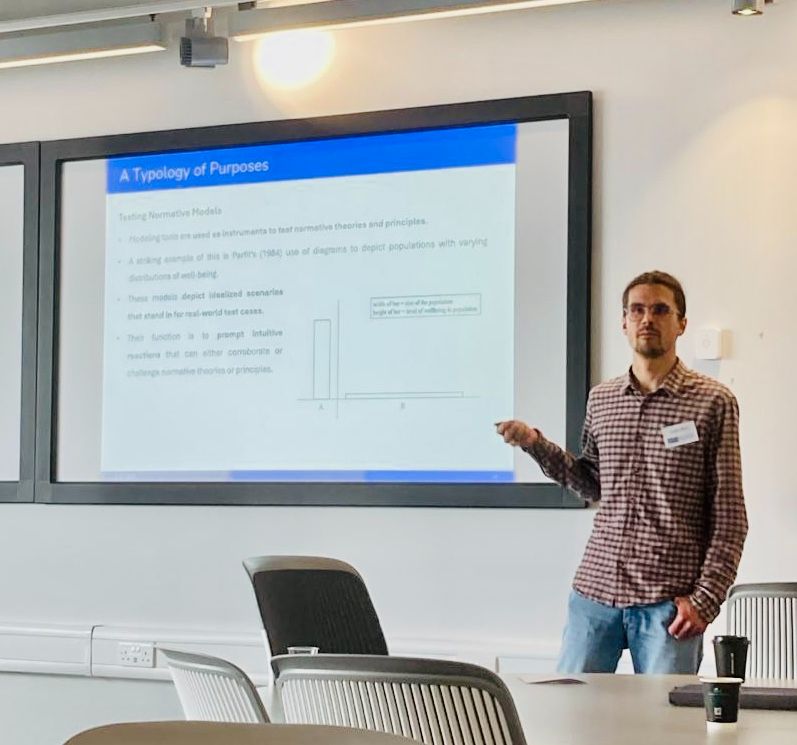
Team member @becklukas.bsky.social presented "On the Diversity of Models in Normative Inquiry" at the #BSPS2025

It was such a great conference, thank you, @mapsproject.bsky.social team!
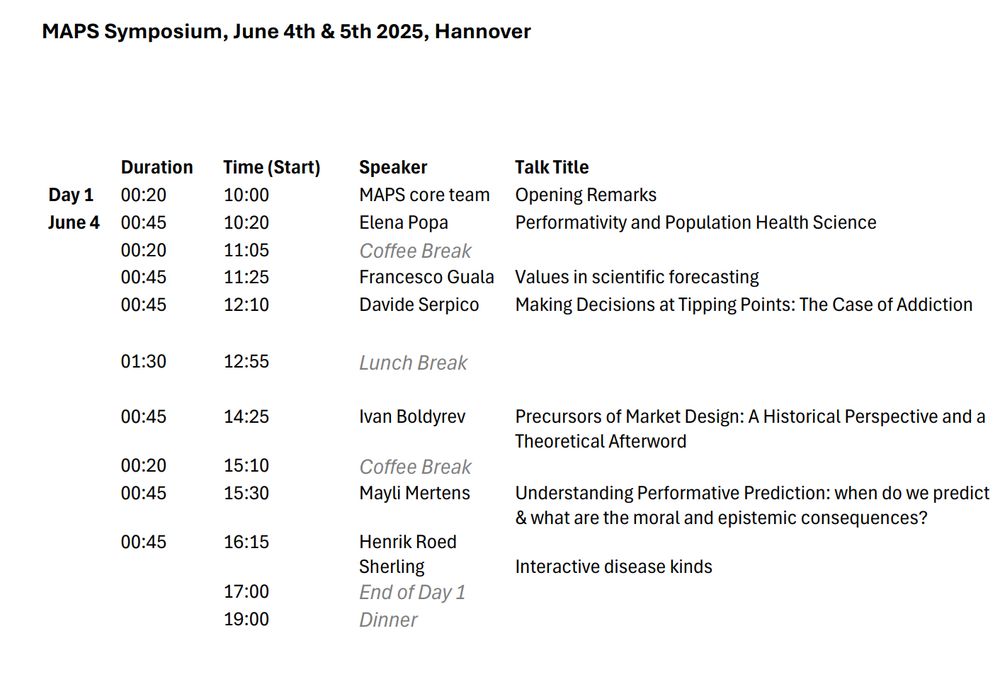
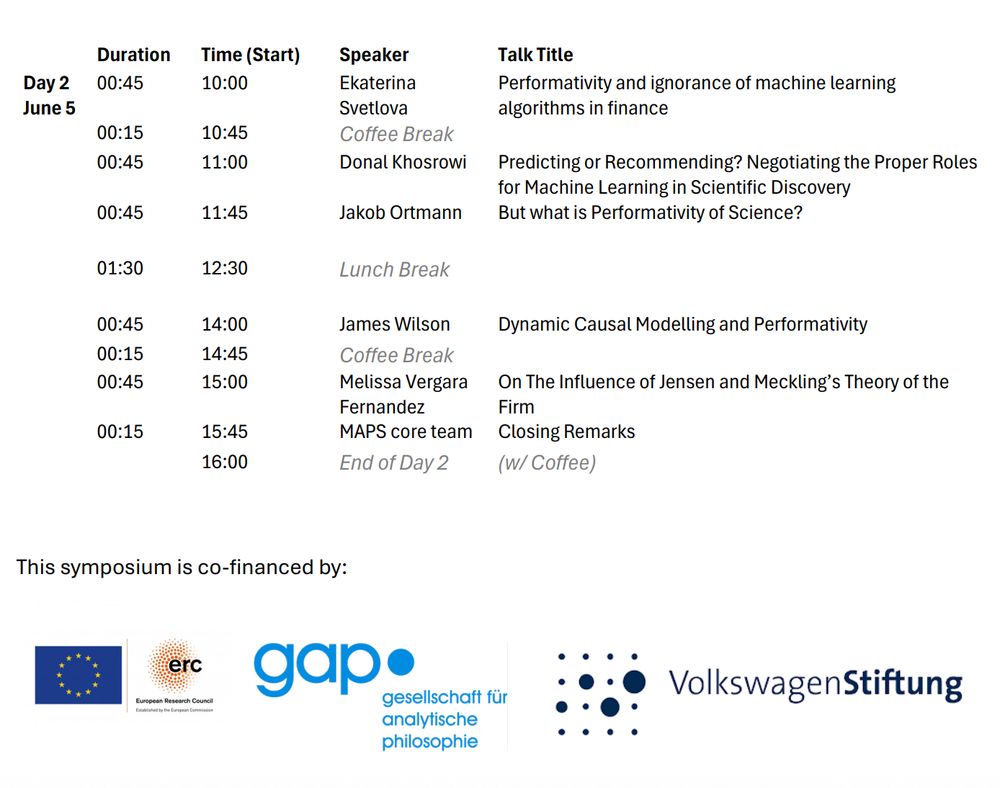
We are pleased to invite you to the MAPS Symposium, taking place on June 4 and 5, 2025, at Koniglicher Pferdestall. Attendance is free and open to all. We have a great lineup! Join us for two days of engaging discussions and critical reflections.
I think the thing people are missing about Trump’s plan is that, while we have to go through some short term pain, in exchange we will get long term pain.

In collaboration with Luca Congiu (University of Rome Tor Vergata), we are conducting an experimental study to test whether presenting probabilities pictorially reduces the prevalence of choice patterns in line with the Allais paradox.
Congratulations to my spouse who is now a certified expert in strategic behavior and manipulation in collective decision-making 🥳
This is great, right? 😅

The great conference (my very first one!) is in Atlanta this year. Send ‘papers on any topic in philosophy of the social sciences, especially those that tackle philosophical issues as they arise in, and are consequential for, practicing social scientists’. Abstracts by Dec 15th! #philsci #philsky

No one likes a poorly attended inauguration... so please join me in London or online on 3 Dec for my inaugural lecture, "The Edge of Sentience". www.lse.ac.uk/Events/2024/...
@henrikthoren.bsky.social, Dominic Lenzi and I are looking forward to your submissions.
Deadline: 28.02.2025
CfP: What is the appropriate role of climate economics in decision-making and climate policy? What role do value judgments play in its models and methods? How does it relate to other disciplines?
If you have answers, submit them to our topical collection for the EJPS: philsci.eu/Phil-Climate...

I designed a lecture course on measurement that I will teach at Cambridge in Spring 25 and, in extended form, at Boston University in Fall 25 (drive.google.com/file/d/1w3QE...). t focuses on perennial problems (quantification, scales, evidence) and methods. Happy about feedback. #philsci #philsky
So many newspaper stories about AI have the form "In the future, AI will be able to X." But absent a demonstrable ability to X in the present, this isn't news – it's marketing dressed up as news. Journalists should not be that credulous.

"The new UK government would be well advised to focus on health in delivering transport policies, not only on reducing carbon emissions." blogs.lse.ac.uk/politicsandp...
Thank you for the introduction, Anna! 🫶 Glad to see so many great philosophers here on Bluesky 👋

I’m happy to share that my paper “Is Quantitative Measurement in the Human Sciences Doomed? On the Quantity Objection” has been accepted for publication by The British Journal for the Philosophy of Science. Check it out here: www.journals.uchicago.edu/doi/10.1086/...
Or ask me for a copy!