
Want to join a global 🌎 initiative to test the thermal limits of 🐟 using standardised approach? Led by @patricepottier.bsky.social, we are planning a globally distributed experiment to collect data on fish embryonic heat tolerance 🌡️. Make this experiment global!
🔗: www.thermalecologyalliance.org
28.10.2025 04:04
👍 27
🔁 17
💬 0
📌 0

"A systems-modelling approach to predict biological responses to extreme heat" doi.org/10.32942/X2B...
30.07.2025 12:00
👍 4
🔁 2
💬 0
📌 0
Very important study!! Check out the physiological and life-history to experimental evolution for thermal tolerance 👇
Some surprising results that help us better understand trade-offs and physiological mechanisms conferring thermal sensitivity
🐟🌡️
14.05.2025 23:45
👍 13
🔁 3
💬 0
📌 0
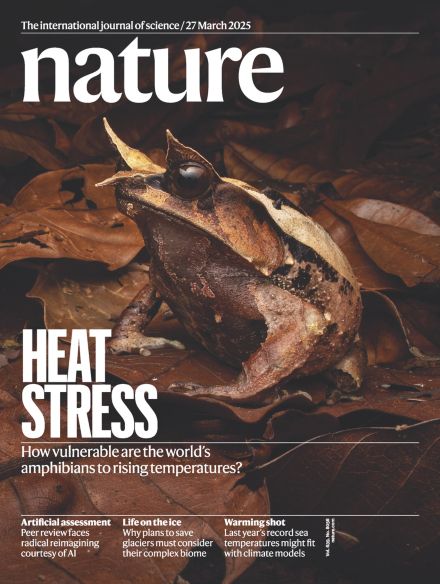
Cover of the journal "Nature" showing a long-nosed horned frog on leaf litter and the words "Heat Stress: How vulnerable are the worlds amphibians to rising temperatures?"
We made the cover
www.nature.com/articles/s41...
27.03.2025 16:54
👍 106
🔁 18
💬 3
📌 0
Thank you for sharing!
28.03.2025 11:25
👍 1
🔁 0
💬 0
📌 0

The latest issue of @nature.com sports a charismatic cover image ooooof... A frog! :) our recent paper on amphibians and the ways global climate change is bound to affect them (www.nature.com/articles/s41...) found its way to the cover of Nature. 💜💚🐸
26.03.2025 19:20
👍 39
🔁 9
💬 1
📌 3

Sorry, one of the images was not uploaded properly.
Here's the figure for the validation approach
🧵(6/27)
07.03.2025 00:27
👍 1
🔁 0
💬 0
📌 0
Please also check out @nicholaswu.bsky.social's fantastic post about this study:
bsky.app/profile/nich...
He's an incredible graphic designer and scientist, and many of the illustrations in this thread/paper are from him.
06.03.2025 23:34
👍 7
🔁 2
💬 1
📌 0
Huge thank you to @unsw.bsky.social and the E&ERC
for supporting me throughout this research.
I am also incredibly thankful to have been able to do this work on the traditional land of the Bedegal people. I feel gifted to learn from thousands of years of cultural and natural heritage.
🧵(27/27)
06.03.2025 23:34
👍 0
🔁 0
💬 1
📌 0
A massive thank you to all my co-authors @ecophys.bsky.social , @nicholaswu.bsky.social , @agunderson.bsky.social n, Julie Rej, Nayelli Rivera-Villanueva, @pietropollo.bsky.social ,
Samantha Burke, @szymekdr.bsky.social & @itchyshin.bsky.social
I couldn't have done this without you!
🧵(26/27)
06.03.2025 23:34
👍 4
🔁 0
💬 1
📌 0
Vulnerability of amphibians to global warming
There is also a dedicated web page hosted in
@github if you would like to go through the analyses and see some additional results and visualisations! 🌟
p-pottier.github.io/Vulnerabilit...
🧵(25/27)
06.03.2025 23:34
👍 1
🔁 0
💬 1
📌 0
Vulnerability of amphibians to global warming
We explore things in more detail in the paper, so please check it out and let me know if you have any questions!
doi.org/10.1038/s415...
This was by far the most challenging, but also rewarding project of my PhD (4 years from conceptualisation to publication). So glad to see this out!!
🧵(24/27)
06.03.2025 23:34
👍 2
🔁 1
💬 2
📌 0
6. Microenvironmental complexity is vital for thermoregulation.
The availability of shade, vegetation, and water bodies is critical in buffering amphibians during heat waves. Immediate action is needed to manage these microhabitat features (esp. water sources!) ⚠️
🧵(23/27)
06.03.2025 23:34
👍 1
🔁 0
💬 1
📌 0
5. Amphibians are vulnerable globally.
Both temperate and tropical amphibians are predicted to experience overheating events!
It is not safe to assume that tropical ectotherms are most vulnerable to warming, it is region- and species-specific ⚠️
🧵(22/27)
06.03.2025 23:34
👍 1
🔁 0
💬 1
📌 0
4. We need to incorporate realistic temperature fluctuations in climate vulnerability assessments.
Using averaged temperatures does not reliably inform vulnerability risk because extreme heat events 🌡️ are the very phenomena triggering overheating events ⚠️
🧵(21/27)
06.03.2025 23:34
👍 1
🔁 0
💬 1
📌 0
3. Plasticity is not able to buffer amphibians from extreme temperature events.
Although plasticity allows amphibians to adjust their thermal limits, it is not sufficient to compensate for projected temperature increases under global warming 😰
🧵(20/27)
06.03.2025 23:34
👍 2
🔁 0
💬 1
📌 0
2. The impacts of global warming on amphibians will escalate abruptly.
Differences projected under 2 or 4°C of warming are enormous. We need to reduce our greenhouse gas emissions before it is too late🥵
🧵(19/27)
06.03.2025 23:34
👍 2
🔁 0
💬 1
📌 0
Ok, but what does this all mean? 🤔
1. Amphibians are particularly vulnerable to extreme temperature events.
Our estimates are in fact conservative (assume constant access to shade and wet skin). The impacts of warming will be much stronger than what we predict 😱
🧵(18/27)
06.03.2025 23:34
👍 2
🔁 0
💬 1
📌 0

This is very different from our results with TSM 🤔
In fact, calculating TSM based on averaged temperature profiles hides critical tipping points for thermal stress (c,d)! ⚠️
Therefore, capturing daily temperature variation is key in assessing vulnerability risk!
🧵(17/27)
06.03.2025 23:34
👍 0
🔁 0
💬 1
📌 0
We did not find uniform latitudinal patterns in the predicted number of overheating events ⚠️
In the S. Hemisphere, tropical species encounter disproportionally more overheating events, while in the N. Hemisphere, non-tropical species are more susceptible (a,b)
🧵(16/27)
06.03.2025 23:34
👍 0
🔁 0
💬 1
📌 0

Interestingly, our models show that most amphibians will not overheat in aquatic microenvironments 💧. Only 11 species would be vulnerable under extreme climate warming scenarios.
This clearly demonstrates the importance of water bodies for amphibian thermoregulation⚠️
🧵(15/27)
06.03.2025 23:34
👍 1
🔁 0
💬 1
📌 0
We predicted that 104 species (2%) are already exposed to overheating events, and 4°C of global warming would push 7.5% of species beyond their thermal limits in terrestrial conditions (a)
In arboreal conditions (b), numbers are slightly lower, but we find similar patterns
🧵(14/27)
06.03.2025 23:34
👍 1
🔁 0
💬 1
📌 0
However, it does not mean that amphibians do not experience overheating events (when body temperatures exceed CTmax)!⚠️
In fact, extreme temperatures occasionally push many amphibians beyond their thermal limits, particularly under extreme warming scenarios😱
🧵(13/27)
06.03.2025 23:34
👍 1
🔁 0
💬 1
📌 0

If we first look at TSM, we find that it is always positive, but declines towards mid and low latitudes, which is consistent with previous evidence ✅
TSM is also slightly higher in aquatic (b) environments relative to terrestrial (b) and arboreal (c) habitats
🧵(12/27)
06.03.2025 23:34
👍 1
🔁 0
💬 1
📌 0

We also accounted for plasticity, and CTmax was adjusted daily to the temperatures experienced in the 7 days prior.
We then calculated 2 metrics: thermal safety margins (TSM, mean difference between CTmax and body temperatures), and the number of overheating events
🧵(11/27)
06.03.2025 23:34
👍 0
🔁 0
💬 1
📌 0
The beauty of biophysical models from
#NicheMapR is that they estimate body temperatures at high spatial and temporal resolutions 🌟
In our study, we estimated daily operative body temperature profiles, and measured their proximity to thermal limits
🧵(10/27)
06.03.2025 23:34
👍 0
🔁 0
💬 1
📌 0
We ran biophysical models globally 🌍, in 3 microhabitats, and under different climate scenarios (current, +2C and +4C of warming) 🌡️
Altogether, this represented ~100k biophysical models 😱 - a huge computational effort!
🧵(9/27)
06.03.2025 23:34
👍 0
🔁 0
💬 1
📌 0


