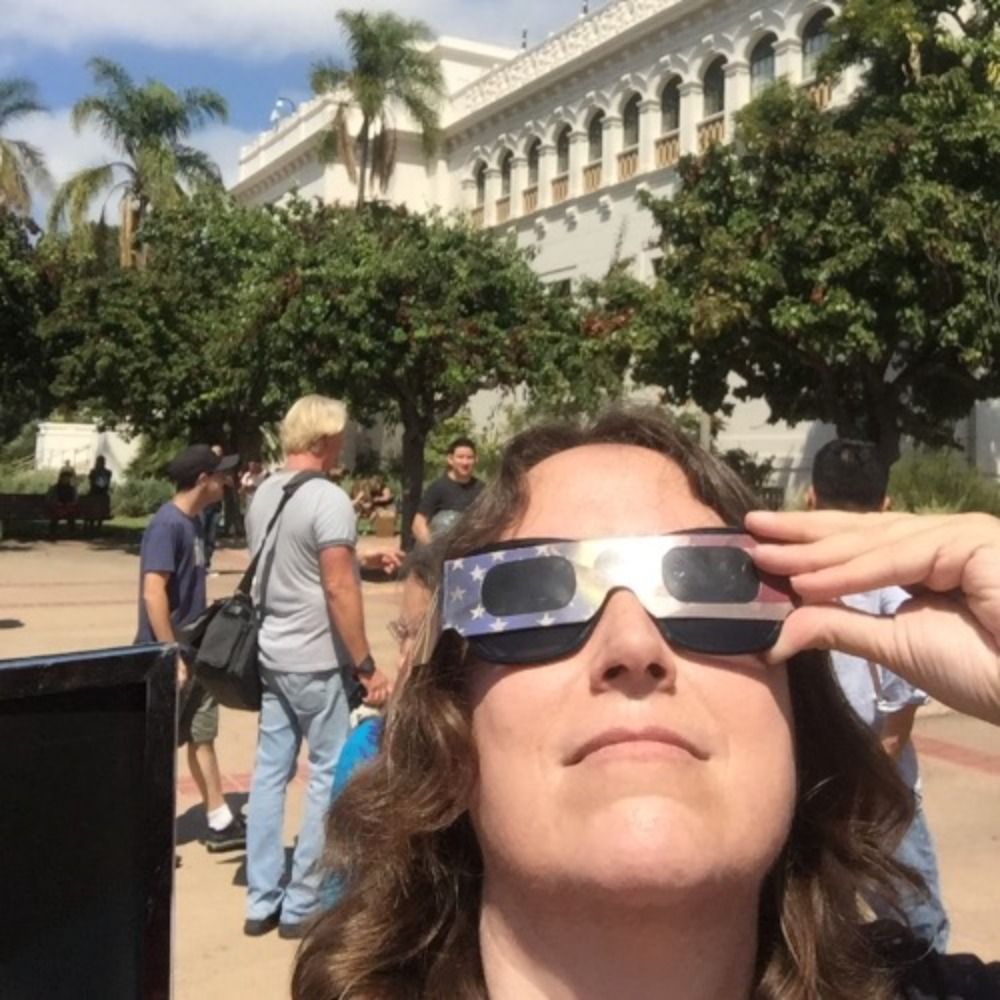
Standing up for science by participating in the San Diego Festival of Science and Engineering tomorrow. Join us at Petco Park! www.lovestemsd.org
06.03.2026 20:25
👍 4
🔁 2
💬 0
📌 1
Standing up for science by participating in the San Diego Festival of Science and Engineering tomorrow. Join us at Petco Park! www.lovestemsd.org
Learning about the TRAPPIST-1 system—an environment composed of seven rocky planets orbiting a red dwarf star—has been an ongoing endeavor. And now #NASAWebb is expanding the scientific story in exciting and new ways: https://bit.ly/4kH9X3i

Two images of a planetary nebula in space. The image to the left, labelled “Euclid & Hubble”, shows the whole nebula and its surroundings. A star in the very centre is surrounded by white bubbles and loops of gas, all shining with a powerful blue light. Farther away a broken ring of red and blue gas clouds surrounds the nebula. The background shows many stars and distant galaxies. A white box indicates the centre of the nebula and this region is the image to the right, labelled “Hubble”. It shows the multi-layered bubbles, pointed jets and circular shells of gas that make up the nebula, as well as the central star, in greater detail.
🤝 Hubble has teamed up with Euclid to image the intricate Cat’s Eye Nebula! 😻
Combining their focused views highlights the nebula’s exquisite structure, while placing it within the broader context.
Read more 👉 www.esa.int/Science_Expl...
🔭 🧪
Thanks so much for all you do!

Graphic about STARTastro info session being held at San Diego City College, Room S-316, at 4PM on Thur, March 5.
Join us at San Diego City College this Thursday, March 5, for information about STARTastro, a great opportunity for transfer students to UCSD and SDSU. This is also your chance to learn about astronomy research at both institutions, as well as enjoy City's newly upgraded planetarium.
😭
Interfering with my ability to procrastinate. Guess I should just do my course prep for the week. SIGH!

Scruffy black and white terrier mix giving side eye.
She's afraid I'm going to make her stop lazing around and clean the gutters.

A white, glowing egg-shaped object lies in the centre of the black-and-white image, on a dark, starry background. Glowing streaks spread upwards from the object. In the top left, a yellow arrow marked ‘Sun’ points straight down, and a blue arrow marked ‘Velocity’ points towards the 7 o’clock direction. In the bottom left, an inset shows the same object on a lighter grey starry background, filled with ragged-edged, concentric egg shapes gradiented black-to-white.
Our first glimpse of comet 3I/ATLAS from Juice's science camera 😍☄️
The precious data from the mission's November observations of the interstellar comet arrived on Earth last week. Teams are now digging in to discover what they reveal.
Stay tuned for updates!
More 👉 www.esa.int/ESA_Multimed...
🔭 🧪

From NASA
Mars used to be warm, watery, and blanketed by a thick atmosphere.
What happened? 🤔
NASA’s ESCAPADE mission just turned on its science instruments to find out. These twin spacecraft are helping prep for future human missions to the Red Planet. 🔴☀️
More: go.nasa.gov/4s5bKSm
All Administration directives can be understood as bigotry and/or grift. NSF has been directed to be part of the grift, shifting taxpayer money to the techbros in the guise of science.
Columbia President with NEW details:
5 DHS agents entered a residency with no warrant.
They said they were police looking for a missing kid.
Security camera even captures them showing pictures of the "kid."
A campus officer asked for a warrant & their boss.
They ignored him & took the student.

Illustrated graphic with the boot-shaped Rubin Observatory atop its site on Cerro Pachón beneath a sparkling night sky and the glowing band of the Milky Way stretching from lower left to upper right. Sprinkled throughout are many "Data alert!" popups, labeled with icons that represent supernovae, asteroids, hungry black holes, and more.

A 3-by-4 grid of grayscale astronomical images zoomed in on single objects. From left to right, the columns are labeled Template, New image, and difference. From top to bottom, the rows are labeled supernova, variable star, active galactic nucleus, and solar system object.
The largest spot-the-difference effort EVER has begun!🚨
On the night of Feb 24, NSF–DOE Rubin Observatory officially released its first ~800,000 public alerts of detected changes in the night sky!🔍
A new era of discovery is here✨ 🔭🧪☄️
🔗: rubinobservatory.org/news/first-a...

A wispy cosmic cloud against a dark starry background. The cloud is horizontally elongated. It has an overall pinkish shade, but it’s full of intricate filaments in different colours.
Largest image of its kind shows hidden chemistry at the heart of the Milky Way!
ALMA has obtained a unique view of the cold gas within the Central Molecular Zone of the #MilkyWay, helping us probe the lives of stars in this extreme region.
https://www.eso.org/public/news/eso2603/
🔭 🧪

Super cute scruffy black and white terrier mix reclining on blanket.
Everybody needs a puppy sometime.

The nebula appears to have distinct regions that capture different phases of its evolution: an outer shell of gas that was blown off first and consists mostly of hydrogen, and an inner cloud with more structure that contains a mix of different gases. Both Webb’s NIRCam (Near-Infrared Camera) and MIRI (Mid-Infrared Instrument) show a distinctive dark lane running vertically through the middle of the nebula that defines its brain-like look of left and right hemispheres. Webb’s resolution shows that this lane could be related to an outburst or outflow from the central star, which typically occurs as twin jets burst out in opposite directions. Evidence for this is particularly notable at the top of the nebula in Webb’s image, where it looks like the inner gas is being ejected outward.
🆕 These new NASA/ESA/CSA James Webb Space Telescope images show the Cranium Nebula using two instruments that reveal enhanced details of its brain‑like appearance. 🧠🧪🔭
🔗 esawebb.org/news/weic2605/
@science.esa.int @stsci.edu

An image labeled “SN 2025 p h t in NGC 1637, Hubble W F C 3 2024 + Webb NIRCam 2024”. The majority of the image shows a face-on spiral galaxy speckled with myriad blue and red stars. The yellowish core of the galaxy forms a fuzzy oval tilted to the upper right. About halfway from the core to the edge of the image at about 4 o’clock, a small region is outlined with a white box. A shaded, nearly transparent white triangle extends to a pullout at upper right labeled “before explosion”, with short lines forming a crosshair that points to a red star at the center. Below this are three more square images, all with crosshairs at the same location. 1) Hubble August 2024, with nothing visible in the crosshairs, 2) Webb October 2024, with a red star in the crosshairs, 3) Hubble July 2025, with a blue supernova in the crosshairs.
A star has died! For the first time, astronomers have used #NASAWebb to identify which specific star exploded as a supernova. The star—located in galaxy NGC 1637—was a red supergiant surrounded by so much dust that it was invisible to Hubble: https://news.stsci.edu/4alt51V

An orange nebula with a cloud-like texture against a black background. The nebula is more yellow-orange and opaque at the centre and darker-orange and more diffuse at its perimeter. At the centre of the image inside the nebula there are two small black dots.
Two's company ⭐️⭐️
Just like we humans are strongly influenced by the presence of companions over the course of our lives, so are stars, literally.
The pair of points at the centre of this image, taken with our VLT, are an old stellar couple known as AFGL 4106.
🔭 🧪
They get away with SO MUCH.

Black and tan terrier pup Amelia. In her tummy, looking up at camera. On a red and grey plaid blanket, under a grey blanket.

Black and white terrier pup Winnie, holding a red bone in her paws, caught mid yawn.
Our pups today.
We desperately need the low-Earth orbit (at minimum) to be considered an environment worthy of protection. We know that won't happen any time soon, so until then, use your right to comment as a member of the public.

Silver Meadow, Uintah Mountains, Utah. Photo: Bill Dunford
It's coldest just before sunrise.
(-5F in this case)

Small black and white terrier mix, Winnie, sitting on a couch and blanket, looking up towards the camera.
Look at this face.
Webb maps the mysterious upper atmosphere of Uranus 🔵
This first vertical view of its ionosphere reveals auroras shaped by the planet's tilted magnetic field and how Uranus’s atmosphere has continued to cool over the past three decades.
Read more 👉 www.esa.int/Science_Expl...
🔭 🧪
To encourage writing as part of their sky watching project, I gave students thin, pocket-sized journals in astro lab today. To turn in so I can see their work, but to be returned to them. Several students appeared genuinely touched to be given something. Looking forward to what they do with them.
AAAHHHHH!!!!
Whoa: young scholar searching Florence libraries for how the ancient Ptolemy informed Galileo found a copy of Ptolemy's Almagest with marginalia in what looks a lot like Galileo's own hand. Like a frozen moment of torch passing, when a carefully tended fire from antiquity ignited something new.
This is the last thing you have to do before you finish your degree in physics.
NOPE
The AI detector in our LMS flags, as far as I cqn tell, changes in style. Students tend to write more informal intro/conclusions, but the body with all the science jargon comes across as more formal. Worthless. Doesn't actually flag the wrong information or madeup graphics provided by AI.


