Je n'ai pas vu de décla officielle / doc FR quant au fait que la FR veuille remettre en cause le merit order, vous savez d'où vient cette affirmation?
07.03.2026 11:05
👍 2
🔁 0
💬 2
📌 0

@phuc-vinh
Head of the Jacques Delors Energy Centre, think tanking on French & EU energy policy @delorsinstitute.bsky.social📍Paris 🇫🇷🇪🇺🔌 Chercheur politique française & européenne de l'énergie - Institut Jacques Delors #energysky
Je n'ai pas vu de décla officielle / doc FR quant au fait que la FR veuille remettre en cause le merit order, vous savez d'où vient cette affirmation?
Quite a poor timing for Italy indeed, who also happens to be the EU MS the most reliant on Qatar's LNG. But the Iran situation might act as a suppletive argument for IT to ask for prices measures during the EUCO, the EC will have to stand its ground.
A much welcomed stance that must also be backed by France as the country benefit a lot from the carbon price signal to export its low-carbon electricity. Postponing the ETS won't solve the heavy-industry loss of competitiveness that is the results of decade of statu quo

L'ETS est injustement attaqué. S'il peut et doit être amélioré afin d'en faire un outil à même de financer la décarbonation de l'industrie, le suspendre reviendrait à tirer un trait sur tout ambition climatique. Notre tribune en réponse : www.lemonde.fr/idees/articl...

L'Europe et la France ont un choix à faire : s'électrifier ou rester sous le joug de l'impérialisme fossile de Donald Trump.
Notre tribune pour @delorsinstitute.bsky.social dans @lemonde.fr 👇
www.lemonde.fr/idees/articl...
Talked to @rlndpapp.bsky.social about my latest paper on the ETS2 and how MS are social concerns are shapping their stance on the file:
institutdelors.eu/en/publicati...
This does not mean the system should not be amended. Among the possibilities, a temporary price corridor could be an option worth looking into. Similarly, to ETS2, the MS may have the final say regarding the fate of ETS1 and the March EUCO might seal the deal, watch out!
MS are playing a dangerous game. They should be reminded that they are the main recipients of ETS revenues, yet they allocate only around 5% to decarbonizing heavy industry — their own choice. Undermining the system’s credibility and predictability is in no one’s interest and will derail us from -55

Frontloading ETS1 revenues is not new and Japan is already doing it. Rather than tweaking the MSR, leading to more emissions, a corridor would help contain price and make frontloading relevant.
Learn more about this proposal go read our latest paper on that matter: institutdelors.eu/en/publicati...
If you replicate that on the ETS1 market you can make a case where you can frontload €200 bn from 2028-2034 making a real difference to finance investment in decarbonization. Ultimately, you favor convergence of the two systems as the EC wanted to. @alicemhancock.bsky.social, @ziaweise.bsky.social

Rather than a buffed MSR, the EC should look into a transitional corridor on ETS2. A ceiling to avoid with certainty the price going past a certain price and a floor to have a minimum level of guaranteed revenues to reimburse the frontloading. This could be transitional (until lets say 2032).
In addition the MSR proposal does not adress one issue: what happens if there were to be multiple price spike (whatever the reason) a year.EC said you could activate the mechanism twice a year. Even if the amount of allowances released is relevant, you cannot rule out the occurence of multiple spike

Finally, the proposal on the MSR contradicts our latest finding. MS do not want an additional mechanism that could EVENTUALLY contain price volatility, they want CERTAINTY on that matter, hence why they forced their way and postponed the EC's hand regarding the postponement.
In addition from a legal point of view, how do you create such a facility w/o reopening the directive? This part remains blurry as you use the revenues to reimburse the loan, it can't be categorized as a non essential part of a delegated act right? @l-guillot.bsky.social, @fredsimoneu.bsky.social
With €6bn available at EU level you can not do that as the frontloading money is shared among 27MS (or at least those who are willing to voluntarly take part in the mecanism). If you want to be serious about frontloading, you have to talk in hundreds of Bn € : institutdelors.eu/en/publicati...
Postponing the ETS2 by a year leads to a lack of revenues (lets say €30bn) in addition to increasing the price pressure on ETS2 starting 2028. To avoid that, what you want to do is MASSIVELY invest in rapid decarbonization measures in big emitters countries : Germany, France, Poland, Italy and Spain

The EC has just published a more detailed proposal regarding the ETS2 changes it intends to do h/t to @annahbrt.bsky.social. On the frontloading the proposal is just ridiculous with "up to €6bn expected to be frontload in years 2026-2027". Let me explain why:
climate.ec.europa.eu/news-other-r...

In this new @delorsinstitute.bsky.social Policy Paper, @phuc-vinh.bsky.social and myself look at how to make the EU's upcoming carbon market ETS2 socially acceptable by drawing lessons from national CO2 price systems to implement well-designed carbon revenue redistribution and investment mechanisms.
Read our papers on that matter and check out @andreaseisl.bsky.social post on how to use carbon revenues smartly based on a comparative analysis of French, German and Austrian experiences.
9/9
Decided unanimously, this could raise €200 billion from 2028-2034 to fund decarbonization investments like heat pumps and electric vehicles and could be discussed in the upcoming months.
8/9
The mechanism would cover both carbon markets, with a price floor ensuring minimum revenue to reimburse the borrowing and a ceiling to limit price surges.
7/9
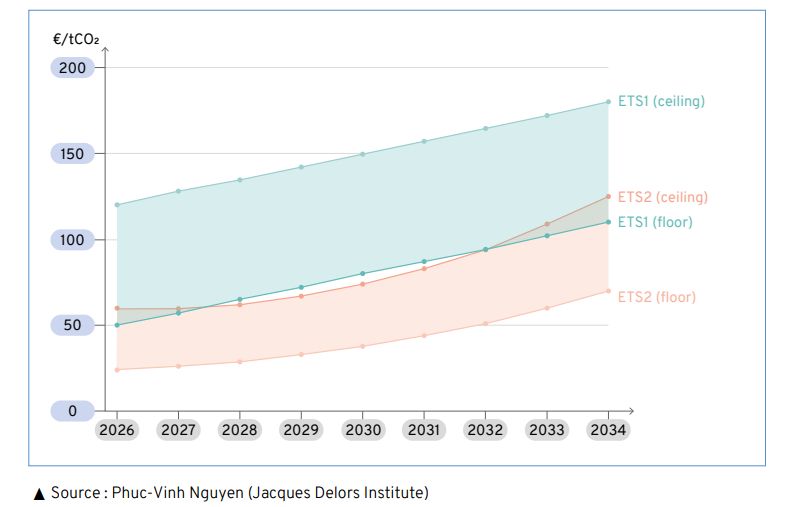
To answer these issues we propose a Japan-inspired mechanism: a common loan repaid from future carbon market revenues from ETS2 but also ETS1 :
6/9
States want to contain ETS2 price volatility and strengthen predictability, especially with a reliable mechanism to manage price spikes. Carbon revenues are seen as insufficient: the Social Climate Fund is too limited, and funding for rapid decarbonization is lacking, especially in Eastern MS.
5/9
Countries with existing carbon pricing generally support ETS2 (except France). Opposition is mainly from Eastern and Southern Europe. In France, government instability delayed political decisions. But the key hurdle is the coincidence of ETS2’s start (2027) with the presidential election.
4/9

So far, 17 states have transposed ETS2, 7 partially, and 3, including France, have not. The map of member states’ positions is more complex.
3/9

ETS2 is the new carbon market applying the polluter-pays principle to road transport, buildings, construction, and small industry sectors. Fossil fuel use in these sectors will be priced, increasing the bills for consumers expecting to drive consumption behaviour.
2/9
ETS2 has been postponed to 2028, raising questions about its actual implementation. For @delorsinstitute.bsky.social here’s a look at the stakes and reform proposals from my latest policy paper available here : institutdelors.eu/en/publicati...
A short🪀
1/9
Indeed, as it stands (see the sucessful CO2 standards for cars push for instance), this might carry on for a while.
Having the EPP ally with the far-right is, as Thu rightfully says, a culmination of already existing dynamics and should not come as a surprise. It was a matter of time. Now the Q° is, will this behaviour be limited to this Omnibus or is this the begining of full unraveling of the Green Deal?
Partly due to the fact that many factors directly impacting price formation have changed since then : CO2 standards will be revised, start date being 2028 puts more pressure on short terms decarbonization act° in big MS (not happening atm) and 30% allowances frontloading loses part of its usefulness