Haha sounds like you gotta make a new one. That way, you will be one of those scientists who make discoveries inspired by their dreams 😄
07.01.2026 23:45
👍 0
🔁 0
💬 0
📌 0
Haha sounds like you gotta make a new one. That way, you will be one of those scientists who make discoveries inspired by their dreams 😄

A conceptual image describing how we go from a regional species pool to local communities elaborating the role of dispersal, environmental filtering and species interactions as one filter on top of the other. Image from Mittelbach and Schemske 2015 Trends in Ecology and Evolution.
This probably isn't it based on your description, but it is one I have used in talks before for conveying a similar message. From Mittelbach and Schemske 2015 in TREE. I am curious to see the one you have in mind, if you do manage to find it.

More than a year ago researchers from @hifmb.de and @icbm-uol.bsky.social started to write about different perspectives on marine biodiversity change from natural and social science perspectives. This morphed into a review paper that was published online today link.springer.com/article/10.1... 🧪

Date and time: 9:00–15:30, Sunday, February 8, 2026 Location: University of Glasgow, room details TBA Title of the event: Designing multiple driver experiments Conveners: Sinéad Collins, University of Edinburgh, Simin Gao, University of Edinburgh, Paul Renaud, Akvaplan-niva Description: The MEDDLE resources were developed to help researchers design and carry out tractable and comparable multiple driver experiments. In this workshop, participants will learn how to use these resources to design multiple driver experiments. While the concepts and methods discussed can apply to many systems, examples used during the workshop will focus on manipulative experiments rather than observational data. The workshop is geared mainly towards PhD students, postdocs, and ECRs new to multiple driver research, and focuses heavily on the rationale of different experimental designs, and analysis strategies for multiple driver experiments. A basic working knowledge of statistics is needed (regression analysis), and statistical analysis examples will use R. Participants should bring a laptop with R and R studio installed. Topics include: • Defining a research question • Identifying relevant drivers • Identifying biological traits and responses • Experimental designs for multiple driver experiments • Statistical analysis plans Hosted by the SCOR project “Changing Ocean Biological Systems”, this free workshop will be led by Sinéad Collins, University of Edinburgh (UK), Simin Gao, University of Edinburgh (UK), Paul Renaud, Akvaplan-niva (Norway). Spaces are limited. If you would like to attend, contact Sinéad Collins (s.collins@ed.ac.uk) by January 15, 2026 to register your interest. Limited to 24 people, so please register early! Please include a brief (<150 words) statement outlining (a) your experience carrying out Ocean acidification or multiple driver experiments (if any) and (b) how you plan to incorporate multiple driver experiments into your work
The COBS working group is offering an experimental design workshop before Ocean Sciences in Glasgow in Feb 2026! 🌊
Join us for a day of learning about designing and analysing multiple stressor experiments without getting multiply stressed out.
forms.office.com/Pages/Respon...
How do temperature and resources interact to shape both population and community growth rates?
We have a model that makes predictions at both levels! And we test them with experimental data from the lab & field.
This one has been gestating for years and we're rather proud of it. Give it a read.

3D figure showing how a family of unimodal, species-level thermal performance curves are collectively bounded by an exponential function across species, uniting predictions of growth rate at population and community levels. From Fig. S4.
Ecologists recognize the importance of integrating across scales, yet our models often target specific scales. Our new paper presents models of population growth that scale up to explain community-level patterns, including interactions of temperature, light & nutrients. doi.org/10.1002/ecm....
Wonderful, thanks!
Hi Sebastian, thanks for organising this! Looks really interesting. Is there registration or anything else like that or do we just join the Zoom link on the page on the day? Just wanted to double check if I missed a link somewhere.

Poster announcing the workshop.
Join us for an @smtpb.bsky.social workshop on Modern Coexistence Theory. We'll cover mathematical foundations, the theory of partitioning, and data-based applications. Featuring @swatipatel.bsky.social, Nick Kortessis, & Lauren Shoemaker. Zoom link here: smtpb.org/event-6426026

Our experimental design workshop had ~40 participants from >15 countries!
@raviranjan.bsky.social and I focused on refining ideas, estimating parameters precisely, leverage in linear & nonlinear regression, and using simulations to compare designs.
Presentation & R scripts in next post:
Congrats Sebastian!
Some self-promotion 😬: @mridulkthomas.bsky.social and I did some work that might be relevant. We re-emphasise Cottingham 2005's msg & also use some statistical theory to generate efficient designs for multiple-driver experiments. Happy to answer any questions!
www.annualreviews.org/content/jour...

1/n
This study led by @aaronferderer.bsky.social tested how 5 diatom species respond to broad ranges of seawater carbonate conditions. Goal was to determine carbonate chemistry niches and to inform Ocean Alkalinity Enhancement (OAE) and Ocean Acidification (OA)
🌊
www.science.org/doi/10.1126/...

A teal flyer for a PhD opportunity to investigate how warming may change antimicrobial resistance. The project will use experiments on Klebsiella bacteria to answer questions about how temperature affects their response to antibiotics, plasmid transfer, and fitness costs. The research involves microbiology lab work, bioinformatics, and mathematical modeling. The flyer includes contact details for Dr. Daniel Padfield and the logos of the sponsoring institutions.
I have an MRC-funded PhD project available (www.exeter.ac.uk/study/fundin...) on how warming will change the problem of AMR. Join a small and friendly group (padpadpadpad.netlify.app/about) in (sometimes) sunny Cornwall. 🧪🦠 #microsky
Please share the ad below with anyone who may be interested.

Poster for 90 minute workshop on HOW TO DESIGN BETTER EXPERIMENTS, by Mridul Thomas & Ravi Ranjan. Details: September 23rd 16:00 CEST ; 14:00 UTC Description: Experimental designs can make or break an experiment. A good experiment has a clear goal and efficiently uses experimental resources to achieve that goal. In this workshop, we will review what experiments are for, basic and advanced principles of designing experiments, and how to use simulations to evaluate designs before actually doing the experiment. We’ll do a moderate amount of coding in R and so experience with this would be helpful but is not required. We intend to have small-group discussions to help participants develop their own experiments, and encourage participants to think of a specific question they would like to answer with an experiment.
@raviranjan.bsky.social & I are teaching a free online workshop with on experimental design for environmental scientists on the 23rd.
We'll focus on using simulations to evaluate how well different experimental designs help achieve your goals.
Please sign up & share! forms.gle/MZTxeQs4UpMr...
Hi! This is such a nice way to get a variety of speakers. I would love the opportunity to share my work. I am a postdoc doing mathematical models of community ecology, eco-physiology and the links between them. Mostly focused on phytoplankton, but thinking about primary producers broadly.
We find stable coexistence of Rüger's tropical tree demographic strategies (slow, fast, short-lived breeders, and long-lived pioneers) in a model with just competition for light and stochastic small-scale disturbances.
Great work, Damla Cinoğlu!
besjournals.onlinelibrary.wiley.com/doi/epdf/10....
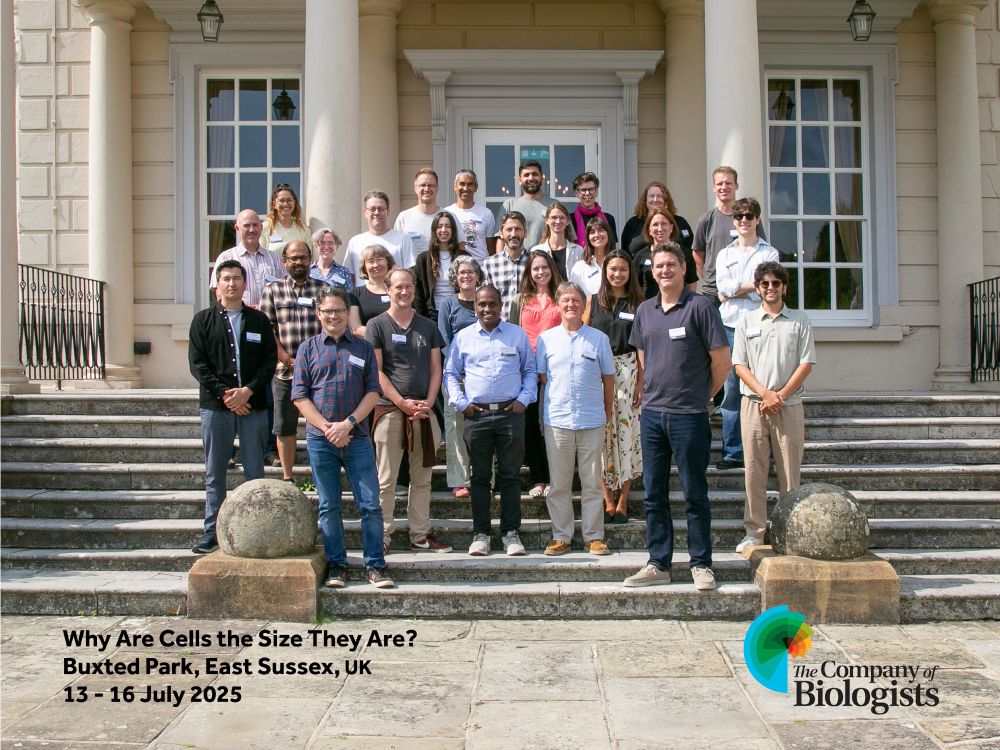
Workshop attendees standing on the steps in front of the event venue. The individuals are dressed in casual to semi-formal attire. Image text: Why Are Cells the Size They Are? Buxted Park, East Sussex, UK 13-16 July 2025
The Company of Biologists Workshop: Why Are Cells the Size They Are?
Thank you to Workshop organisers Dustin Marshall and Craig White.
#Workshop #Biology #CellBiology #Cells #Community #Collaboration #Research #Researchers #Academia #Academics
A couple of forthcoming workshops on experimental design and data analysis, taught by @christinamcgraw.bsky.social, Peter Dillingham, @sineadcollins.bsky.social, Sam Dupont, and me.

Get the word out far and wide. New opportunity from the Simons Foundation in the Eco-Evo space.
2026 Simons Graduate Fellowship in Ecology and Evolution Awards, due July 31, 2025, only for incoming PhD students who plan to start their PhDs in Fall 2026.
www.simonsfoundation.org/grant/simons...
@icbm-uol.bsky.social offers a fully funded professorship in theoretical oceanography. Join a great team of physicists, chemists, and biologists working on the marine environment. Oldenburg is a truly livable city and connected to a range of marine institutes in NW Germany
uol.de/en/job/w2-pr...

No more competing consumers than there are resources can coexist in equilibrium, but have you ever wondered how many consumers actually evolve as resource diversity increases? In our new paper, @chrisklausmeier.bsky.social and I investigate. (1/3)
www.sciencedirect.com/science/arti...
*Please repost* @sjgreenwood.bsky.social and I just launched a new personalized feed (*please pin*) that we hope will become a "must use" for #academicsky. The feed shows posts about papers filtered by *your* follower network. It's become my default Bluesky experience bsky.app/profile/pape...

(it’s a fig tree)

Kellogg Biological Station is searching for a new Director! KBS is unique in its ability to integrate lab and field research, as well as integrating fundamental research in ecology and evolution with applications to environmental problems. Questions to me or the search chairs. Please apply!
No worries! Thank you for adding me. :-)

The W.K. Kellogg Biological Station is looking for a new director!
careers.msu.edu/jobs/institu...
Hi Rodrigo, thanks for putting this together. Could you add me as well?
I am looking for a PhD student to start in fall of 2025 at MSU. Potential topics include trait-based approaches to plankton community resilience, temperature effects on communities, harmful algal blooms and many others. Please get in touch if interested. More info: www.kl-lab.group.
Hi, could you add me here as well? Thanks!