
(3) improve the DSA framework by better accounting for the impact of investments and reforms on growth and the effects of climate nonaction on public budgets.
14.01.2026 13:45
👍 1
🔁 0
💬 0
📌 0
(3) improve the DSA framework by better accounting for the impact of investments and reforms on growth and the effects of climate nonaction on public budgets.
(2) revise the incentive structure of the rules’ extension clause together with the next multi-annual financial framework of the EU to strengthen debt sustainability and the achievement of common priorities; and
To further develop the EU fiscal framework and strengthen its capacity to incite public investment and measures to accelerate the green transition, I make three sets of recommendations: (1) remove the counterproductive deficit and debt safeguards;
This constitutes a missed opportunity to better guide and coordinate the budgetary policies of Member States.
On the downside, while the new extension clause was designed to incentivize Member States to develop major reforms and investments in line with EU priorities, the analysis of the measures included in national MTPs reveals a major lack of ambition, especially regarding the green transition.
This is in stark contrast to the effect EU fiscal rules had in the aftermath of the Great Recession and eurozone debt crisis, when public investment shrank sharply.
On the upside, the analysis suggests that the new central debt sustainability (DSA) framework and the two extension clauses provide significant support for maintaining or even raising public investment levels.
I study the extent to which Member States have made use of these two flexibilisation clauses and the consequences of their activation for public investment and green reform and investment measures.
I focus on key features of the reformed Stability and Growth Pact (GP), the so-called national medium-term fiscal structural plans (MTPs), as well as two flexibilisation clauses of the new rules (extension clause, national escape clause for defense spending).
In this new @delorsinstitute.bsky.social Policy Paper, I analyse the implementation of the reformed EU fiscal framework to assess whether it provides more space and incentives public investment and the green transition.

New publication:
The reformed EU fiscal framework in action: Providing sufficient space and incentives for public investment and the green transition?
Thread:
Check out the full paper here: institutdelors.eu/content/uplo...

#Simplification can be a laudable objective, but is the Digital #Omnibus Proposal the right way forward towards competitiveness? 👉 @andreaseisl.bsky.social reflects on this dilemma in our Experts' Debrief ⬇️
🔗 tepsa.eu/policy-advic...
@delorsinstitute.bsky.social @sciencespo.bsky.social

@andreaseisl.bsky.social & @dzurstrassen.bsky.social on the EU's Important Projects of Common European Interest (IPCEIs)
Part of the Special Issue: European Integration in the Geopolitical Age by @lucasschramm91.bsky.social
@cfreudlsperger.bsky.social
🔗 www.tandfonline.com/doi/full/10....

ETS2 has been postponed to 2028, raising questions about its actual implementation. For @delorsinstitute.bsky.social here’s a look at the stakes and reform proposals from my latest policy paper available here : institutdelors.eu/en/publicati...
A short🪀
1/9
In a second publication, @phuc-vinh.bsky.social discusses the recent ETS2 postponement by Member States, provides a mapping of their positions on ETS2, and proposes a significant reform to address country concerns while ensuring an ETS2 effective implementation. institutdelors.eu/content/uplo...
You can check out the full study here: institutdelors.eu/content/uplo...
We also highlight the need for well-designed regulatory measures to ensure CO2 price effectiveness, to smartly combine compensation with investment tools, and to coordinate such investment support to provide a demand stimulus to EU cleantech industries.
Based on our findings, our recommendations stress the importance of a strict earmarking of ETS2 revenues and the visibility of support measures, and discuss how to best target citizens through redistribution mechanisms.
Our analysis highlights major differences in the design of compensation mechanisms and identifies country-specific best practice examples for investment support and accompanying policies.
We study the political processes surrounding their implementation as well as selected regulatory, redistribution and investment measures linked to the national CO2 prices in these countries.
To inform these exercises, our policy paper delves into three country cases (France, Germany, Austria), where national carbon price systems are already in place.
While currently only 9 EU Member States have national carbon price systems in place, with ETS2 a common price will apply across the Union, requiring to set up national social climate plans and identify spending priorities for the expected national cabron price revenues.
However, without adequate accompanying compensation and investment measures, additional costs for citiziens will not be socially acceptable and might lead to a reversal of climate policies.
The introduction of a CO2 price for fossil fuels in the housing and mobility sectors is a key measure to ensure that the EU will be able to achieve it climate objective.

In this new @delorsinstitute.bsky.social Policy Paper, @phuc-vinh.bsky.social and myself look at how to make the EU's upcoming carbon market ETS2 socially acceptable by drawing lessons from national CO2 price systems to implement well-designed carbon revenue redistribution and investment mechanisms.

🧭 #Hommage Aujourd’hui, Jacques Delors aurait eu 100 ans.
Les équipes des instituts de Paris, Berlin et Bruxelles lui rendent hommage en citant des pensées emblématiques de celui qui a façonné l’Europe.
@delorsberlin.bsky.social @delorseurope.bsky.social
Avec la participation précieuse de @andreaseisl.bsky.social et @jeromesegal.bsky.social
@table.media published our OpEd on how to support energy-intensive industry in Europe while avoiding inefficient subsidy races.
@ph-jaeg.bsky.social has a nice and short summary in his thread. ⬇️
table.media/en/europe/op...
@lukasbe.bsky.social and @andreaseisl.bsky.social
With the CID & Energy Action Plan, the EU wants to support energy intensive industries.
Support is needed - but it's crucial that any national subsidies to lower electricity prices don't result in inefficient distortions that end up harming competitiveness and climate.
Short🧵 on a new joint OpEd:
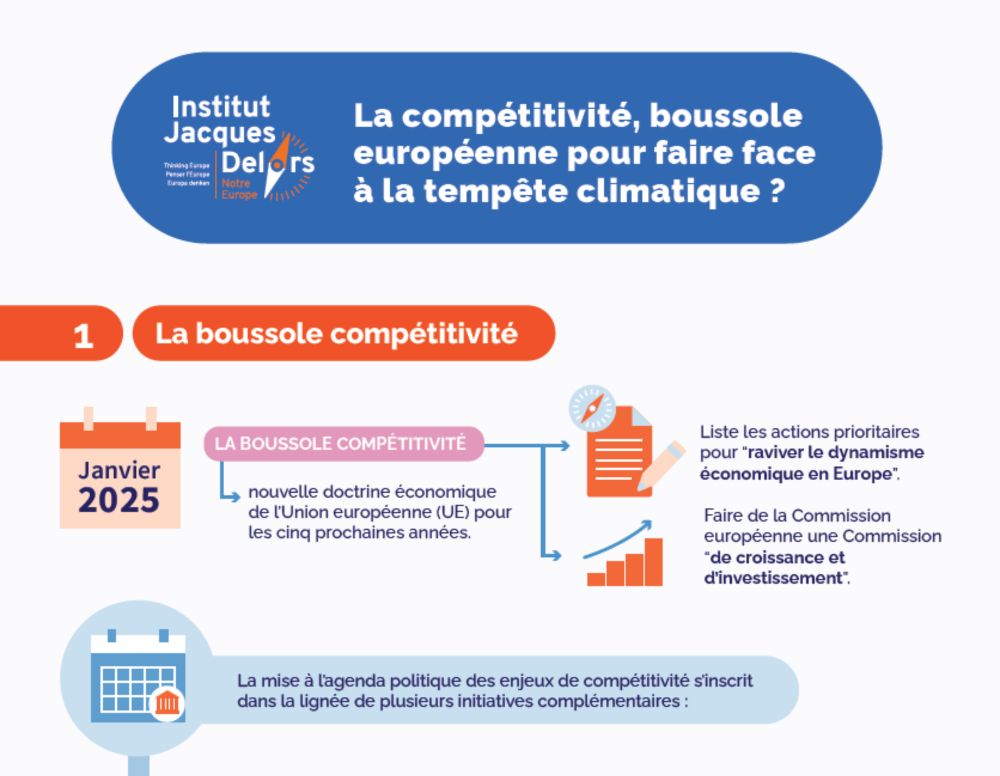
📊 #Infographie Quelles ambitions UE en matière de #compétitivité ? 1/5
Initiatives annoncées, leurs échéances, positionnement des groupes politiques du Parlement, attentes du couple franco-allemand.
infographie par @phuc-vinh.bsky.social & @andreaseisl.bsky.social 👇