
🚨 NEW ISSUE 🚨
🌏 Special section on how the rise of Asia reshapes international financial affairs
🗣️ Articles on ghosting diplomacy, ASEAN and human rights, India's China strategy and more
🤝 Policy paper on China and 'America First'
📚 25 book reviews
Read the issue > academic.oup.com/ia/issue/101/5
08.09.2025 08:05
👍 13
🔁 9
💬 1
📌 2
This, in turn, reflects China's own international financial subordination, as noted previously by authors like
@iliasalami.bsky.social. In Sri Lanka's case, once access to bond markets was lost, the govt defaulted on its external debt, including to Chinese lenders. 7/7
05.09.2025 06:40
👍 2
🔁 0
💬 1
📌 0
Borrowing from China thus plays a role in driving up debtors' borrowings on international bond markets, which increases their vulnerability to shifts in monetary policy in the US, rather than lessen it. 6/
05.09.2025 06:40
👍 1
🔁 0
💬 1
📌 0
Second, rather than Chinese lending rescuing borrowers from the vagaries of financial markets, in reality Chinese loans create demand for US$, needed to repay these loans. 5/
05.09.2025 06:40
👍 0
🔁 0
💬 1
📌 0
First, from the point of view of borrowing governments, Chinese loans and international sovereign bonds are complementary, not competing, sources of financing, that are being deployed for different political purposes. 4/
05.09.2025 06:40
👍 0
🔁 0
💬 1
📌 0
In this article, we examine the pivotal case of Sri Lanka, the 'poster-child' for the debt-trap diplomacy thesis, whose default in 2022 kicked off a blame game between creditors. We make two interrelated arguments. 3/
05.09.2025 06:40
👍 0
🔁 0
💬 1
📌 0
China is often seen to offer borrowers in the global south an alternative model for development, contrasted with the West's neoliberal model, notably sovereign borrowing on bond markets. 2/
05.09.2025 06:40
👍 0
🔁 0
💬 1
📌 0
Validate User
NEW #openaccess Article: published in International Affairs: 'Competing or complementary: Chinese loans and international bonds in Sri Lanka's default', co-authored with Umesh Moramudali. academic.oup.com/ia/article/1... 1/
05.09.2025 06:40
👍 4
🔁 1
💬 1
📌 1
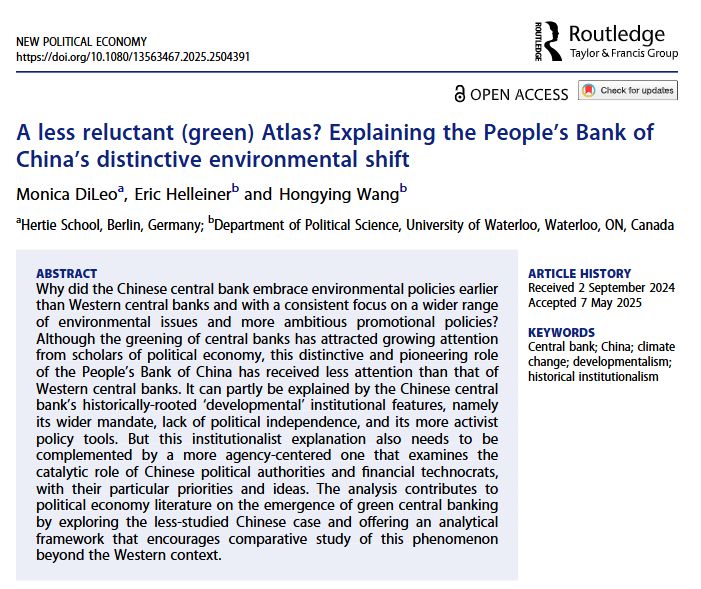
New (open access!) paper out now with Eric Helleiner and Hongying Wang in New Political Economy:
"A less reluctant (green) Atlas? Explaining the People’s Bank of China’s distinctive environmental shift"
1/ A brief thread 🧵
doi.org/10.1080/1356...
30.05.2025 10:15
👍 60
🔁 26
💬 3
📌 5
On the recent challenges to the foundations of dollar hegemony from Stephen Miran to Donald Trump by Madison Cartwright
@mkonings.bsky.social @shaharhameiri.bsky.social @tomchodor.bsky.social
www.ppesydney.net/trump-versus...
21.05.2025 22:06
👍 3
🔁 3
💬 0
📌 0
Great news! This article is now available #OpenAccess. Check it out: www.tandfonline.com/doi/full/10....
08.05.2025 07:08
👍 4
🔁 1
💬 0
📌 0
That what happens when you're trying to implement sweeping tariffs in a highly financialised and still integrated economy.
11.04.2025 01:53
👍 2
🔁 0
💬 0
📌 0
But they push back when serious cuts to net present value or face value are at stake, often in ways that undermine China's overall diplomatic and geopolitical imperatives. 12/12
10.04.2025 23:53
👍 0
🔁 0
💬 0
📌 0
These creditors are concerned to protect their balance sheets above all else. Hence they cooperate where they can, typically agreeing to reschedule debt and offer grace periods. 11/
10.04.2025 23:53
👍 0
🔁 0
💬 1
📌 0
We explain how its domestic governance of development financing and debt restructuring negotiations operates and show that the main interests shaping Chinese negotiations over sov debt have been of its mammoth policy banks - the China Exim Bank and the China Development Bank. 10/
10.04.2025 23:53
👍 1
🔁 0
💬 1
📌 0
In the article we explain this incoherent behaviour by using the analytic framework we developed in our book Fractured China. We argue that China is not necessarily a strategising top-down monolith. www.cambridge.org/core/books/f... 9/
10.04.2025 23:53
👍 0
🔁 0
💬 1
📌 0
It has not sprung the supposed 'debt trap' on distressed debtors and hasn't used debt restructuring to win friends by showing generosity. In fact, Chinese creditors have often been most reluctant to provide generous debt restructuring deals. 7/
10.04.2025 23:53
👍 0
🔁 0
💬 1
📌 0
Alongside these challenges, however, there is evidence of some Chinese cooperation with the IMF and Paris Club, notably via G20 initiatives. China's behaviour in debt restructuring also doesn't make sense from any established geostrategic point of view: 6/
10.04.2025 23:53
👍 0
🔁 0
💬 1
📌 0
These challenges are often claimed to be part of China's wider challenge to the US-led order of which the IMF is a core pillar. 5/
10.04.2025 23:53
👍 0
🔁 0
💬 1
📌 0
and (c) its refusal to join the Paris Club of creditor countries and its rejection of the Club's norms of transparency among creditors, collective bargaining with debtor countries and comparability of treatment among creditors. 4/
10.04.2025 23:53
👍 0
🔁 0
💬 1
📌 0
The article examines the challenge that China poses for international efforts to address sovereign debt distress: (a) its 'rescue' lending that competes with the IMF (b) its challenge to the established debt analysis and restructuring framework of the IMF and World Bank; 3/
10.04.2025 23:53
👍 0
🔁 0
💬 1
📌 0
Many developing countries have been experiencing serious debt distress in recent years due to the pandemic response and rising interest rates in the US in particular. The danger of a bigger sovereign debt crisis is far from over. 2/
10.04.2025 23:53
👍 0
🔁 0
💬 1
📌 0
China won't be replacing US aid in Africa or anywhere that easily. Overall, China has been in retrenchment mode for a while, and while some anecdotal evidence could emerge of China moving in to capitalise on US retreat this needs to be put in perspective. onlinelibrary.wiley.com/doi/10.1111/...
04.04.2025 01:27
👍 0
🔁 0
💬 0
📌 0


