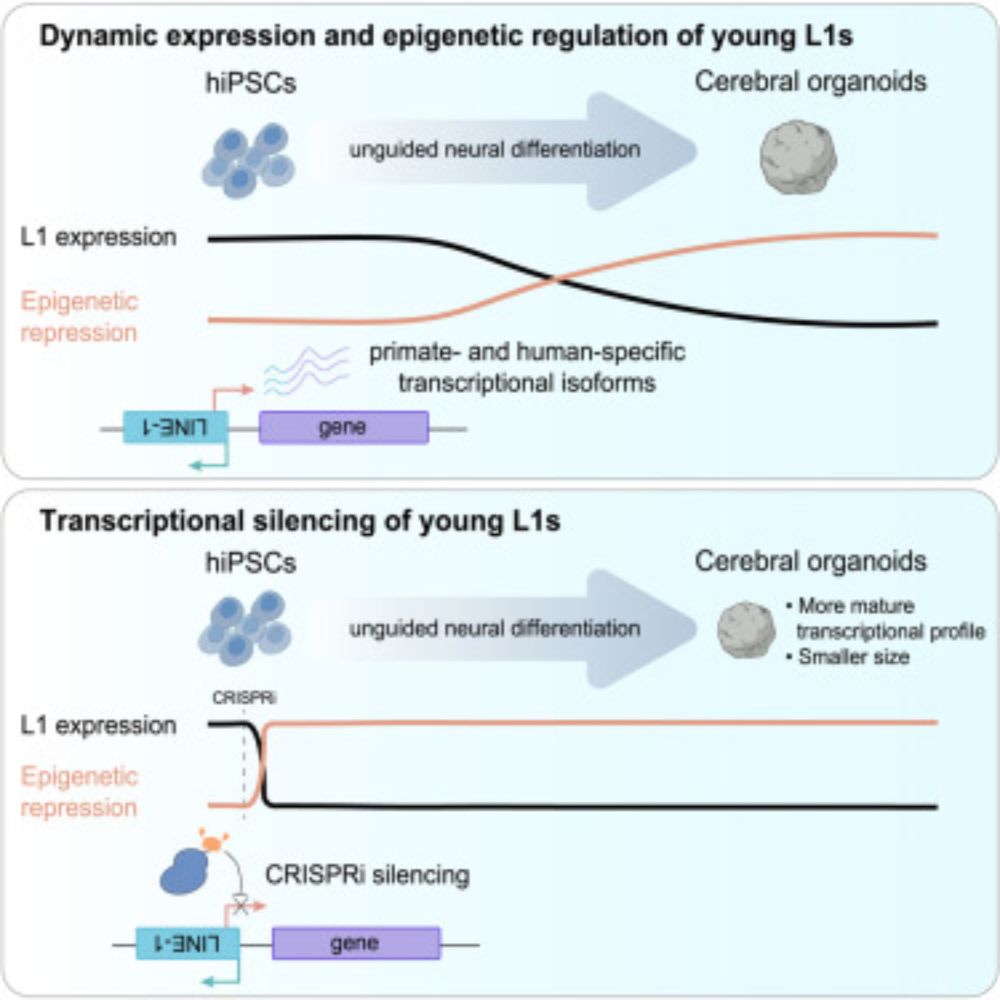
New preprint from the lab! We dig into the regulatory roles of TEs in the mouse placenta, with some surprising findings. Led by the awesome @smamante.bsky.social. Particular kudos to him for navigating the many twists and turns of the project.
02.02.2026 10:25
👍 44
🔁 22
💬 4
📌 1

Project Assistant
The Department of Medical and Translational Biology at the Faculty of Medicine is now seeking a project assistant for a research project related to human brain aging. The position is full-time and lim
📣We are looking for a Project Assistant to join my group at the Wallenberg Center for Molecular Medicine at Umeå University. Join us if you are interested in transposable elements, epigenetics and human brain aging. 🧠🧬 Dont hesitate to reach out with any questions! 📣
umu.varbi.com/en/what:job/...
06.12.2025 20:06
👍 8
🔁 10
💬 0
📌 0

Had an absolute blast presenting my “Last Minute Breakthrough talk” at #EMBOmobilegenome today! 🔥 What an incredible crowd, the energy in the room was unreal. Huge thanks to the organizers for selecting me and to everyone who came, asked questions, and made it such a fun session! 🙌
05.11.2025 18:58
👍 25
🔁 5
💬 1
📌 1
🌟Im happy to share that this winter I'll be starting my lab at the Wallenberg Center for Molecular Medicine at Umeå University! Excited to join the Department of Medical and Translational Biology as a Wallenberg Fellow and looking forward to new collaborations and cool transposon research 🤩 🧬
26.10.2025 16:49
👍 46
🔁 5
💬 5
📌 0

Early career group leaders
We appoint researchers from across biology and biomedicine to set up their first groups at the Crick.
The @crick.ac.uk is recruiting Early Career Group Leaders
- Lab set-up, research costs, salaries for up to 5 researchers
- Support for up to 12 years
- Access to our core facilities
- Competitive salary
- Fantastic colleagues
- All areas of biology
Deadline 27 Nov
www.crick.ac.uk/careers-stud...
10.10.2025 08:20
👍 155
🔁 154
💬 2
📌 3
⚡⚡Excited to announce I'll be starting my lab at the Max Planck Institute of Molecular Genetics (@molgen.mpg.de) in Berlin in December! Leaving sunny California to join a fantastic environment with colleagues who do super cool work.
🔬🦠I'm hiring at all levels! 🔬🦠Check: www.molgen.mpg.de/fueyo-lab
06.10.2025 13:46
👍 86
🔁 26
💬 3
📌 2
Well done!!!
05.09.2025 16:41
👍 0
🔁 0
💬 0
📌 0

DNA methylation influences human centromere positioning and function - Nature Genetics
Genome-wide and targeted perturbation of DNA methylation at centromeres affects CENP-A positioning and centromere structure, resulting in aneuploidy and reduced cell viability.
#1 Centromeres are epigenetic loci defined by CENP-A, positioned in unmethylated DNA flanked by highly methylated regions. Our work, published in @natgenet.nature.com in collaboration with @naltemose.bsky.social investigates the role of DNAme at human centromeres www.nature.com/articles/s41...
04.09.2025 13:10
👍 85
🔁 36
💬 9
📌 1
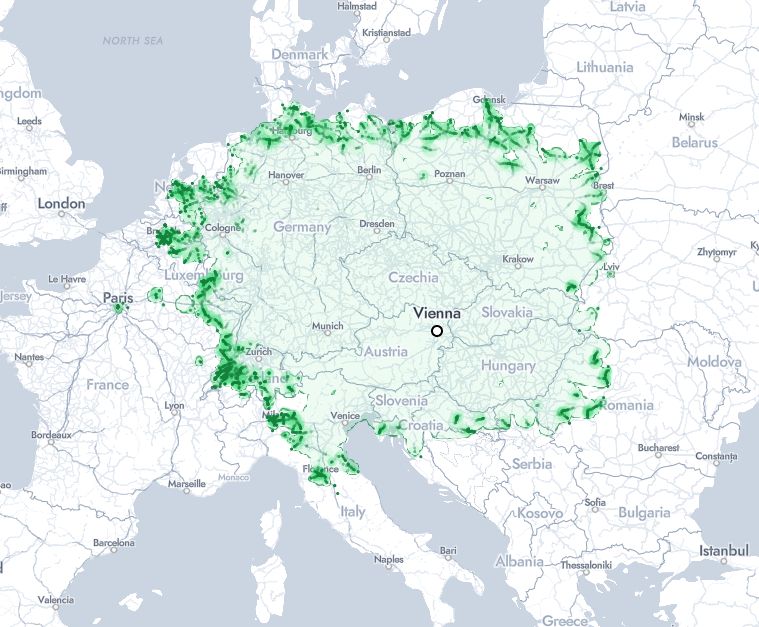
Cities reachable by train from Vienna in under 10 hours
Civilization, visualized
Positively mesmerizing: www.chronotrains.com/en/explore/2...
10.08.2025 15:09
👍 76
🔁 30
💬 5
📌 4
A must read!
16.07.2025 11:43
👍 1
🔁 1
💬 0
📌 0
We are looking for new colleagues to come join us in Galway as group leaders (Junior and Senior). The Centre for Chromosome Biology is a great place and it is a good time to join. Please reach out if you want to chat about the opportunity!
www.nature.com/naturecareer...
16.07.2025 08:56
👍 67
🔁 55
💬 2
📌 2
The work was led by my inspiring PhD student Fereshteh Dorazehi and ably supported by a team of wonderful scientists over many years! Fereshteh and I have presented/will present the story at some recent and upcoming meetings and are happy to hear feedback. For now it's time for summer holidays! 9/9
01.07.2025 12:55
👍 0
🔁 0
💬 0
📌 0
Second, the factor directing human L1 methylation in early development was unknown - a deletion in the ancestral promoter is thought to evade silencing by the KRAB-ZNF/TRIM28 system. We show MORC2 is critical here, at least for those most dangerous elements transcribed in the pluripotent state. 8/X
01.07.2025 12:55
👍 0
🔁 0
💬 1
📌 0
First, MORC2 ATPase mutations cause severe developmental disorders: we explain how ATPase activity is coupled to chromatin binding and CpG methylation patterning of different targets. That many of the hyperrepressed genes encode KRAB-ZNFs, themselves TE silencers, is conceptually fascinating! 7/X
01.07.2025 12:55
👍 0
🔁 0
💬 1
📌 0
Apart from relating human genetic L1 activation to a clear cellular phenotype in development cell models, we are excited about these results for two main reasons...
6/X
01.07.2025 12:55
👍 1
🔁 0
💬 1
📌 0
Genetic loss of L1 silencing due to MORC2 mutation had severe consequences on cellular fitness in a 2D NPC model after pluripotency exit - rescued upon L1 CRISPRi! (shout out to @anitaada.bsky.social @jakobssonlab.bsky.social for the vector - see www.biorxiv.org/content/10.1... ) 5/X
01.07.2025 12:55
👍 0
🔁 0
💬 1
📌 0
Explaining the persistence of these transcriptional phenotypes we found striking loss of CpG methylation over the youngest human- and hominoid specific L1s (including polymorphic alleles), and hypermethylation of gene promoters. 4/X
01.07.2025 12:55
👍 0
🔁 0
💬 1
📌 0
Modelling these effects in pluripotent stem cells, we observed loss of function (transcriptional activation) at L1s and gain of function (transcriptional repression) at promoters, an effect which persisted upon differentiation to neural progenitors. 3/X
01.07.2025 12:55
👍 0
🔁 0
💬 1
📌 0
We engineered mutations to figure out requirements of MORC2 binding to its distinct chromatin targets. Accumulation of MORC2 at L1s and other broad targets requires reversible ATP-dependent dimerization, whereas engagement of gene promoters does not. Mutation misdirects MORC2 onto promoters. 2/X
01.07.2025 12:55
👍 0
🔁 0
💬 1
📌 0
A major KI initiative to recruit new assistant professors with outstanding proposals in all areas of medicine, biomedicine and public health. We offer an amazing research environment, great colleagues and generous startup packages. Check it out and get working on your applications! (repost please!)
25.06.2025 10:08
👍 115
🔁 109
💬 2
📌 3