Thank you!
02.03.2026 18:24
👍 1
🔁 0
💬 0
📌 0
Thank you!
I have not been on here much but my initial impressions caused nostalgia for the old Twitter science community. I did get a bunch of interactions from posting my paper last week on LinkedIn, so that does seem to be working...
Great, and completely accurate, quote 🙂
That could be one interpretation or extrapolation. But I'm not sure. Perhaps it's worth a look!
I don't mind it too much!
Glad you will find it useful! You should also look at the work of Laura van Rosmalen, Joke Meier and the Rhabdomys groups in Manchester - all very interesting!
Most early-stage biomedical research exposes cells to constant conditions. But in real life, hormones, nutrients and metabolic signals rise and fall across the 24-hour cycle. Microfluidics allows us to closely model this, improving our fundamental research, helping make big advances in medicine.
What’s next? Well today I’m spending most of the day in the dark room, setting up a new experiment on a piece of equipment that really changed the direction on our Science study: microfluidics - a technology that allows us to precisely control how a cell’s environment changes over time.

Since I moved to @mrclmb.bsky.social I’ve been trying to answer this: Why are some mammals active at night and others in the day? Today our answer is out @science.org www.science.org/doi/10.1126/....
If you’re interested in circadian biology, evolution or how timing shapes physiology, take a look
Yeah my favourite bit of the journey was a chill breakfast in Perpignan!
I made this journey with the climate in mind - it's important for scientists to attend meetings, but it's also important to do so while minimising impact. Yes this journey was long, and yes it was more expensive than flying. But it's possible, especially within Europe.
Arrived! 7 legs of public transport from home to the conference with not a single problem.
Solid night's sleep! (OK, bar is low with a young family).
Dinner in Paris, breakfast in Perpignan, lunch in Barcelona - travelling by train is great!
So the intercite du nuit is cosy. Bed's comfy enough - I've got the bottom bunk which is at least easy to get into!
A conference in Europe gives the opportunity to not travel by plane
So, I'm travelling to GRC Chronobiology #circadian in Barcelona by train from Cambridge. Smooth ride so far but Eurostar is unexpectedly busy! Next connection - the overnight from Paris to Perpignan. Travelling backpacker style 😀

If anyone is interested, I've updated our take on a cellular basis of the mammalian nocturnal-diurnal switch @biorxivpreprint.bsky.social
We've refined the paper (for the better, hopefully!) - my fave updates are the results from a collab with Zoonomia (Fig 3)
www.biorxiv.org/content/10.1...

#EMBOClimateResilience
“The way in which our universities have divided up the sciences does not reflect the ways in which nature has divided up its problems”
@embo.org
@monicabettencourt.bsky.social
I was today years old when I first heard this gorgeous quote at #EMBOclimateResilience: “The way in which our universities have divided up our sciences does not reflect the way in which nature has divided up its problems” (Kurt Salzinger) - thank you @luciastrader.bsky.social!
Thank you 👍
Thank you, I really appreciate your posts!
My final hour application might have unfortunately been too late to get me a stream link. Teaches me a lesson!
Is anyone (virtually) attending the @embo.org EMBO Workshop on Integrating cell and planetary scales to address climate resilience? Looks fascinating but I think I put my application in too late to get the stream link. So, if anyone wants to fill me in I would love to hear!
#EMBOclimateresiliance
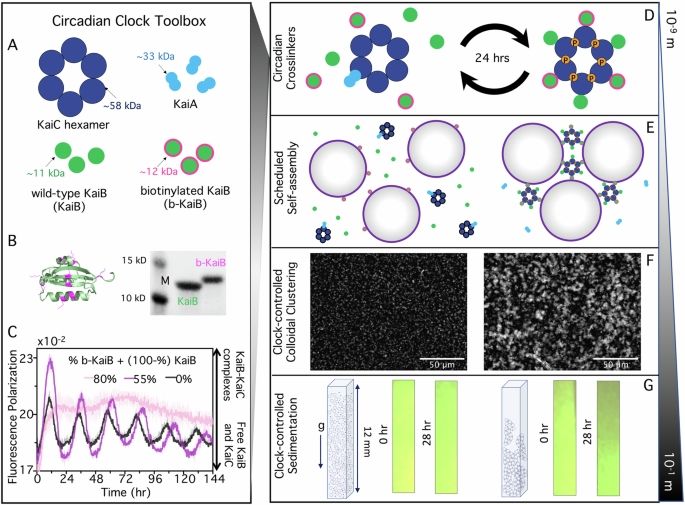
Biology-inspired design has always fascinated me. I am by no means an expert, but I was interested to see this paper in @naturecomms.bsky.social this month - using the autonomous Kai oscillator for time-dependent synthetic assembly: "circadian materials".
www.nature.com/articles/s41...
#1stpost
Thanks for this list! Very helpful to get started on here