Close up of a herring gull, with red around the yellow eye, and a red spot on the lower beak
🚨Not one, but two papers now out on response inhibition (also called motoric self-regulation or inhibitory control in the field of animal cognition). Many studies find no link between individual performance on different tasks supposedly measuring response inhibition.
1/6
12.02.2026 07:41
👍 67
🔁 10
💬 2
📌 0

Recent breeding experience improves egg ejection behaviour
Abstract. Recognizing one’s own eggs is crucial for birds, especially for hosts of brood parasites that must identify and reject different-looking parasiti
Hot off the press 🐣 Do birds have any idea of what their eggs look like? Contrary to our expectations, we show that barn swallows don't, nor do they learn it over time. Yet that doesn't stop them from successfully ejecting foreign eggs!
🔗 Read more here: doi.org/10.1098/rsbl... #OpenAccess
05.02.2026 13:03
👍 20
🔁 11
💬 2
📌 0

Have you ever wondered how animals were using affective states to cope with our activities?
Here's our NEW PAPER (and my first) that tells you everything you need to know and how much should we feel concerned by the consequences of our activities besjournals.onlinelibrary.wiley.com/doi/10.1111/...
21.01.2026 11:15
👍 12
🔁 5
💬 1
📌 0
There is still some time to submit for our Special Collection on social cognition and anthropogenic environments! We are looking forward to hear from you! link.springer.com/collections/... Please do get in touch if you have any questions.
#openaccess #socialcognition
20.01.2026 09:13
👍 8
🔁 10
💬 0
📌 0


New paper out!
Early-life social instability increases aggression in chickens, but does not affect response inhibition 🐤
We discuss what this means for developmental links between social environments, cognition, and social behaviour, highlighting strong context dependence
Full text: rdcu.be/eYOzC
13.01.2026 14:36
👍 37
🔁 12
💬 1
📌 0


✨New paper✨
How do juvenile ravens find social groups?
We describe how juvenile common ravens, who have left their natal territories seeking to join non-breeder flocks, use space with respect to other birds, and discuss what this means for social integration.
www.cell.com/iscience/ful...
11.01.2026 14:34
👍 66
🔁 23
💬 4
📌 0
📢 Our new article entitled “With or without you: common marmoset, Callithrix jacchus, personality expression is mediated by social setting” has just come out *open access* in #AnimalBehaviourJournal! ✨ 🥰🥳🐒 @asab.org
doi.org/10.1016/j.an...
A thread. 😊
01.12.2025 10:46
👍 26
🔁 10
💬 1
📌 2


1/3 Cooperative hunting in ravens
Brown-necked ravens (C. ruficollis) work together to prevent lizards (U. aegyptia) from entering and blocking their burrow by inflating their bodies using their pointed tails to obstruct the entrance.
(paper; 2010) link.springer.com/article/10.1...
07.11.2025 19:56
👍 26
🔁 10
💬 1
📌 0
That's amazing!!! Congratulations 🎉
06.11.2025 07:25
👍 3
🔁 0
💬 0
📌 0
Unsung Songbirds: Advances in the Study of Corvid Communication
"Unsung Songbirds: Advances in the Study of Corvid Communication" - a new review paper (preprint) https://ecoevorxiv.org/repository/view/10600/ Corvids are amazing, so I'm v pleased to be a small part of this review led by Claudia Wascher and Valerie Dufour. #corvids #bioacoustics
24.10.2025 08:38
👍 18
🔁 9
💬 0
📌 2
Social Cognition in a Human World
As humanity exploits and reshapes the environment to accommodate for development and population growth demands, animals need to adapt to these human-induced ...
Excited to announce that Eli Garcia-Pelegrin and I are co-editing a special collection for Animal Cognition on "Social Cognition in a Human World". Do you study how urbanization, pollution, heat stress, fragmentation, ... affects cognition? We want to hear from you! link.springer.com/collections/...
22.10.2025 08:02
👍 17
🔁 14
💬 0
📌 2

Mic’d bats reveal midnight songbird attacks
Sensor data reveal greater noctule bats chasing, catching and chewing on birds during high-altitude, nighttime hunts.
🧪 Incredible research reveals how greater noctule bats seek out, capture, and eat songbirds--all on the wing. (Also, my first story for @sciencenews.bsky.social!) 🦇🪶☠️ www.sciencenews.org/article/bats...
10.10.2025 19:37
👍 12
🔁 4
💬 0
📌 1
Adorable 🤩
20.09.2025 13:40
👍 1
🔁 0
💬 0
📌 0

Visit our website and learn more about the @behavecol.bsky.social conference venue, host city and schedule!
www.isbe2026.com
09.08.2025 07:53
👍 22
🔁 12
💬 0
📌 0

A great tailed grackle, a black slender bird with a long tail, is eating fast food cheese sauce in a parking lot. Photo credit C. Logan
„behavioral flexibility, while helpful in allowing birds to adapt to new environments, is not the primary facilitator for range expansion“
https://news.ucsb.edu/2025/021980/both-flexibility-and-persistence-make-some-birds-successful-human-made-environments
#TheGrackleProject
06.08.2025 17:57
👍 6
🔁 2
💬 0
📌 0
Congratulations for your PhD ☺️🎉
23.07.2025 15:07
👍 1
🔁 0
💬 1
📌 0
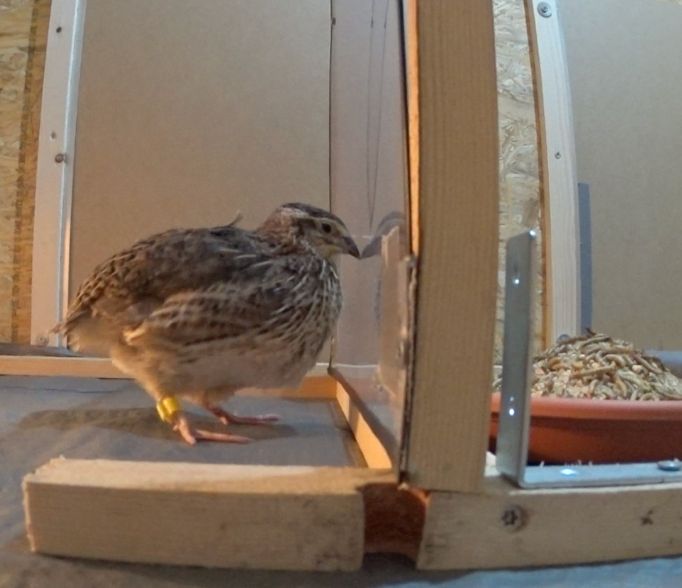
A young quail in front of a transparent barrier, looking towards a massive bowl of grains and mealworms
This study was a team effort so thank you to: @katywillcox.bsky.social Reinoud Allaert @anneleendewulf.bsky.social Wen Zhang @camilletroisi.bsky.social Sophia Knoch, An Martel, Luc Lens, @fredverb.bsky.social @ecobird.bsky.social
23.07.2025 10:33
👍 4
🔁 0
💬 0
📌 0
1) Quails raised in small groups had worse inhibition, but no group difference in aggression. 2) Quails more aggressive towards unfamiliar individuals pecked more at the transparent cylinder. Aggression and inhibition are partly linked, but other factors mediate the influence of social group size.
23.07.2025 10:33
👍 3
🔁 0
💬 1
📌 0
We raised 120 Japanese quails in small groups of 5 or large groups of 15 and evaluated 1) the effect of social group size on response inhibition (inhibitory control, RI) and aggression at a group-level, and 2) whether deficits in inhibition were linked to increased aggression at an individual-level.
23.07.2025 10:33
👍 2
🔁 0
💬 1
📌 0

A beautiful, slender, blue corvid picking up a pine cone to extract the seeds
Big thank you to Nanxi Huang for her help with data collection, Abdelrahman Elzayadi for his help with video scoring, and to Debbie Kelly for her guidance and advice!
Picture by the Bandelier National Monument
#corvids #birdcognition #caching
10.07.2025 10:19
👍 1
🔁 0
💬 0
📌 0
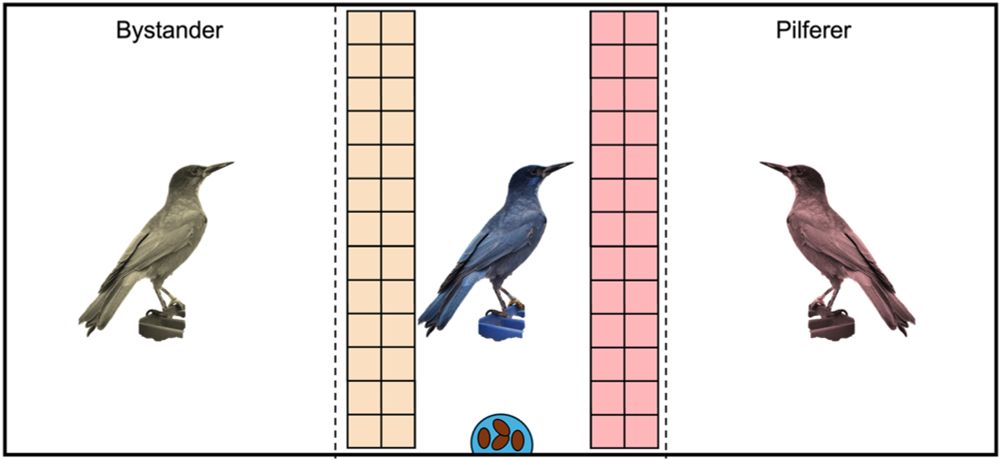
Both species used the trays differently: birds moved their stored seeds around more in the tray given to the thief once the observers were gone, but only when the observers were conspecifics. We then discussed the ability to discriminate between individuals when caching.
10.07.2025 10:19
👍 1
🔁 0
💬 1
📌 0
We gave the choice to highly-social pinyon jays and non-social Clark’s nutcrackers to store food between two trays that either a thief or a non-thieving observer could have access to. Observers could either be conspecifics or heterospecifics, and their roles were consistent throughout the study.
10.07.2025 10:19
👍 0
🔁 0
💬 1
📌 0
Congratulations @meganjthompson.bsky.social
Another great paper!
05.07.2025 05:05
👍 1
🔁 1
💬 0
📌 0

In our new paper we discuss the coevolution of cognition and sociality (link: royalsocietypublishing.org/doi/10.1098/...). It was a pleasure to work on this project with Andoni Sergiou, @josharbon.bsky.social, @inesfuertbauer.bsky.social, @shoalgroup.bsky.social, and @cornishjackdaws.bsky.social!
27.06.2025 14:26
👍 47
🔁 17
💬 1
📌 0