
The 2025 AI Index Report | Stanford HAI
The 2025 AI Index Report[stanford]. The AI Index is recognized globally as one of the most credible and authoritative sources for data and insights on artificial intelligence. #AI #artificialintelligence
hai.stanford.edu/ai-index/202...
29.04.2025 13:56
👍 7
🔁 2
💬 0
📌 0

How the U.S. Public and AI Experts View Artificial Intelligence
These groups are far apart in their enthusiasm and predictions for AI, but both want more personal control and worry about too little regulation.
How U.S. Public and AI Experts View Artificial Intelligence. The public and experts are far apart in their enthusiasm and predictions for AI. But they share similar views in wanting more personal control and worrying regulation will fall short. #AI #regulation
www.pewresearch.org/internet/202...
27.04.2025 09:23
👍 9
🔁 0
💬 0
📌 0
The error slipped through the cracks of peer review and was unknowingly repeated across nearly two dozen published studies.
20.04.2025 19:08
👍 2
🔁 0
💬 0
📌 0
The original phrase was electron microscopy of vegetative structures a well-established method of studying plant tissues like leaves and roots. But due to AI's inability to properly interpret text spanning multiple columns, words were jumbled together into an entirely new and nonsensical term. #AI
20.04.2025 19:08
👍 2
🔁 0
💬 1
📌 0
The bizarre phrase was first flagged on PubPier, an online research forum, by a Russian chemist using the pseudonym Paralabrax Clathratus. However, it was software engineer Alexander Magazinov who traced the error back to a single AI-generated mistranslation from a 1959 scientific paper. #AI
20.04.2025 19:08
👍 0
🔁 0
💬 1
📌 0
The controversy began when scientists noticed a peculiar phrase appearing in multiple published papers: vegetative electron microscopy. On the surface, it seemed like an advanced technical term, but experts quickly realized—it made no sense. #AI #AI-error #AI-translation
20.04.2025 19:08
👍 0
🔁 0
💬 1
📌 0
What began as a simple misinterpretation by AI spiraled into a shocking example of the dangers of unchecked automation in academia. The mistake, buried deep within scientific literature, went unnoticed by peer reviewers. #AI #AI-error #AI-translation
20.04.2025 19:08
👍 1
🔁 0
💬 1
📌 0
So to make the initial claim is a bit problematic for me. But the rest is very interesting. Yes people will conflate AI to human cognition. But I am skeptical that the research community will make this very basic conflation. Nevertheless a interesting paper.
20.04.2025 18:23
👍 1
🔁 0
💬 0
📌 0
maybe we can reasonably claim that, studying AI in its current form in-order to understand human cognition is decreasing in its value. But there are other pathways like comparing the difference between current AI and human intelligence to further our understanding of human cognition.
20.04.2025 18:23
👍 1
🔁 0
💬 1
📌 0
I did read it. I am not claiming to be a perfect expert on your research. but, you are claiming "Al in current practice is deteriorating our theoretical understanding of cognition rather than advancing and enhancing it." that absolutely is not something that can be said in my opinion.
20.04.2025 18:23
👍 1
🔁 0
💬 1
📌 0
I really want to clear this up a bit. When people say AI is going to replace humans they not mean every human in the loop. It means it we reduce the number of humans needed maybe by a factor of 10. Where you needed 10 people now you only need 1. This is actually very much possible.
20.04.2025 15:55
👍 1
🔁 0
💬 1
📌 0
Interesting perspective. But also to keep in mind that it is called artificial intelligence, so it needn't be a mirror of human intelligence. Besides the physical principles our human brain and AI works are completely different, so the cognition that emerge can be different.
20.04.2025 15:51
👍 4
🔁 0
💬 1
📌 0
As AI grows more sophisticated, the next major milestone will be predicting cellular changes before they occur a shift that could propel personalized medicine further into the realm of prevention. “Biology is being transformed into a predictive science.” Rabadán says. #AI #biomedical #medicine
18.04.2025 16:01
👍 1
🔁 0
💬 0
📌 0
Meanwhile, a team led by Columbia biostatistician Zhonghua Liu has built an AI model to identify the key genetic drivers of diseases. In a paper in Cell Genomics, he and his colleagues reported to have used the tool to pinpoint seven genetic mutations that may contribute to Alzheimer’s disease. #AI
18.04.2025 16:01
👍 1
🔁 0
💬 1
📌 0
“Right now, we don’t have any reliable methods of tracking how cells evolve in response to each other over time, but that will be essential for developing better immunotherapies,” says Cameron Young Park, a PhD student in biomedical engineering who is helping to lead the project. #AI #biomedical
18.04.2025 16:01
👍 0
🔁 0
💬 1
📌 0
The researchers say the tool, called DIIsco, could eventually be used both to advance research into the human immune system’s capacity for fighting cancer and to guide treatment strategies for individual patients. #AI #ArtificialIntelligence #biomedical #medicine
18.04.2025 16:01
👍 0
🔁 0
💬 1
📌 0
Computational biologist Elham Azizi and her team, for example, have developed a machine-learning program that describes how immune cells and cancer cells adapt to each other in their struggle for survival. #AI #ArtificialIntelligence #biomedical #medicine
18.04.2025 16:01
👍 1
🔁 0
💬 1
📌 0
Xi Fu, a PhD student in Rabadán’s lab who led the creation of GET and is now working to improve its predictions, says the team’s ultimate goal is to uncover universal principles that govern cellular behavior — something akin to “Newton’s laws of biology.” #AI #biomedical #medicine
18.04.2025 16:01
👍 1
🔁 0
💬 1
📌 0
“It provides a powerful new method for studying the most fundamental questions in epigenetics,” says Rabadán. “Like, how do stem cells transform into specialized cells? How do immune cells know when it’s time to attack? How do healthy cells turn cancerous?” #AI #biomedical #medicine
18.04.2025 16:01
👍 0
🔁 0
💬 1
📌 0
“You can use the model to simulate lots of molecular interactions and identify the most promising possibilities to study with traditional methods,” he says. One potential application is for investigating how cells regulate gene expression. #AI #ArtificialIntelligence #biomedical #medicine
18.04.2025 16:01
👍 0
🔁 0
💬 1
📌 0
Using the new tool, Rabadán says, scientists can dramatically increase the speed and efficiency with which they study molecular networks. Called GET, the open-source model enables scientists to test out large numbers of hypotheses in silico before committing to time-intensive lab experiments. #AI
18.04.2025 16:01
👍 0
🔁 0
💬 1
📌 0
Rabadán’s team recently developed a technology that could help illuminate these processes. The researchers, by training computers to sift data from millions of human cells, created an AI program that can predict how genes, proteins, and other molecules in any given cell are likely to interact. #AI
18.04.2025 16:01
👍 0
🔁 0
💬 1
📌 0
As AI and technologies like genetic and proteomic sequencing continue to advance, biomedical research is entering a new era — one where the body can be viewed as a vast, interconnected system of data waiting to be interpreted. #AI #ArtificialIntelligence #biomedical #medicine
18.04.2025 16:01
👍 0
🔁 0
💬 1
📌 0
A key driver of this shift is the rapid evolution of artificial intelligence, which is allowing scientists to leverage a flood of biological data that has been generated since the early 2000s. #AI #ArtificialIntelligence #biomedical #medicine
18.04.2025 16:01
👍 0
🔁 0
💬 1
📌 0
“To make sense of complexity requires collecting large amounts of data and identifying patterns within it,” says Raúl Rabadán, a Columbia professor of systems biology and director of the department’s program for mathematical genomics. “Biology is increasingly becoming a quantitative field.” #AI
18.04.2025 16:01
👍 0
🔁 0
💬 1
📌 0
Gone are the days when biomedical researchers spent all their time scrutinizing test tubes, culturing microorganisms, and counting cells by hand. Today, they’re as likely to be poring over computer spreadsheets as peering into microscopes. #AI #ArtificialIntelligence #biomedical #medicine
18.04.2025 16:01
👍 0
🔁 0
💬 1
📌 0

How Artificial Intelligence Is Changing Biomedical Research
Columbia researchers are using artificial intelligence to unravel genetic mysteries behind cancer, Alzheimer’s, and more.
How Artificial Intelligence Is Changing Biomedical Research. Columbia researchers are using AI to unravel genetic mysteries behind cancer, Alzheimer’s, and more. [Columbia Magazine] #AI #ArtificialIntelligence #biomedical #medicine
magazine.columbia.edu/article/how-...
18.04.2025 16:01
👍 2
🔁 0
💬 1
📌 0
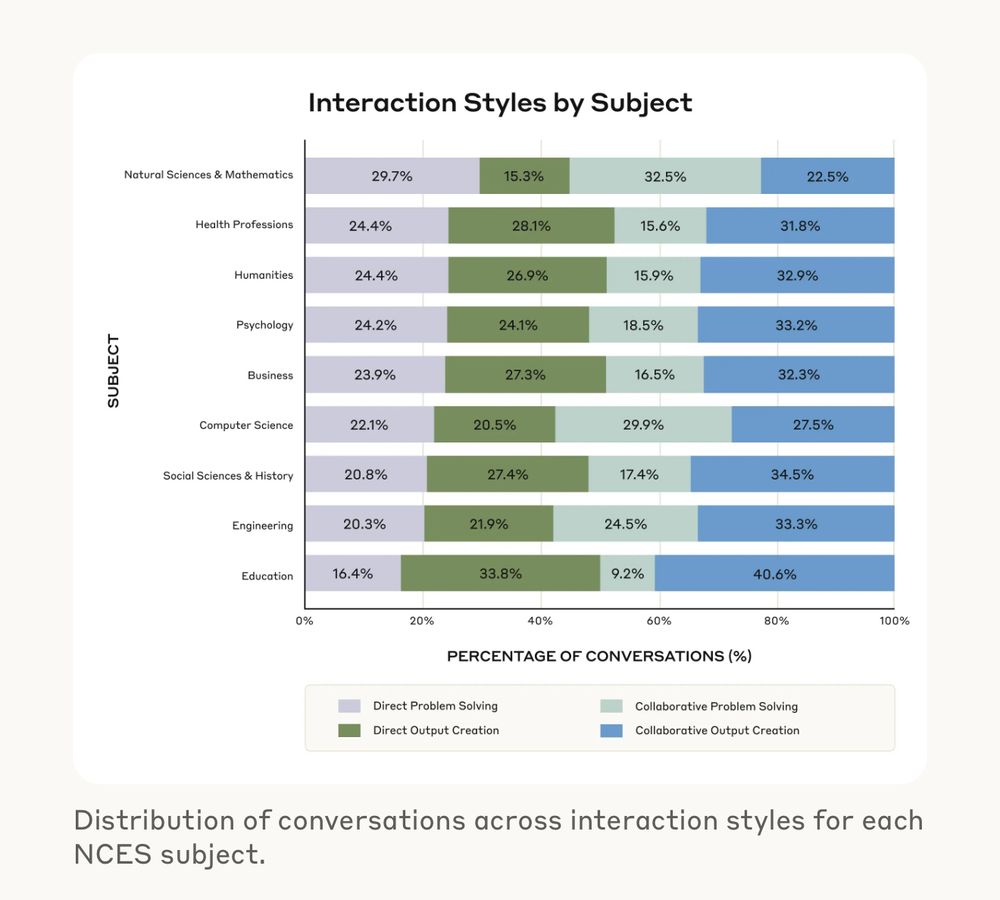
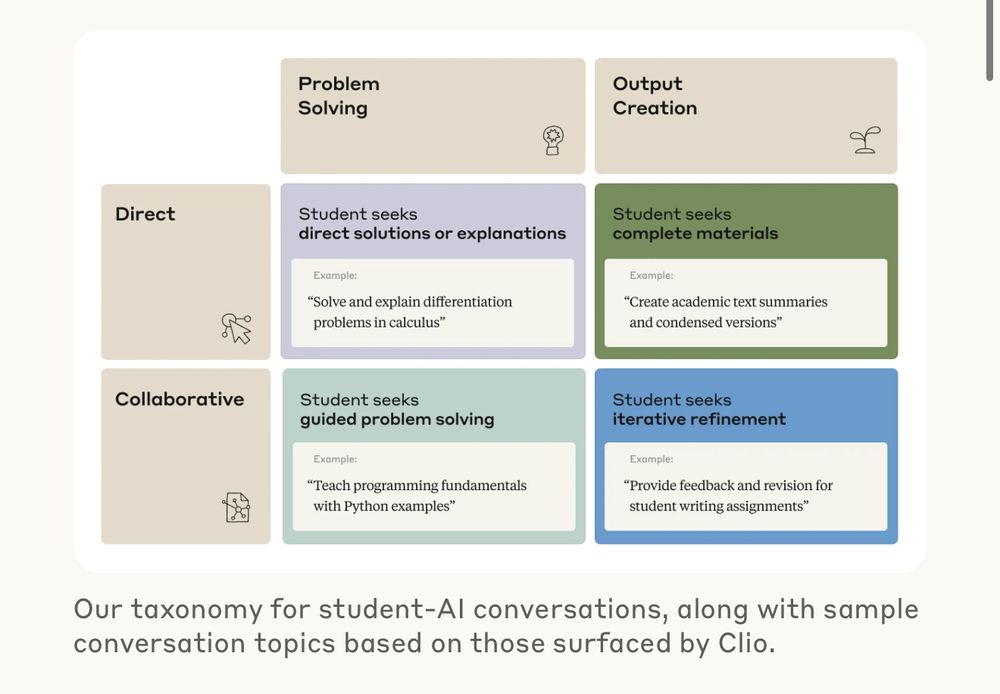
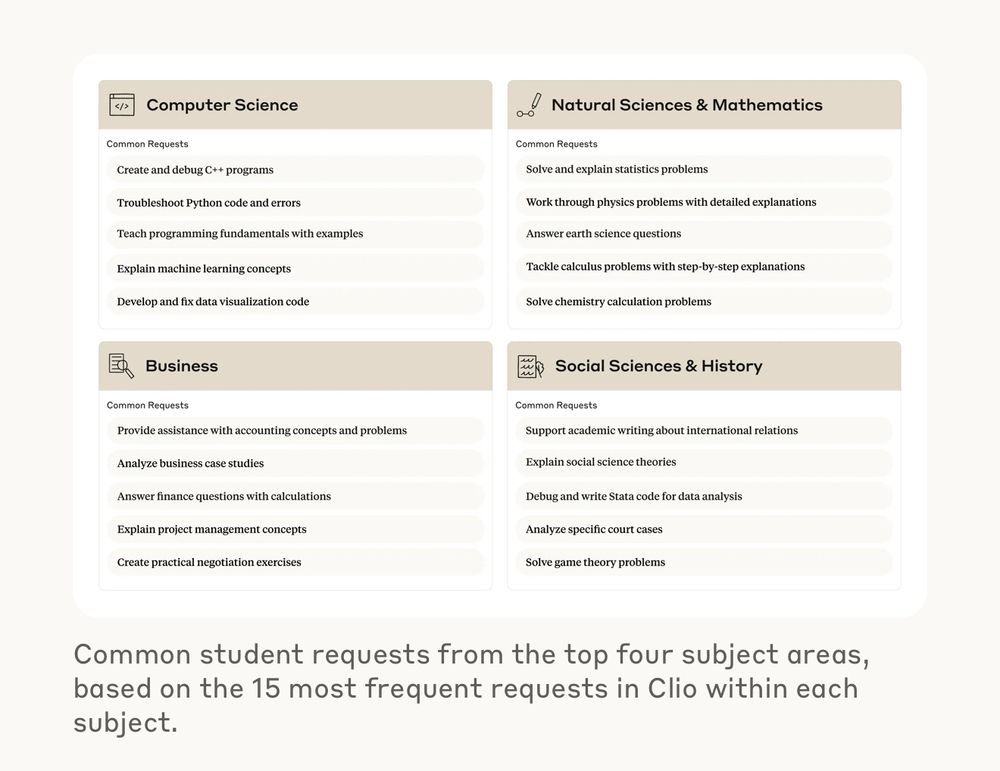
Anthropic continues to put out solid studies of how Claude is used, this time in universities
It shows both AI perils & promise. Students are getting direct answers from Claude, making up a lot use, but there are many cases of AI supporting their learning; too. www.anthropic.com/news/anthrop...
12.04.2025 16:41
👍 82
🔁 19
💬 3
📌 1


