First preprint from the lab! Using intracellular recordings & analysis of 2-photon imaging data, we show that spiking & neuromodulatory input during experience drive a reorganization of visuomotor inputs in V1 layer 2/3 neurons, consistent with enhanced visuomotor cancellation - bioRxiv link below.
05.03.2026 09:06
👍 62
🔁 20
💬 1
📌 2
analogous to the role of a bottom-up sensory input - i.e. L5 input and motor-related predictions influence L2/3 PE with opposite signs.
06.03.2026 14:41
👍 1
🔁 0
💬 1
📌 0
Our data here actually makes no constraints for the BAC firing coincidence detection idea. This might well happen at the level of L5. At the level of L2/3, however, the signs of influence are all just consistent with L5 functioning as a teaching input for L2/3 -
06.03.2026 14:41
👍 1
🔁 0
💬 1
📌 0
So, the combination of these two wrong signs is exactly why we think cortex follows something like a JEPA algorithm, and not PP.
06.03.2026 14:41
👍 0
🔁 0
💬 1
📌 0
The sign of interactions between L5 neurons and L2/3 PE neurons is “wrong” with respect to the non-hierarchical model of PP. At the same time the sign of interactions between PE and L5 is also “wrong” but with respect to the hierarchical model.
06.03.2026 14:41
👍 0
🔁 0
💬 1
📌 0
See, for instance, openreview.net/pdf?id=BZ5a1... for the description of the idea.
06.03.2026 14:28
👍 0
🔁 0
💬 1
📌 0
Hi Chris! Having the learning objective entirely in representation space functions to encourage learning of the representations that are semantically rich and task-structured, while reducing the pressure to focus on irrelevant low-level details (e.g. pixel-level features).
06.03.2026 14:28
👍 1
🔁 0
💬 1
📌 0
We think cortex might function like a JEPA. It looks like prediction errors in layer 2/3 are not computed against input (as is the idea in predictive processing), but against a representation in latent space (i.e. like in a JEPA arxiv.org/abs/2301.08243 or RPL doi.org/10.1101/2025...).
30.01.2026 14:51
👍 36
🔁 10
💬 2
📌 2
Most importantly, this framework is falsifiable – mapping JEPA architectures onto cortical circuits (see also the RPL proposal bsky.app/profile/fzen...) produces experimental predictions that we can test to further constrain the search space for algorithms of cortical function!
30.01.2026 14:37
👍 6
🔁 0
💬 2
📌 0
We think the idea of a JEPA could be an opportune starting point for developing the next iteration of a hypothesis for the algorithm of cortical function. It shows consistency with physiological and anatomical data and addresses many of the PP limitations.
30.01.2026 14:37
👍 4
🔁 0
💬 1
📌 0

This suggested to us that cortex might function similar to a JEPA @yann-lecun.bsky.social, in which deep and superficial cortical layers implement the encoder networks and prediction error is minimized in latent space rather than input space.
30.01.2026 14:37
👍 5
🔁 0
💬 1
📌 0

We investigated this idea further by developing a paradigm of artificial coupling between L5 activity and motor-related predictions in the absence of sensory input. We discovered that a mismatch between L5 activity and motor prediction is indeed sufficient to drive prediction error responses in L2/3
30.01.2026 14:37
👍 3
🔁 0
💬 1
📌 0
However, we discovered that L5 functionally interacts with L2/3 like a bottom-up teaching signal, and we hypothesized that L2/3 might function to model and predict L5 activity rather than raw sensory input.
30.01.2026 14:37
👍 4
🔁 0
💬 1
📌 0

By probing the functional influence between neurons of deep and superficial cortical layers, we were able to test the experimental predictions the two implementation proposals make. Intriguingly, neither proposal could account for the interlaminar interactions that we observed!
30.01.2026 14:37
👍 3
🔁 0
💬 1
📌 0
Most prevalent circuit models of PP postulate laminar segregation between prediction error neurons and internal representation neurons. We set out to experimentally distinguish between two PP proposals that differ in their assumptions on whether the cortex is a hierarchy.
30.01.2026 14:37
👍 3
🔁 0
💬 1
📌 0
You have less than 3 days to apply for the #LakeConference on the Neurobiology of Mental Health in Lake Thun, Switzerland!
📆 May 17-21 in Thun, Switzerland
🏔️ All career stages welcomed
⏳ Apply by January 31
Learn more and apply: https://bit.ly/4pCHrAH
🧠📈
28.01.2026 17:12
👍 5
🔁 1
💬 0
📌 0

1/n: A new collaborative preprint from the lab to start the year: "A multi-ring shifter network computes head direction in zebrafish" together with Siyuan Mei, Martin Stemmler and Andreas Herz from the LMU, Munich.
02.01.2026 17:52
👍 52
🔁 23
💬 1
📌 3

1/6 New preprint 🚀 How does the cortex learn to represent things and how they move without reconstructing sensory stimuli? We developed a circuit-centric recurrent predictive learning (RPL) model based on JEPAs.
🔗 doi.org/10.1101/2025...
Led by @atenagm.bsky.social @mshalvagal.bsky.social
27.11.2025 08:24
👍 141
🔁 42
💬 3
📌 4
Home - Lake Conferences
Join us for the second Neurobiology of Mental Health conference (May 2026) that will explore the biological mechanisms underlying mental health challenges and their treatment. Information and application on: lakeconferences.org. The deadline for applications is January 31st, 2026.
13.10.2025 16:47
👍 9
🔁 6
💬 0
📌 0
I’m super excited to finally put my recent work with @behrenstimb.bsky.social on bioRxiv, where we develop a new mechanistic theory of how PFC structures adaptive behaviour using attractor dynamics in space and time!
www.biorxiv.org/content/10.1...
24.09.2025 09:52
👍 219
🔁 86
💬 9
📌 9
This year's Ruth Chiquet Prize goes to @solygamagda.bsky.social, who sent a video message, for her work on how the brain detects sensory mismatches. Read more at: www.fmi.ch/news-events/...
17.09.2025 08:52
👍 11
🔁 3
💬 0
📌 1
A new preprint from our lab with @zelechowski.bsky.social & @georgkeller.bsky.social !
Using wireless EEG + VR, we recorded visuomotor mismatch responses in freely moving humans.
Huge thanks to all participants, Keller Lab members and FMI facilities!
Read more: www.biorxiv.org/content/10.1...
19.08.2025 13:39
👍 28
🔁 13
💬 0
📌 1
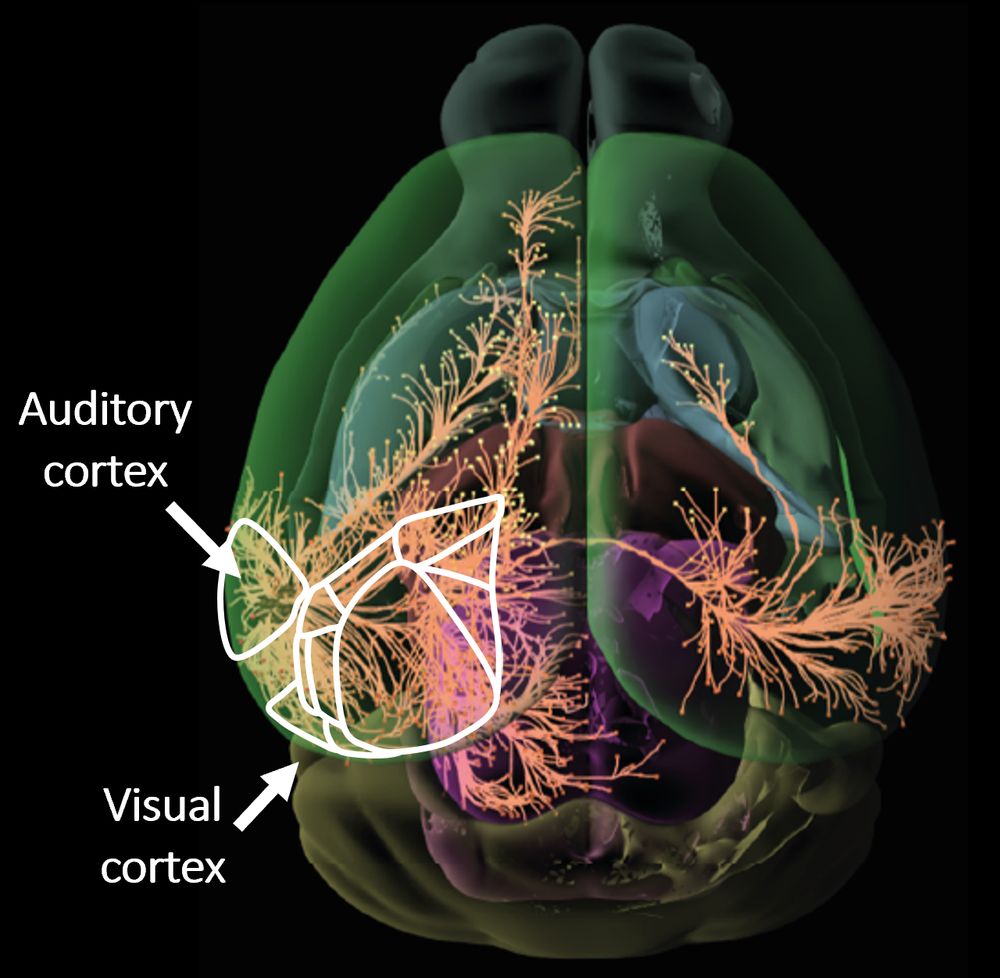
1/N What are the organizational principles underlying crossmodal cortical connections?
We address this in this new preprint, led by @alexegeaweiss.bsky.social & @bturner-bridger.bsky.social in collab w/ @petrznam.bsky.social @crick.ac.uk
www.biorxiv.org/content/10.1...
01.08.2025 10:09
👍 91
🔁 33
💬 1
📌 5

Publishing with eLife: “the future of science lies in greater transparency”
Neuroscientist Magdalena Solyga shares her latest study and her experience publishing with eLife.
Ditching months-long delays for fast, constructive feedback.
This interview with @solygamagda.bsky.social dives into the experience of publishing with eLife and what it could mean for a more open and efficient future in science.
21.07.2025 15:59
👍 15
🔁 9
💬 0
📌 0
100%, but also - the eLife experiment is a good reminer that we need experiments here. Open reviews were not a thing until they were, peer reviews were not a thing until they were, so did preprints, and the ability not to respond to reviewers comments etc. We can try to re-imagine publishing!
20.07.2025 07:45
👍 15
🔁 3
💬 0
📌 0
Let's say you have a journal that isn't worried about protecting an impact factor, so it didn't need to package a million results into a single paper (to maximise citation-to-publication ratio). What would you do? Couple of suggestions below. Others very much appreciated!
05.07.2025 08:37
👍 40
🔁 9
💬 9
📌 1