
NKO shows that most Dutch voters are fine with their second (or third) choices, that’s why everyone decides so late
31.10.2025 18:59
👍 1
🔁 0
💬 1
📌 1
NKO shows that most Dutch voters are fine with their second (or third) choices, that’s why everyone decides so late
Voters would presumably understand this and adjust their vote accordingly? Like in Sweden
Ik ben op zoek naar bevolkingsdata van de kiesdistricten van Amsterdam, Rotterdam, Utrecht, en Den Haag voor 1917. Heeft iemand toegang tot een digitale kopie Parlement en kiezer. Jaarboekje 1(1911-1912) tm 7(1917-1918) door Jungmann en Van Iterson? Eeuwige dank terug!
Congrats!
Many thanks for having me!
Hoe we met zijn allen blijmoedig door de PR hoepels springen, onze eigen ondergang tegemoet. Mijn essay voor de VVOJ is nu online
www.vvoj.org/2024/11/18/v...

I am honored to receive the John Sullivan Award for the best paper by a graduate student on an Elections, Public Opinion, and Voting Behavior (EPOVB)-sponsored panel at APSA's 2023 Annual Meeting in Los Angeles.
Many thanks to all involved!
www.eui.eu/news-hub?id=...
Thanks Jack! My pleasure; I can share 50 free downloads. www.tandfonline.com/eprint/HZIAE... Feel free to reach out
#polsky
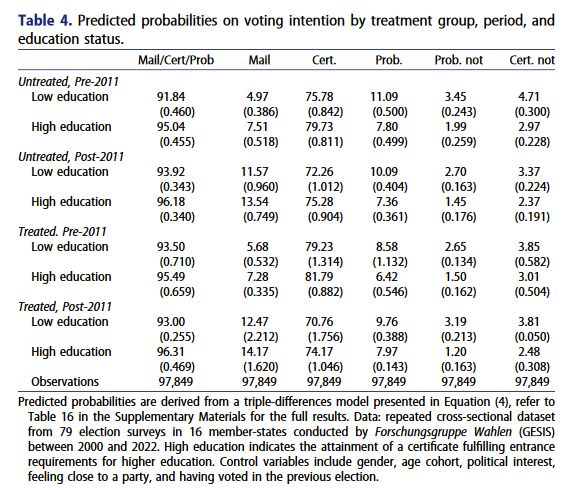
I also find that the reforms increased the participation gap between citizens with higher and lower levels of education. The lower-educated in Bremen and Hamburg were less likely to participate after 2011 compared to before, while lower educated elsewhere were more likely to turn out.
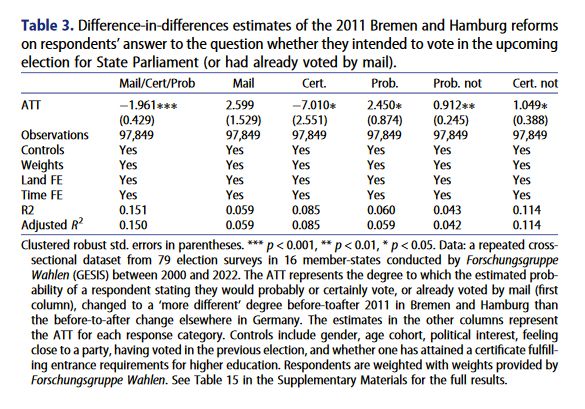
Moreover, I used data from 79 election surveys to compare 97,849 observations. I find a significant and negative disparity between the change in voting intention among respondents from Bremen and Hamburg before and after 2011 and the change observed among respondents from other member-states.
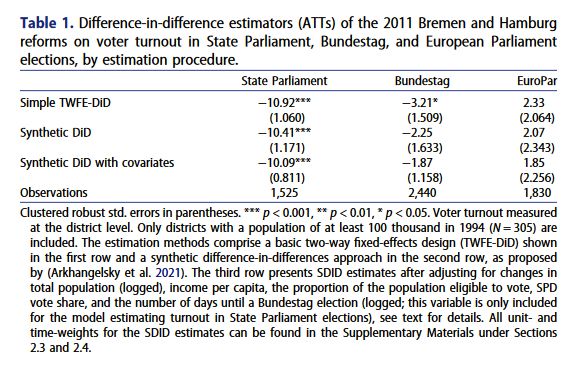
I find no significant before-to-after-reform differences in voter turnout for the unreformed Bundestag and European Parliament elections, ruling out that something other than the reforms is causing Bremen and Hamburg voters to be less inclined to vote.
The results hold after weighting control units and periods and after adjusting for population changes, changes in the share of citizens eligible to vote, changes in the SPD's vote share, and differences in the number of days until a federal election.
Pre-reform voter turnout trends in Bremen and Hamburg were similar to those in 305 comparable, untreated German districts or cities. However, the before-to-after-2011 change in Bremen and Hamburg is at least ten percentage points lower than elsewhere.
Despite extensive information campaigns, turnout reached historical lows below 60% after the system's implementation.
I find evidence for a causal relationship.
But do these changes induce voters to turn out? "Turns out," not in Germany: Bremen and Hamburg changed the system for their State Parliaments in 2011. Before, voters had one vote, to vote for a party. Now, voters have multiple votes to distribute and accumulate over all parties or candidates.
In recent decades, parties have changed how we vote: Increasingly, we vote for candidates, and these votes are also increasingly consequential in helping your favorite candidate pass the minimum number of votes required to win a seat.
I am happy to share that I have a new publication, "The Effect of More Choice on Voter Turnout: Causal Evidence from Germany," appearing today in German Politics: lnkd.in/e7dpNyFn
