Flyer for event

Cover of scientific journal "current biology" showing a man-o-war
Need a break from EVERYTHING??
Come join our free public talk this evening, where NYU professor Dr. Samuel Church will tell us all about his hunt for new blue bottle (man-o-war) species 🪼🧪🌊🦑
7:30 PM (EST)
Zoom link: u-tokyo-ac-jp.zoom.us/j/8337406906...
Meeting ID: 833 7406 9068
Passcode: 430292
27.01.2026 23:30
👍 47
🔁 20
💬 2
📌 1

Workshop on Molecular Evolution | Marine Biological Laboratory
The workshop serves graduate students, postdocs, and established faculty from around the world seeking to apply the principles of molecular evolution to questions of anthropology, conservation genetic...
Applications are now open for the 2026 Workshop on Molecular Evolution (MOLE)!
www.mbl.edu/education/ad...
Claudia Solis-Lemus and I will be holding an informational session on Zoom next Wed (1/21) from 10:30-11:30 AM Central for those interested:
lsu.zoom.us/j/4968115684
Deadline to apply: 1/26
16.01.2026 21:00
👍 22
🔁 20
💬 0
📌 1

Our eLetter github.com/caseywdunn/s... responding to a recent Science paper was just posted. The paper found more genes with consistent support for sponge-sister than ctenophore-sister. We found several technical issues that, when corrected, reverse the conclusions and recover ctenophore-sister.
09.01.2026 11:44
👍 131
🔁 57
💬 5
📌 9

The Church Evolution Lab (CEL@NYU) is hiring a postdoc! We have several new projects to study the genomic basis of biodiversity in model clades – especially Hawaiian Drosophila. apply.interfolio.com/179354
Come join our new group, you can study bugs and live in NYC! Feel free to share widely!
22.12.2025 14:30
👍 20
🔁 13
💬 0
📌 1
It was amazing to be part of this cool natural history project led by @patrickmckenzie.bsky.social, and I’m so happy I can now say I have worked on plants!
14.11.2025 22:22
👍 4
🔁 0
💬 0
📌 0
Our NY area population genetics meeting is back and "upgraded", as Simons Foundation @simonsfoundation.org generously agreed to host. Please save the date: March 9, 2026. Look forward to seeing many of you from NY and beyond.
14.11.2025 17:58
👍 24
🔁 15
💬 1
📌 1
In our last thread, we left the jelly-enjoyers of Bluesky with a cliff hanger ending, in what one eager onlooker described as soap opera science 😜 ... wait no more, we are back! Grab your popcorn shrimp and come with us on a journey spanning more than...
bsky.app/profile/iwan...
10.11.2025 22:13
👍 59
🔁 18
💬 3
📌 8
Apply - Interfolio
{{$ctrl.$state.data.pageTitle}} - Apply - Interfolio
Still a few days left to apply for this Assistant Professor position in our department at NYU: apply.interfolio.com/175592
Please pass the word around, if you know of someone at the interface of ecology, evolution, and disease!
10.11.2025 18:21
👍 2
🔁 3
💬 0
📌 0
C. elegans is a real animal and we set out to understand how it comes to have its distinctive biogeography. Its ancestral center of diversity is in the higher elevation forests of Hawaii. Its closest relatives are spread across east Asia. Did they travel from Asia? [Preprint 🧵]
24.09.2025 20:33
👍 168
🔁 79
💬 5
📌 8
Church Evolution Laboratory
Department of Biology, New York City
The Church Evolution Laboratory (CEL@NYU) will be official as of Sep 1st: shchurch.github.io. We are recruiting at all levels, including a postdoc to work on evolutionary patterns and processes via comparative genomics in Hawaiian Drosophila. Please share widely!
28.08.2025 18:16
👍 27
🔁 12
💬 0
📌 0
Such cool work by @rbabedon.bsky.social! These results came from his awesome senior thesis on Atlantic man-o-war dispersal. He found iNat (@inaturalist.bsky.social) records of young colonies, they look like tiny living bubbles before they grow into the sailing giants we sometimes see further North
19.08.2025 18:06
👍 21
🔁 1
💬 0
📌 0
A big blow to All of Science, not just Harvard, not just the Fly community, not just Genetics. All of Science. Turbocharge was just switched off. Flies gave us so many insights.
11.08.2025 19:07
👍 52
🔁 19
💬 0
📌 0

Marine biodiversity: Gone with the wind? Our dispatch out now in @currentbiology.bsky.social
New research shows that wind and currents act as invisible barriers, reshaping our view of ocean connectivity. 🌊🪼
authors.elsevier.com/a/1lYLj3QW8S...
@iramaegele.bsky.social @msarscentre.bsky.social
04.08.2025 16:38
👍 27
🔁 11
💬 1
📌 2
Thanks, you as well!
23.06.2025 11:04
👍 1
🔁 0
💬 0
📌 0
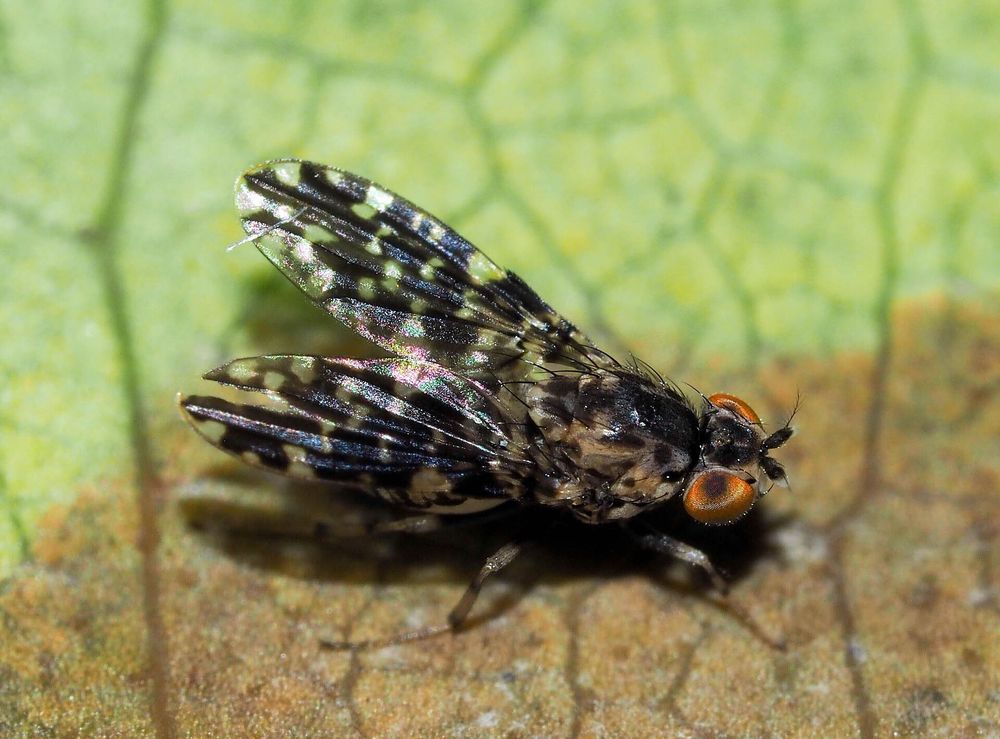
Drosophila picticornis, a Hawaiian fly with patterned wings
Wish I could be at #Evol2025 this year! I’ll be starting a new lab at NYU this fall, and will be recruiting at all levels. Please spread the word if you know anyone who wants to work on evo. genomics, phylogenies, and comparative development of inverts (like Hawaiian Drosophila!) shchurch.github.io
21.06.2025 21:02
👍 38
🔁 17
💬 7
📌 0
Wow thanks Jenn! It could not have happened without you, we were very lucky you joined the Physalia team 🪼
19.06.2025 20:32
👍 1
🔁 0
💬 0
📌 0
@jenncoughlan.bsky.social @alexdemendoza.bsky.social @obog.bsky.social @planktomancer.bsky.social @zrlewis.bsky.social
19.06.2025 19:54
👍 2
🔁 1
💬 0
📌 0
Many people were essential, I can only tag a handful here! @caseywdunn.bsky.social @stevehaddock.bsky.social @colinjanthony.bsky.social @rebeccarhelm.bsky.social @catmunro.bsky.social @amandine-oceano.bsky.social @scientifikita.bsky.social @guillermodelia.bsky.social & Yale Peabody Museum
19.06.2025 19:51
👍 4
🔁 1
💬 1
📌 0
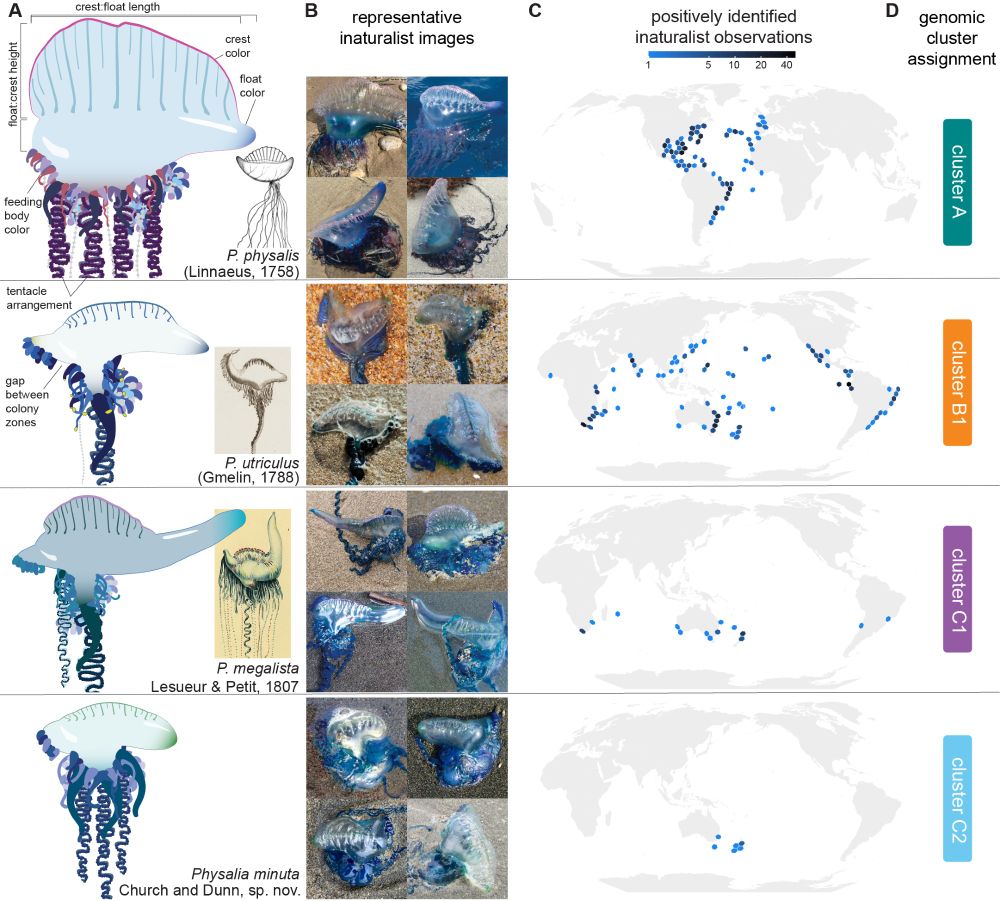
illustrations of four species of Physalia alongside original drawings and iNaturalist images. Maps of positively identified iNaturalist records show the distribution of each species.
My favorite outcome was validating species descriptions from 18th century scientists who illustrated animals on their voyages. Their descriptions were often rejected as implausible – we found that in many cases they were exactly right. Yet another reason why @biodivlibrary.bsky.social is so valuable
19.06.2025 19:51
👍 49
🔁 9
💬 3
📌 0

Portuguese Man o' War (Physalia physalis)
Portuguese Man o' War from Hamilton Parish, Bermuda on April 29, 2022 at 12:59 PM by Miguel A Mejias, PhD.. Native species to the island. Blown in with strong NW winds.
We combined sequencing data with thousands of participatory science images via @inaturalist.bsky.social, to connect genomic clusters to distinct morphologies. Credit to awesome undergraduates River Abedon and Diego Ramirez on this part! www.inaturalist.org/observations...
19.06.2025 19:51
👍 11
🔁 1
💬 1
📌 0
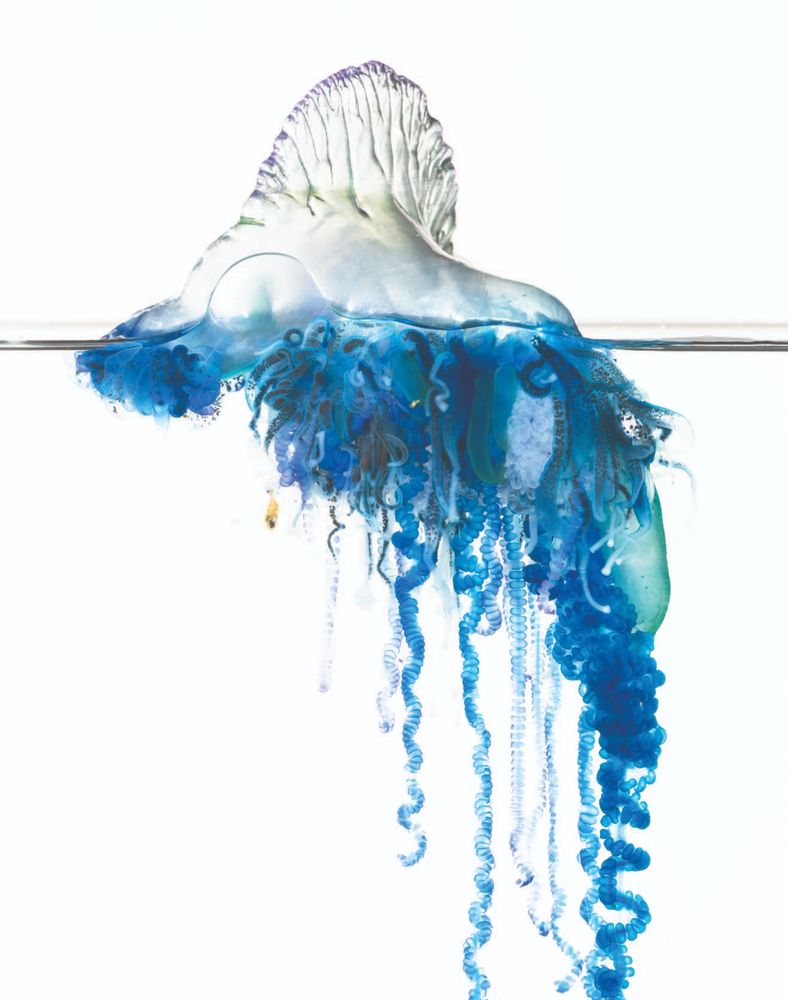
Physalia megalista, a cnidiran with a gas filled float, raised sail, and long blue tentacles hanging below. Image credit: Dalila Destanović
Excited to share our study on sailing siphonophores, AKA bluebottles or man-o'-war! 🌊 we received hundreds of samples from scientists around the world, part of a huge effort to sequence genomes and test for multiple species 🧬 out today in @currentbiology.bsky.social doi.org/10.1016/j.cu... 🦑🧪📌
19.06.2025 19:51
👍 171
🔁 48
💬 2
📌 6
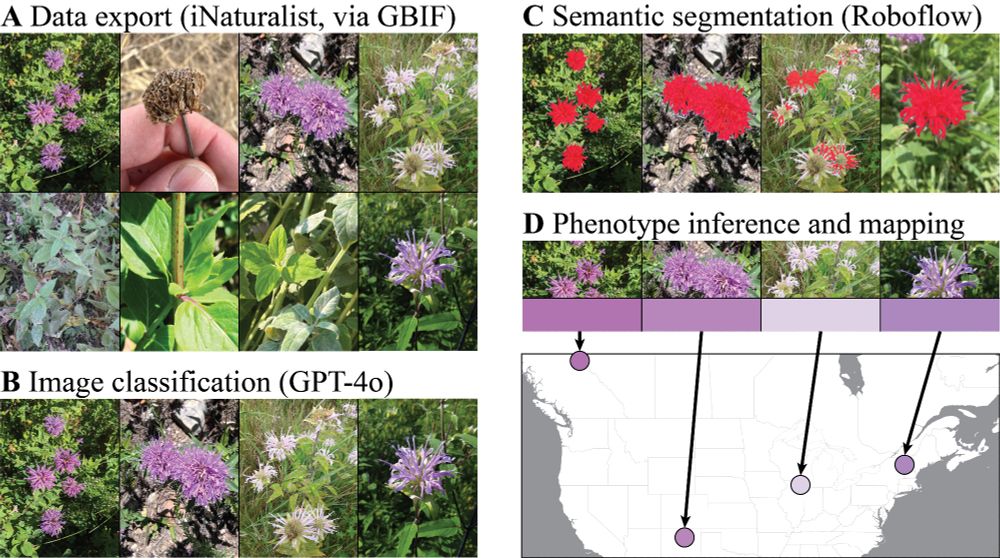
Figure 1: Steps with representative photographs of the flower color phenotyping pipeline. A) We exported all research-grade iNaturalist observations of Monarda fistulosa from GBIF. B) We used GPT-4o to classify each image as to whether it contained a flower. C) We trained a Roboflow semantic segmentation model on a subset of images and applied the trained model to extract “flower” pixels from each image in the dataset. D) We calculated the geometric median of each set of extracted pixels to represent the flower color phenotype from each image, and we paired this phenotype with the observation’s iNaturalist metadata for spatial analysis.
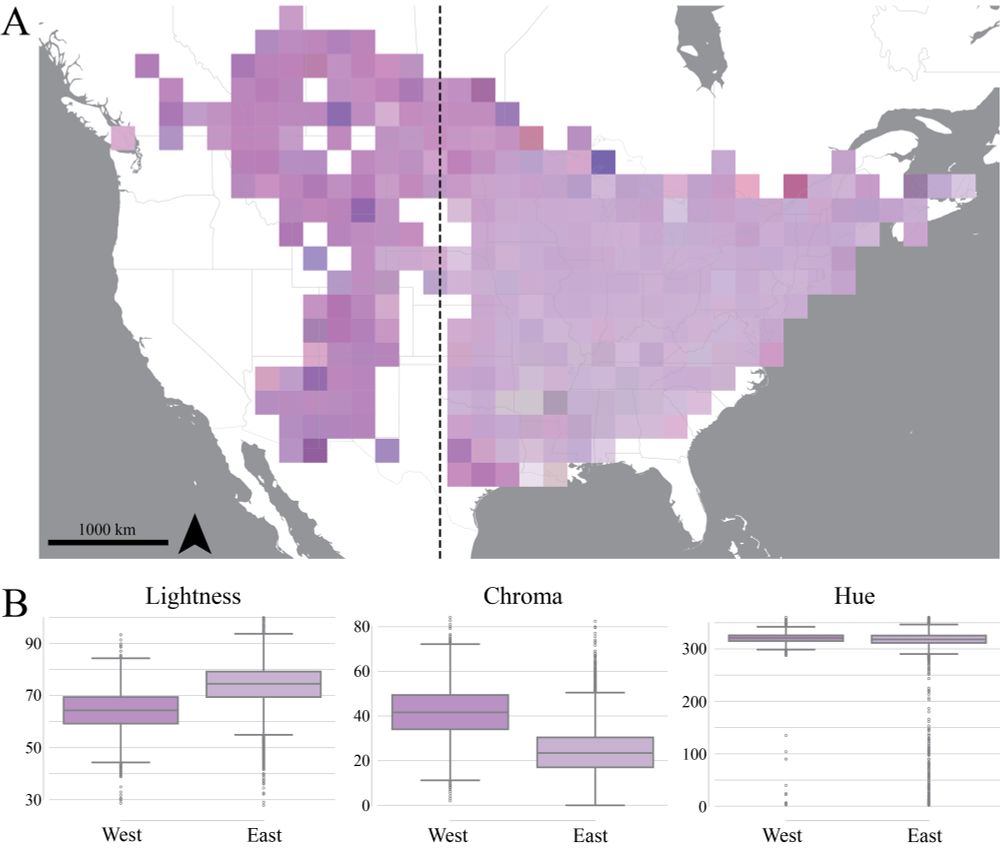
Figure 2: Spatial summary of Monarda fistulosa flower colors across North America. A) Map of the color of M. fistulosa flowers. Each square is a 200km x 200km cell with the color corresponding to the average median CIELAB color value of each observation in the cell. The dotted line denotes -100° longitude, separating eastern and western regions of the range. B) Boxplots summarizing LCh color components west and east of -100° longitude, with each box showing the median and interquartile range, and with the color of each box reflecting the geometric median CIELAB value from west and east, respectively.
New preprint out today! A really fun collaboration with @shchurch.bsky.social and Robin Hopkins in which we study flower color variation in Monarda fistulosa using iNaturalist data. We process >40,000 images and use them to phenotype flower color in >16,000 observations: doi.org/10.1101/2025...
27.05.2025 20:23
👍 22
🔁 8
💬 1
📌 1