Registration and abstract submission for the ECBB in Cambridge are open - yay, don't miss it! 🦩🤩
08.03.2026 20:57
👍 2
🔁 2
💬 0
📌 0

@dudumizi
Interested in animal behaviour, biodiversity, ecology, evolution, conservation and physiology; studying sex roles and evolutionary ecology of coucals and conservation of grassland birds such as whinchats; based at the Max Planck Institute in Seewiesen
Registration and abstract submission for the ECBB in Cambridge are open - yay, don't miss it! 🦩🤩
Visuelle Signale verändern die Reaktion von Libellenlarven auf Gefahr 👀❗
Tóth et al. zeigen, dass Libellenlarven ihre Aktivität reduzieren, wenn sie chemische Alarmstoffe verletzter Artgenossen wahrnehmen. Können sie jedoch andere Larven sehen, verändert sich diese Reaktion!

🧪ETHOLOGY: Visual cues change how dragonfly larvae react to danger 🐉🪰👀❗
Tóth et al. show that dragonfly larvae reduce activity when detecting chemical alarm cues from injured conspecifics—but this response changes when they can see nearby larvae. Read here, it's #OpenAccess: doi.org/10.1111/eth....

And the defense @oulu.fi with very thorough but cordial opponent Terje Lislevand (right) was a special experience! Supervisor @koivulakari.bsky.social looks ecstatic (🇫🇮❄️).
Congratulations 🥂, Dr. Hanna Algora! Thesis on nesting ecology featuring Finnish #waders, ruffs and dunlins, defended convincingly today. Another fledgling 🪺🐦🐣 from @oulu.fi and @mpiforbi.bsky.social


Great job Maja Peng and Ludmila Kerhartová presenting our work on 🐭 vocal recognition 🎶 at the “Ethology 2026” conference in Grünau 👏. We also listened to Rosemary and Peter Grant giving amazing talks 🐦⬛. What an inspiration! @klivvvienna.bsky.social


There were also 3 awsome and very inspiring plenaries at this year's meeting of the @ethoges.bsky.social: Thomas Bugnyar (sadly I took no picture), Rosemary Grant and Lars Chittka 🐦🐝

Spinnenpheromone im Freiland erfassen 🕷️🌿
Dössel et al. stellen eine einfache Methode zur Sammlung von Sexpheromonen im Feld vor. Am Beispiel einer Wespenspinne schließt der Ansatz die Lücke zwischen Laborergebnissen und natürlichen Signalbedingungen.
#Pheromone #Methoden #Feldforschung
🧪 ETHOLOGY: How to sample spider pheromones in the wild 🕷️🌿
Dössel et al. present a simple field method to collect sex pheromones in spiders. Applied to a wasp spider, the approach can help bridge the gap between lab findings and natural signalling conditions. #OpenAccess doi.org/10.1111/eth....
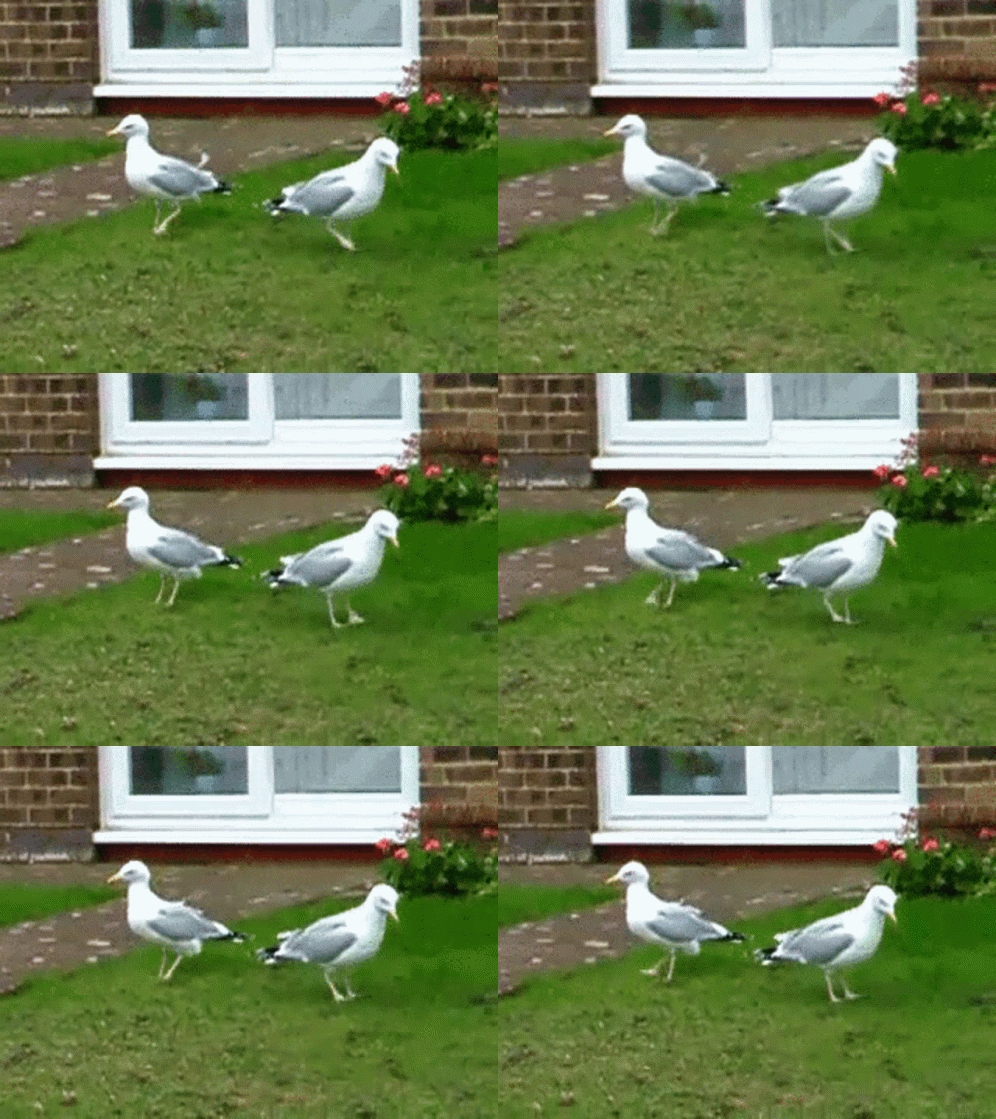
While an amazing Annual meeting of the Ehtological Society has just passed, we are hoping to see many of you in beautiful Konstanz next year! Save the date: 24.–26. Februar 2027

Wissen Giftschlangen, wenn ihr Vorrat zur Neige geht? 🐍🧪
Kodama et al. untersuchten, ob die Rotschneckennatter ihre eigenen Toxinreserven erkennt. Nach Entleerung der Nackendrüsen zeigte sich keine Veränderung im Abwehrverhalten – offenbar überwachen die Schlangen ihren „Waffenvorrat“ nicht direkt.
🧪 ETHOLOGY: Do toxic snakes know when they’re running low? 🐍🧪
Kodama et al. tested whether the red-necked keelback detects its own toxin reserves. After experimental depletion of toxins, defensive behavior didn’t change—suggesting they may not directly monitor their arsenal. doi.org/10.1111/eth....


We got to see the famous geese at the Konrad Lorenz Forschungsstelle in Grünau during the meeting of the @ethoges.bsky.social
Schadstoffe wirken nicht auf allen Arten gleichermaßen 🐟🌊
Ozeki et al. untersuchten, ob das Verhütungsöstrogen EE2 auch Kühnheit und Angst eines Meeresfisches beeinflusst. Nach 14-tägiger Exposition blieb das Verhalten unverändert – ein Hinweis auf artspezifische Reaktionen auf Umweltbelastungen.

🧪 ETHOLOGY: Pollutants don't change behavior equally across species 🐟🌊
Ozeki et al. tested whether the contraceptive estrogen EE2 also affects boldness and anxiety in a marine fish. After 14 day-exposure, behavior remained unchanged—highlighting species-specific responses. doi.org/10.1111/eth....

Annual Meeting of the Ethologische Gesellschaft 2026
Keynote: Rosemary Grant
In her keynote speech, Rosemary Grant discusses the role of #behavior in the #evolution of Darwin’s finches.
📍 Grünau | 📅 Feb 18–21, 2026
Four days of science and exchange—where ethology made history.
@ethoges.bsky.social

🧪 ETHOLOGY: When looking alike doesn’t lead to love 💙🌈🪰
Even though blue coloration may honestly signal individual quality in damselflies, Melillo et al. show that mates don’t assort by color. Even as time for reproduction runs out, similar colors don’t attract. #OpenAccess: doi.org/10.1111/eth....

A photo I took in Monterey Bay was on the cover of @behavecol.bsky.social in late 2025! Killer whales are 1 of many case studies explored in our paper "Integrating space, time, and culture in animal conservation practice". tinyurl.com/2pnx2k36 Excited about more ongoing culture + ecology work...

Common Tern Museum at the Bantersee

Common Tern Museum at the Bantersee

View of the ice-bound Waddensee

Profs Miriam Liedvogel & Prof Sandra Bouwhuis - brilliant leaders of the Institute of Avian Research (with some old German ornithological leaders in the background)
A richly rewarding two days reviewing @ifv-whv.bsky.social: thriving under the brilliant leadership of Sandra Bouwhuis & Miriam Liedvogel. An exciting programme of research into avian migration & life histories with many future stars. Outstanding @commonternproject.bsky.social museum by frozen sea!

The Globalization of Canadian Rage www.nytimes.com/2026/02/06/o... 🎁 link

Scientific Paper: royalsocietypublishing.org/rspb/article...
Study by: @lguadal.bsky.social & @dudumizi.bsky.social & @chorlnev.bsky.social
Art by @somedonkey.bsky.social

Who benefits from mating with multiple partners? Darwin suspected that in some cases, it may be the females rather than the males. A new long-term study on African coucals shows: when males provide all parental care, females can have more offspring by competing for and mating with multiple partners.

black coucal perching in vegetation
and this is how sex-role reversed black coucals actually look like...
doi.org/10.1098/rspb...

Our new paper on Bateman gradients in black coucals and white-browed coucals is out. Females of both species outperform males in mating and reproductive success - confirming the generality of Bateman's principle when sex roles differ.
Check it out: royalsocietypublishing.org/rspb/article...

New issue of ETHOLOGY - check it out! onlinelibrary.wiley.com/doi/10.1111/...
Elefantenbabys knüpfen früh soziale Bindungen! 🐘💞
Revathe & Vidya zeigen, dass asiatische Elefantenkälber bereits früh differenzierte Beziehungen aufbauen: Sie interagieren eng mit Mutter und „Begleitkühen“, die allomaternale Fürsorge leisten, meiden jedoch meist andere Weibchen. #Sozialverhalten

🧪 ETHOLOGY: Baby elephants build social bonds early! 🐘💞
Revathe & Vidya show that Asian elephant calves form differentiated relationships early on: they interact closely with mothers and “escorts” who provide allomaternal care, while largely avoiding other females. Read: doi.org/10.1111/eth....

Diese Rede des Kanadischen Premierminister Carney ist groß. Das ist keine Deeskalation. Es ist eine Kampfansage für Menschenrechte (u Ökologie) an Trump, u er erhält Standing Ovation in Davos (hoffentlich steigen die Europäer darauf ein)
www.youtube.com/live/Pg4rNz8...

@dingemanselab.bsky.social
Recently out in #animalbehaviour: Yuval Zukerman investigated Interindividual variation in tolerance behavior of #NubianIbex inhabiting human settlements and found that the way humans behave shapes the behavior of the ibex, leading to separate social cliques.
www.sciencedirect.com/science/arti...
Erkennen Krabben Individuen wieder? 🦀👀
Robinson liefert Hinweise darauf, dass Geisterkrabben vertraute Artgenossen von unbekannten unterscheiden können. In einem 3-Kammer-Test verbrachten sie mehr Zeit bei bekannten Individuen–ein Zeichen für individuelle Wiedererkennung über visuelle Hinweise!