I’ll discuss our recent papers:
An Earth-System-Oriented View of the S2S Predictability of Weather Regimes (AIES)
doi.org/10.1175/AIES...
Observed and Modeled Amplification of the Frequency, Duration, and Extreme Heat Impacts of the Pacific Trough Regime (Earth's Future)
doi.org/10.1029/2025...
26.01.2026 18:51
👍 0
🔁 0
💬 0
📌 0
And to my talk on S2S predictability and long-term changes of the Pacific Trough weather regime:
- 13B.6 Predictability and Long-Term Changes of the Pacific Trough Regime and Associated Extreme Heat Impacts
(Thursday, 9:45–10:00 am)
ams.confex.com/ams/106ANNUA...
Excited to see you there!
26.01.2026 18:51
👍 0
🔁 0
💬 1
📌 0
#AMS2026 If you’re in Houston this week, I’d like to invite you to attend a session I’m co-chairing with my advisor, Maria Molina:
- 9B Artificial Intelligence for Actionable Insights and Applications in Climate Science
(Wednesday, 8:30–10:00 am)
ams.confex.com/ams/106ANNUA...
26.01.2026 18:51
👍 0
🔁 0
💬 1
📌 0

Screenshot of part of our paper "Increasing Frequency and Persistence of the Summertime Greenland High Regime Not Captured by a Seasonal Prediction Model Very Large Ensemble" in GRL
📣 New paper with Lorenzo Polvani published in @agu.org GRL!
Increasing Frequency and Persistence of the Summertime Greenland High Regime Not Captured by a Seasonal Prediction Model Very Large Ensemble
Open access: doi.org/10.1029/2025...
@earthscista.bsky.social @lamont.columbia.edu
10.01.2026 11:47
👍 21
🔁 7
💬 2
📌 0

Composite-mean normalised 500 hPa geopotential height anomalies for the four North American weather regimes: Pacific Trough, Pacific Ridge, Greenland High and Alaskan Ridge. The remaining 14% of days are classified as No Regime.
Updated time series of daily year-round North American weather regimes for 1 Jan 1979 to 31 Dec 2025 just published on Zenodo: doi.org/10.5281/zeno...
I plan to keep this dataset updated annually. Happy regime-ing!
07.01.2026 16:34
👍 23
🔁 8
💬 3
📌 0
Some festive vortices to spin you into the new year!
visualpde.com/fluids/vorti...
25.12.2025 22:26
👍 8
🔁 3
💬 0
📌 0
I came to the US over 10 years ago for a postdoc at NCAR. It changed my life and supercharged my ability to do science. NCAR's unique community nature makes it a global node in atmospheric and climate research. It's really not possible to overstate its value for science and society.
17.12.2025 13:55
👍 131
🔁 30
💬 0
📌 3


Hudson Bay is finally starting to freeze over in earnest.
2025 will likely go down as the 2nd-longest ice-free period for the Western Hudson Bay polar bear population, continuing the long-term trend (now >1 month longer than in the 1980s).
02.12.2025 17:03
👍 5
🔁 2
💬 0
📌 0
The goal of the course is to discuss key strategies and pitfalls in scientific ML applications. We will cover topics like data preprocessing, imbalanced datasets, choosing the appropriate ML architecture, uncertainty quantification, explainability and interpretability, and recent generative AI.
17.11.2025 17:44
👍 1
🔁 0
💬 0
📌 0

The WCRP Earth System Modelling and Observations (ESMO) Working Group on Subseasonal to Interdecadal Predictions (WGSIP) is launching a new webinar series in late 2025.
29 October 2025, 22:00 UTC — Theme: Predictability limits
More info: https://loom.ly/F-Vfj6o
#WCRP #ESMO #WGSIP
23.10.2025 05:30
👍 1
🔁 1
💬 0
📌 0

Diffenbaugh, N. S. (2025) Committed acceleration of climate stresses in the coming decades. Environmental Research: Climate, in press. doi.org/10.1088/2752...
21.10.2025 15:42
👍 19
🔁 10
💬 1
📌 0
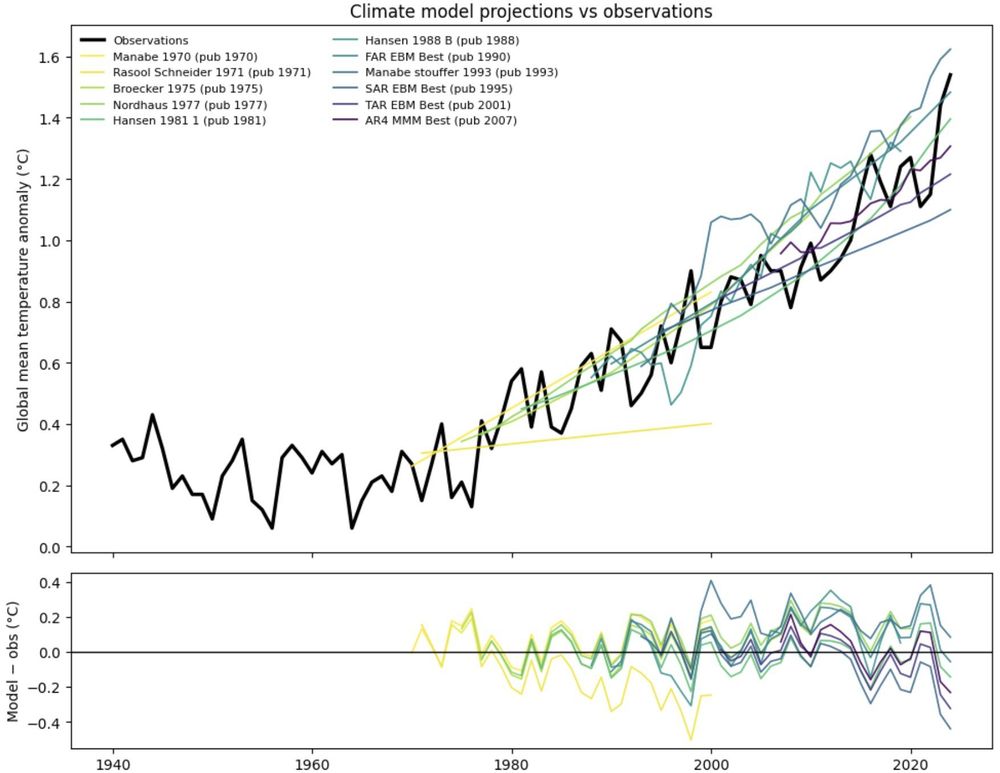
Its worth noting that when the first modern climate models were published in 1970 it was hardly clear that there was a warming trend; if anything there had been flat or slightly cooling global temperatures for the past three decades:
23.09.2025 17:07
👍 77
🔁 11
💬 2
📌 1

In a UN speech today, President Trump said that "all of these [climate] predictions were wrong".
Back in 2019 I led a research effort to digitize old climate model projections and assess how well they did. Turns out they got future warming pretty spot on!
23.09.2025 17:01
👍 772
🔁 371
💬 17
📌 17
🚨 Recruiting Two PhD/MS Students 🚨
I am looking to bring on at least two GRAs (M.S. or Ph.D. Level) beginning Spring or Fall 2026 to join our CHAOS research group. Research projects will be related to artificial intelligence and machine learning applications for extreme temperatures and rainfall
08.09.2025 16:21
👍 21
🔁 20
💬 1
📌 1
Thanks, Prasad!!
20.08.2025 04:06
👍 1
🔁 0
💬 0
📌 0
Thanks!!
19.08.2025 23:43
👍 1
🔁 0
💬 0
📌 0
Our paper aims to provide an ML-based view of mid-latitude S2S predictability that could help open new scientific pathways and increase our ability to handle weather-related risks.
Check it out here! doi.org/10.1175/AIES...
19.08.2025 21:13
👍 4
🔁 1
💬 1
📌 0
Leveraging ML, we show how predictability sources vary across seasons and regimes. Data-driven models confirmed previously found sources of predictability (like ENSO and MJO) but also highlighted new opportunities for improved predictions, like stratosphere-troposphere and land surface interactions.
19.08.2025 21:13
👍 2
🔁 0
💬 1
📌 0
🚨I’m excited to share that the final version of my first PhD paper is already published! With my amazing advisor, Maria Molina, we characterized the predictability of North American weather regimes.
19.08.2025 21:13
👍 7
🔁 1
💬 2
📌 0
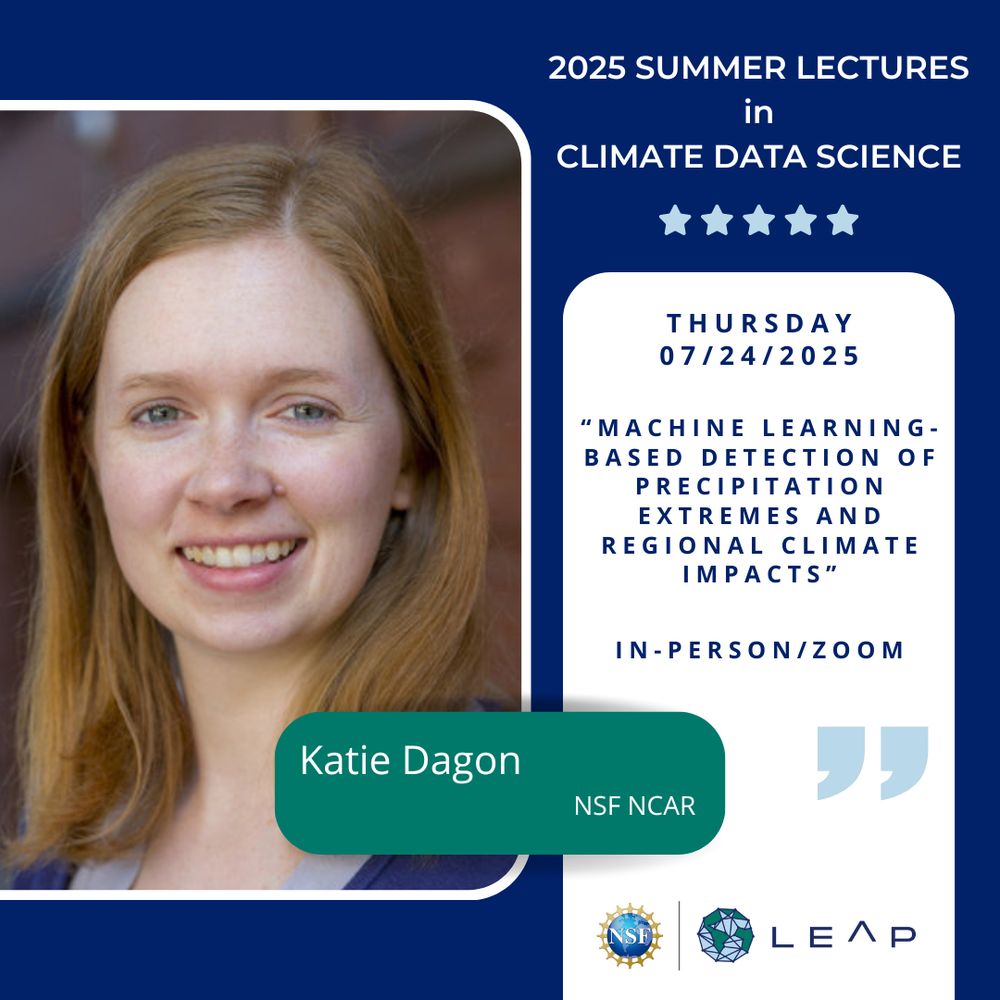
Katie Dagon @ncar-ucar.bsky.social presents our next Lecture in #Climate #Data Science!
📅 THURS, 7/24/25
🕧 12:30p ET * please note time-shift this week *
📍 @columbiaseas.bsky.social Innovation Hub/Zoom
💻 RSVP: www.eventbrite.com/e/summer-202...
@climate.columbia.edu #LEAPEducation #CESM #AI
22.07.2025 15:11
👍 6
🔁 2
💬 0
📌 0
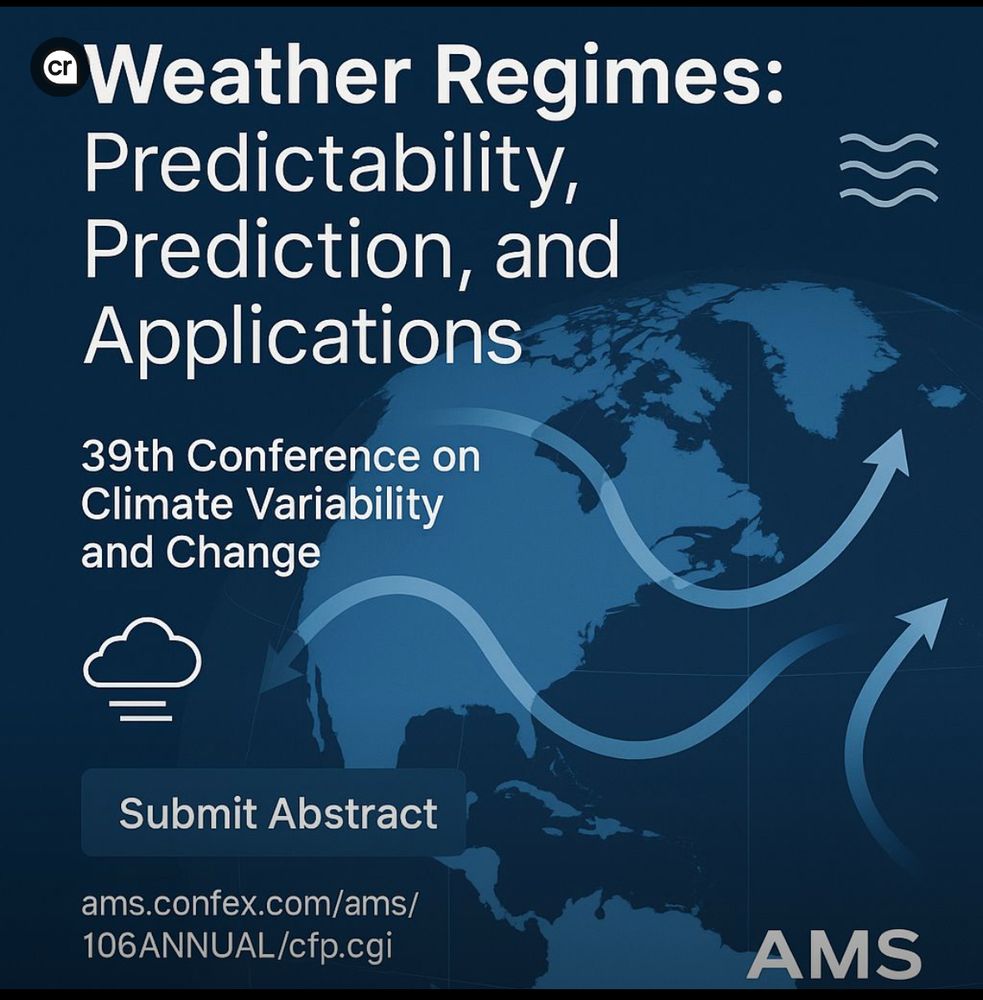
Please consider submitting an abstract to the Weather Regime session that I am co-chairing at the AMS 106th Annual Meeting. 👍🏼
15.07.2025 18:37
👍 5
🔁 3
💬 0
📌 0

New Article: "When and where soil dryness matters to ecosystem photosynthesis" rdcu.be/evfGV
A causality-guided explainable AI framework shows soil moisture dominates vapour pressure deficit in shaping global photosynthesis during water-limited conditions.
08.07.2025 03:34
👍 10
🔁 3
💬 0
📌 1

Space‐Time Causal Discovery in Earth System Science: A Local Stencil Learning Approach
We introduce Causal Space-Time Stencil Learning (CaStLe) for learning local causal dynamical structure underlying space-time data CaStLe enables previously infeasible analyses of grid-cell-level ...
Published in JGR:MLC! We introduce CaStLe (Causal Space-Time Stencil Learning), a method for grid-level space-time causal discovery that scales efficiently in high-dimensional Earth system data. It enables causal analysis of grid-level processes like eruption plumes.
#EarthScience #CausalDiscovery
11.07.2025 20:19
👍 4
🔁 1
💬 0
📌 0
👏👏👏👏
10.07.2025 17:48
👍 1
🔁 0
💬 0
📌 0


