
Consider: AL, KS, SD & WY would get more Medicaid money from the federal government under the OBBBA. All four are smaller states with two GOP senators.
05.03.2026 19:55
👍 1
🔁 1
💬 0
📌 0
@mfcannon
“An influential health care wonk at the libertarian Cato Institute“ – Washington Post. “A pleasant discovery” – Capitalism magazine. Washingtonian’s “Most Influential People” in DC 2021-present.
Consider: AL, KS, SD & WY would get more Medicaid money from the federal government under the OBBBA. All four are smaller states with two GOP senators.
This raises the question of whether drafters deliberately structured OBBBA provisions to “buy” enough votes to ensure passage, and found the support of senators form those sparsely populated states carried the lowest fiscal price.
The study could spur further profitable research, including into correlations between OBBBA state fiscal impacts and states’ political makeup.
Example: Wyoming and South Dakota would see net increases in federal Medicaid funds.

A new @RANDCorporation study provides important perspectives on how various provisions of the OBBBA will affect Medicaid overall and individual states.
The correlation isn’t perfect, but it projects many Democratic states will lose money and many GOP states will save money.
www.washingtonpost.c...
“We have to avoid overlearning the lessons of the past.”
- JD Vance

The CBO said the Obamacare-exempt plans often covered more expenses (lower deductibles and cost-sharing) and more providers (broader networks) than Obamacare plans.
All while making health insurance affordable without government subsidies.

It’s not the case that everyone is a fraudster.
It’s not only the far right that harbors those antisocial thoughts.
I encourage everyone to remember that, while fraud against government programs is bad, other things that government does are far worse: open.substack.com/pub/mfcannon...
We should see what they find and take it from there.
But the biggest question at the moment is, why weren’t these data publicly available from the start? Why did it take 60 years?
(Answer: the fraud lobby.)
As for why private-sector individuals are digging into the data, no doubt many are good civic-minded folk who are trying to do their part for God and country.
Others may have more political motives (e.g., they want to make a point about immigration).
Between the political constraints and their inadequate funding (itself a result of political constraints), they might not even try.
So even if the bureaucrats were looking at the new Medicaid data and saw home-health hot spots in Brooklyn and elsewhere, they might not get very far if they pressed the matter.

"...Democrat of New York, and other politicians.’ Medicare officials, no doubt expressing a sentiment shared by members of Congress, admit they avoid aggressive anti-fraud measures that might reduce access to treatment for seniors.”
"When the federal government began poking around a Buffalo school district that billed Medicaid for speech therapy for 4,434 kids, the New York Times reported, ‘the Justice Department suspended its civil inquiry after complaints from Senator Charles E. Schumer...
People think I’m kidding when I say there is a fraud lobby, but there are absolutely powerful interest groups that lobby to preserve the ease with which people get money from these programs:
“Politicians routinely subvert anti-fraud measures to protect their constituents.
Congress has made it so easy for people to bill Medicare and Medicaid, and uses so few antifraud measures, that those programs are effectively giant ATMs. Anyone who punches in the right numbers can make off with bags of cash.
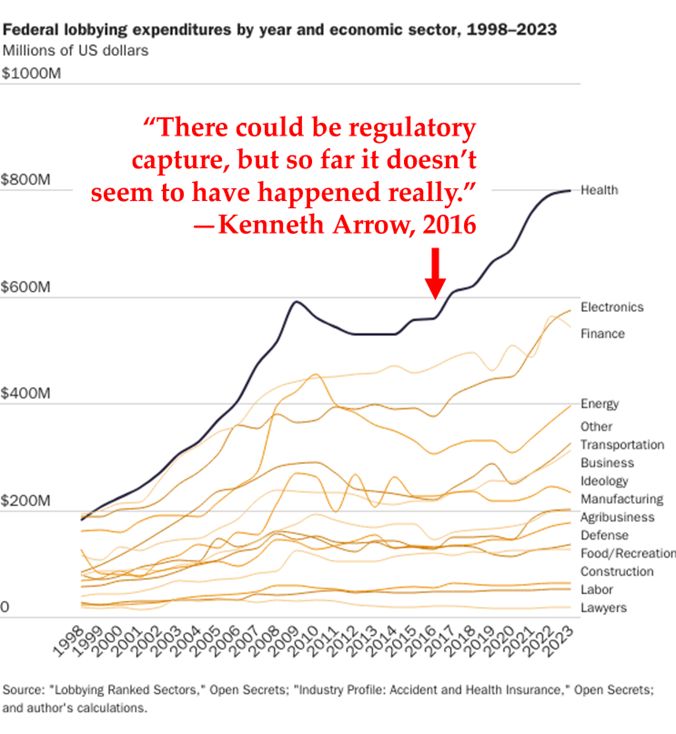
Oh, and the health care industry spends six times more than the defense industry on congressional lobbying.

In government health programs, it’s far worse. Health the largest category of federal spending, the programs are vastly more complex (harder to police), and recipients have even less patience for antifraud measures. Health care can be a matter of life and death, after all.
So, to the extent the government tries to use them in Social Security/EITC/WIC/etc., we complain to our members of Congress. We complain, and Congress dials back the anti-fraud measures, until the complaints and the antifraud measures reach an equilibrium.
When it’s the government’s money, we’re not willing to put up with those inconveniences because subsidy recipients and taxpayers receive effectively zero personal benefit from assisting with or tolerating those antifraud measures. The savings do not redound to us.
If you didn’t tolerate those things, if you switched to a credit card company that didn’t employ such measures, you’d have to pay more (likely, via a higher interest rate).
Ditto when they block the occasional unusual purchase. You tolerate it because it’s not much of an inconvenience, and it saves you money.
We “vote” on those approaches, taking their costs and benefits into account when we choose where to shop, where to bank, etc. Your credit card company requires you to input your zip code at the gas pump because doing so prevents a substantial number of frauds.
Here’s how I just explained the problem of fraud in government programs.
Humans bring fraud. It’s everywhere.
People who provide us goods and services take various steps to protect themselves and us from fraud.
As bad as Medicare and Medicaid fraud are, far worse are the countless ways government violates our health care rights and places health care out of reach of vulnerable patients.
mfcannon.substack.co... #CatoSOTU

"Covid-related frauds...exceeded $280B...Obamacare enrollment fraud is pervasive, likely costing taxpayers $27B...[CMS] made $87B in 'improper payments' to fraudsters and people who provided insufficient documentation in 2024."
www.cato.org/comment... #CatoSOTU

A "war on fraud" in government programs would be welcome. But the scale and brazenness of the fraud schemes in Minnesota are not unique.
mfcannon.substack.co... #CatoSOTU

President Trump says he wants to protect Medicare. What about protecting taxpayers from Medicare?
Taxpayers cannot afford to keep Medicare as it is. Even the laws the politicians say will reduce Medicare spending end up increasing it.
www.cato.org/blog/in... #CatoSOTU
“Obamacash for enrollees” would expand Obamacare and create countless problems.
But “universal health accounts” would free workers to control the $1 trillion that employers control—a larger effective tax cut than Reagan’s. #CatoSOTU
