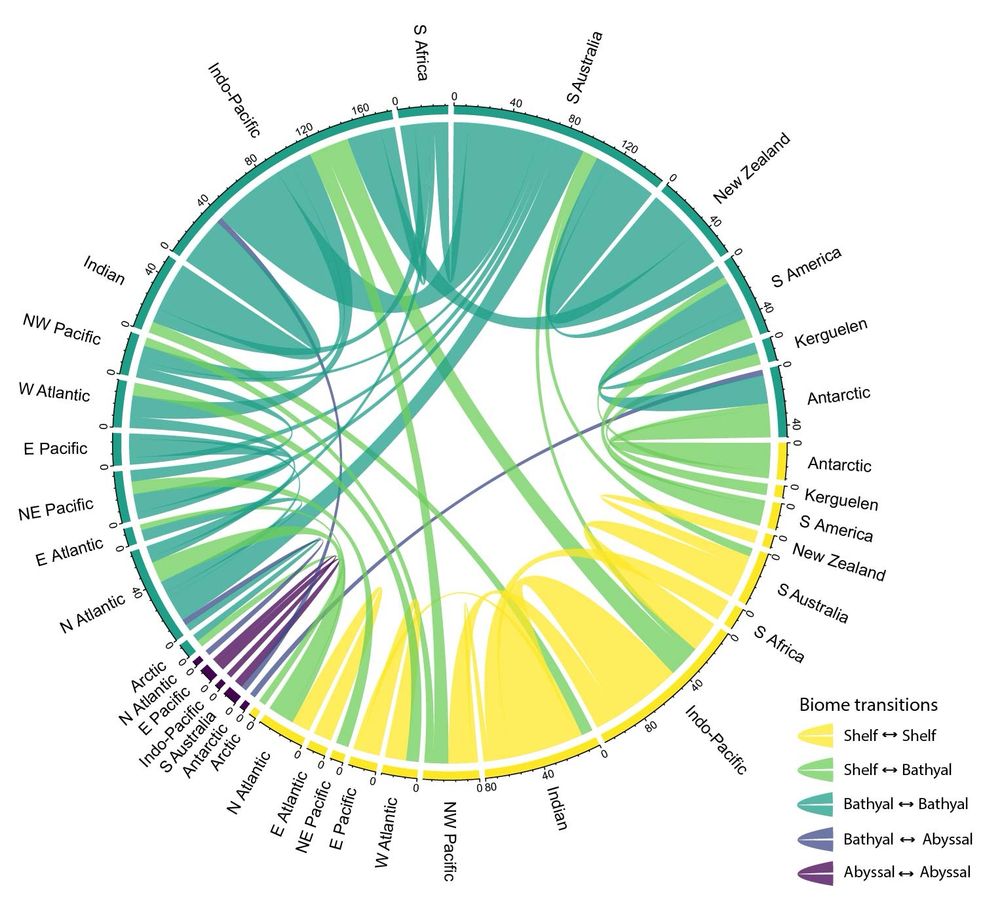
New paper in Nature: global evolutionary biogeography of my favourite animals.
www.nature.com/articles/s41...
theconversation.com/five-arms-no...
www.theguardian.com/environment/...
23.07.2025 21:22
👍 10
🔁 2
💬 0
📌 0
Wow, no idea what this is.
29.04.2025 03:23
👍 1
🔁 0
💬 1
📌 0
Beautiful image. I will read the paper tomorrow!
22.01.2025 10:59
👍 1
🔁 0
💬 1
📌 0
Yeah, that was a cool talk.
18.01.2025 02:12
👍 2
🔁 0
💬 1
📌 0

It’s out! A new faunal inventory for deep sea habitats around cold seeps off Costa Rica, including sone cool brittle-stars, see zookeys.pensoft.net/article/1343...
04.01.2025 00:47
👍 7
🔁 3
💬 0
📌 0

Here is the long lost brittle star Asteroschema monobactrum, last collected over a hundred years ago, from the SE seamounts of Chile. Merry Christmas!! #oceancensus #museumsvictoria
25.12.2024 00:20
👍 12
🔁 3
💬 0
📌 0

I have found old friends on seamounts in the SE Pacific, same species as from seamounts off New Zealand & Australia. Never ceases to amaze me how far these animals have dispersed across open oceans. #taxonomyworkshop2024-ID #chile
10.12.2024 10:28
👍 7
🔁 2
💬 0
📌 1

Woohoo, the Cocos (Keeling) Island seamount makes the front cover of DSBII. Mapped for the first time by the RV Investigator in 2022. Now I had better finish the macroecology paper …
09.12.2024 10:43
👍 5
🔁 2
💬 0
📌 0

Australian man smiling wearing a white shirt with a jar containing a snake star on a coral

A snake star with long curled arms on a pink coral

man in white shirt with jar containing snake star on pink coral in foreground, background with microscope and sample jars
The @oceancensus.bsky.social #taxonomyWorkshop2024 in Chile CONTINUES! Here, drtimohara.bsky.social, world ophiuroid expert from #museumvictoria studies ASTEROSCHEMA one of the most widespread #deepea serpent stars! #echinoday How many new? species will we find?? #falkor
06.12.2024 23:55
👍 9
🔁 3
💬 1
📌 0
Also a quick note to those who are following.. THIS is Dr. Tim O'Hara's proper Blue Sky account @drtimohara.bsky.social
· the other one is some other guy with the same name!
06.12.2024 23:57
👍 0
🔁 1
💬 0
📌 0
Today’s marine biogeography thought: the first brittle stars to reach remote oceanic islands are Amphipholis squamata & Ophiactis savignyi, both polyploids! Super-dispersers!
29.11.2024 23:01
👍 7
🔁 1
💬 0
📌 0
Weird looking Amphiura, the overall morphology looks more like Ophiodaphne (although I can’t see the mouthparts).
29.11.2024 22:55
👍 1
🔁 0
💬 1
📌 0