Grateful to our amazing team and all the nurses who participated in our studies!
Check out our paper and code:
🔗 Code & data: github.com/keyeun/adapt...
📄 Paper: arxiv.org/abs/2506.00386
#ACL2025 #HealthcareAI #VirtualPatient
07.06.2025 13:04
👍 0
🔁 0
💬 0
📌 0
In validation studies with practicing nurses, our virtual patient demonstrated high realism, and our evaluation system accurately distinguished between communication skills of experienced versus novice nurses.
07.06.2025 12:53
👍 0
🔁 0
💬 1
📌 0
Our Adaptive-VP framework consists of four key modules: (1) evaluating trainee dialogue, (2) adjusting patient responses based on evaluation results, (3) generating contextually appropriate patient utterances, and (4) reviewing the quality and safety of generated responses.
07.06.2025 12:53
👍 0
🔁 0
💬 1
📌 0

Our research focused on developing an AI virtual patient capable of "adaptive responses" for more effective communication training.
07.06.2025 12:53
👍 0
🔁 0
💬 1
📌 0
For effective training, virtual patients must respond appropriately based on trainees' communication skills - showing cooperation when trainees demonstrate effective communication aligned with learning objectives, and expressing dissatisfaction or resistance when they don't.
07.06.2025 12:52
👍 0
🔁 0
💬 1
📌 0
Many nurses face challenges in patient communication, but traditional standardized patient training has limitations, including high costs and rigid scenarios. This has led to growing interest in developing AI-powered virtual patients for training purposes.
07.06.2025 12:52
👍 0
🔁 0
💬 1
📌 0


I'm excited to share that our research team's paper "Adaptive-VP: A Framework for LLM-Based Virtual Patients that Adapts to Trainees' Dialogue to Facilitate Nurse Communication Training" has been accepted to ACL 2025 Findings! #ACL2025
07.06.2025 12:52
👍 0
🔁 0
💬 1
📌 0
Our framework consists of four core modules
: multi-agent evaluation of trainee performance, dynamic adjustment of patient behavior that escalates or de-escalates based on communication quality, contextual dialogue generation, and safety monitoring to balance realism with learner well-being.
04.06.2025 01:31
👍 1
🔁 0
💬 0
📌 0
Adaptive-VP addresses these limitations through real-time adaptation based on trainee communication performance: dynamic patient behavior that escalates with poor communication and de-escalates with effective responses
04.06.2025 01:28
👍 0
🔁 0
💬 1
📌 0
Traditional nursing communication training relies on standardized patients, but this approach has critical limitations:
- High costs and inflexibility
- Scripted interactions that don't reflect dynamic clinical encounters
04.06.2025 01:28
👍 0
🔁 0
💬 1
📌 0

SPeCtrum: A Grounded Framework for Multidimensional Identity Representation in LLM-Based Agent
Keyeun Lee, Seo Hyeong Kim, Seolhee Lee, Jinsu Eun, Yena Ko, Hayeon Jeon, Esther Hehsun Kim, Seonghye Cho, Soeun Yang, Eun-mee Kim, Hajin Lim. Proceedings of the 2025 Conference of the Nations of the ...
Read the full paper here: aclanthology.org/2025.naacl-l...
03.05.2025 19:40
👍 1
🔁 0
💬 0
📌 0
Excited to present our work at #NAACL2025 in Albuquerque! We tackle a core question: What fundamental information is needed to effectively simulate human identity in AI agents?
03.05.2025 19:38
👍 3
🔁 0
💬 1
📌 0
SPeCtrum provides a principled framework for creating more authentic AI agents that better reflect the richness of human identity, with applications ranging from personalized AI assistants to more realistic social simulations.
03.03.2025 16:30
👍 1
🔁 0
💬 1
📌 0
One fascinating finding: When we tried to infer social and personal traits from context alone, it worked reasonably well for fictional characters but much less accurately for real people - highlighting the need for our multi-dimensional approach.
03.03.2025 16:30
👍 2
🔁 0
💬 1
📌 0

But for real-world individuals? The full SPC combination significantly outperformed using any single component. Real human identity requires a more comprehensive representation approach than fictional characters.
03.03.2025 16:29
👍 1
🔁 0
💬 1
📌 0

How effective is each component? Through automated tests with popular drama characters and human evaluations, we found that Personal Life Context (C) alone worked almost as well as the full SPC combination in capturing their identity.
03.03.2025 16:29
👍 1
🔁 0
💬 1
📌 0

Table: Components of the SPeCtrum Framework
Building on established self-concept research, We break down identity into three key components:
🔹 S: Social Identity (group affiliations and demographics)
🔹 P: Personal Identity (personality traits & values)
🔹 C: Personal Life Context (daily routines & preferences)
03.03.2025 16:28
👍 1
🔁 0
💬 1
📌 0
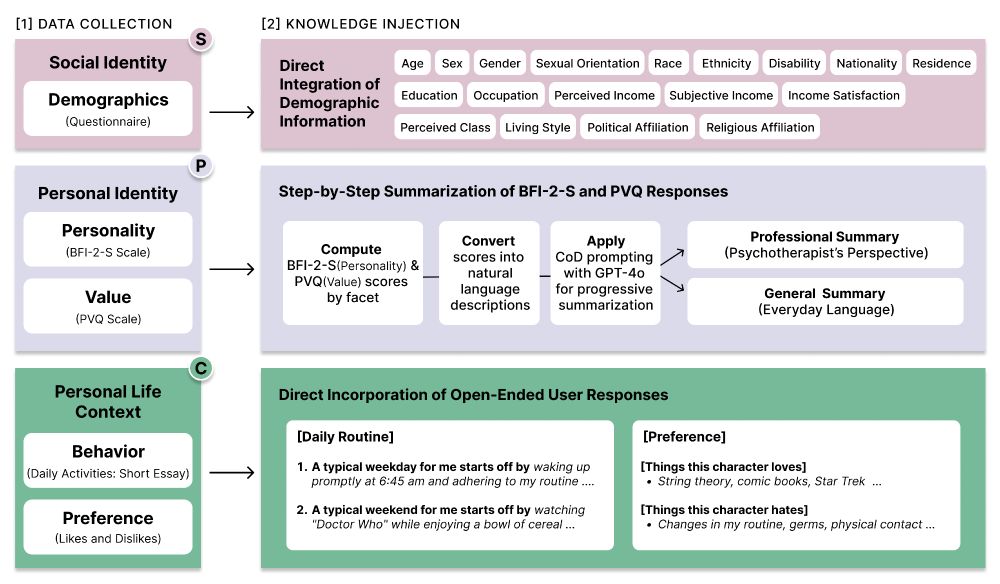
Overview of the SPeCtrum Framework for Multidimensional Identity Representation
Ever wondered how much data it takes to "clone" yourself as an AI? Our #NAACL2025 paper, "SPeCtrum: A Grounded Framework for Multidimensional Identity Representation in LLM-Based Agents," tackles this head-on by asking: What's the minimum data needed to reflect a complex self-concept?
03.03.2025 16:27
👍 6
🔁 2
💬 2
📌 2
Thank you so much for sharing my website - I truly appreciate your support 🙏 (Sorry for the late reply!)
18.12.2024 10:09
👍 1
🔁 0
💬 0
📌 0

