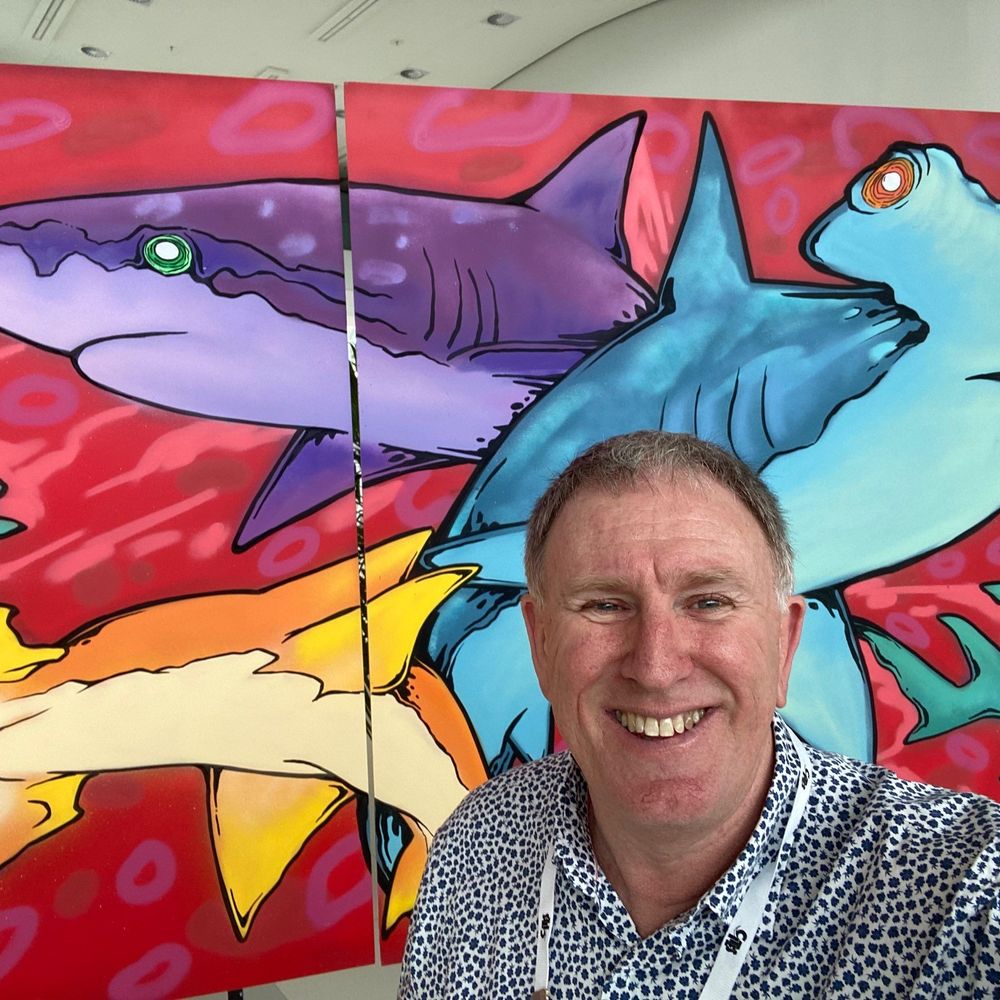
I just spent part of my morning summarising literature on the sandbar shark. Now i need a nap I was so bored. #yawnshark
25.01.2026 02:36
👍 7
🔁 1
💬 1
📌 0
I just spent part of my morning summarising literature on the sandbar shark. Now i need a nap I was so bored. #yawnshark

Photo of a boring shark
The sandbar shark is so boring even the triangles it forms with its fins are obtuse. #YawnShark @whysharksmatter.bsky.social

New paper is out 🔓!
We reconstructed the 145-myr diversity of sharks & rays using deep learning, unveiling hidden patterns:
- modern diversity levels by the Cretaceous 📈
- small decline in the K/Pg 🤏
- a peak in the Eocene 🌄
- a long-term decline towards the present �
www.cell.com/current-biol...

New online! Bending back the curve of shark and ray biodiversity loss

Oh to have lived 50 million years ago during peak elasmo diversity!
Great 🧵on 🦈 trends by @nickdulvy.bsky.social 👇🏼

A theory of shark and ray conservation change. Structural drivers of shark and ray decline can be addressed through three types of measures that target trade and demand management, fisheries management, and rehabilitation.
We don’t need new frameworks — we need to connect and implement the ones we have.
Fisheries management, trade rules, compliance, and demand must align to reduce fishing mortality at scale.
Implementation is the bottleneck.
@hollieboothie.bsky.social
@sharkcolin.bsky.social

Green List Status Assessment of the Banded Wobbegong (Orectolobus halei) The recovered (blue) status compared to what the past status might have been without conservation (Conservation Legacy, green) and future status unless management continues (Conservation Dependency, orange).
Decline is not inevitable.
Where fishing mortality has been reduced — through catch limits, retention bans, or spatial protection — shark and ray populations are stabilizing or recovering.
Recoveries documented for wide-ranging and restricted-range species @charlie-huveneers.bsky.social

Progress and priorities in shark and ray fisheries management. The risk to species owing to incomplete management (‘M-Risk’, part a) can be described by Compliance, one of 19 attributes across four classes for requiem sharks and guitarfishes
Gaps in catch limits, compliance, and enforcement mean fishing mortality stays high even where policies exist.
Where management is complete, risk is lower and recovery is possible.
@hollieboothie.bsky.social
@sharkcolin.bsky.social
Read the paper here: rdcu.be/eZ9n9

Progress and priorities in shark and ray fisheries management. The risk to species owing to incomplete management (‘M-Risk’, part a) can be described by 19 attributes across four classes for requiem sharks and guitarfishes.
Overfishing is compounded by under-management
Fishing mortality is the primary driver &
management completeness (for guitarfishes & requiem sharks) stands at ~49% globally.
@sammsherman27.bsky.social
@vanderwright.bsky.social
Read the paper here: rdcu.be/eZ9n9

Taxonomic differentiation of catch. FAO (United Nations Food and Agricultural Organization) on the percentage of catch reported to the species level worldwide.
What’s driving the decline?
The crisis isn’t just fishing — it’s invisible fishing.
Much shark & ray catch is under-reported, aggregated, or mislabeled, masking real mortality & delaying management.
What we don’t measure, we don’t manage.
@cgmull.bsky.social
@nathanpacoureau.bsky.social

Extinction risk and the spatial patterning of shark, ray and chimaera richness, including hotspots of coastal and deepwater richness, for wide-ranging and endemic species.
Sharks & rays are sentinels of ocean health.
- Global abundance has been fished down by 65%,
- Now 37.5% of species are threatened,
- The current extinction rate is 25–250 times greater than the background fossil record, with greatest losses in tropical coastal seas. #BiodiversityTargets

Bending back the biodiversity loss curve of sharks and rays. The loss of sharks and rays to date has involved serial depletion of the largest, most evolutionary and functionally distinct species, and the increasing prevalence of smaller-bodied species that have benefited from release from predation.
New paper out today in @natrevbiodiv.nature.com by the #GlobalSharkTrends team: Bending back the curve of shark & ray biodiversity loss;
Read the paper here: rdcu.be/eZ9n9
@sfu.ca
@sfubiosciences.bsky.social
@earth2ocean.bsky.social
Totally!
Time for a rethink! Thank you science.
@iucnshark.bsky.social @nickdulvy.bsky.social @sharks-int.bsky.social

And to be fair, we had a hint about this from a previous paper, but it was for a single animal and so I, like many others, dismissed it as a one-off.
"The critically endangered bowmouth guitarfish (Rhina ancylostoma) in the open ocean with an associated tuna school"
dx.doi.org/10.1007/s125...
I always thought these animals lived close to the seafloor in coastal areas. But it turns out they occur they are observed in the open ocean a lot. This is totally mind blowing and makes me think that everything that we thought we knew about this species is just a tiny sliver of what we need to know
Sometimes you stumble on some #sharkscience that makes you think you don't really know anything about them at all. Yesterday i found this paper: "Observations of the bowmouth guitarfish by-catches by the tropical tuna purse seine fleet in the Indian Ocean’s open waters"
doi.org/10.1017/S002...

And more new #sharkscience, this time from Sushmita Mukherji "Assessing mechanisms of intrinsic vulnerability in sharks occupying different marine environments"
link.springer.com/article/10.1...
@imas-utas.bsky.social @iucnshark.bsky.social

New #sharkscience #sharkconservation
"Bending back the curve of shark and ray biodiversity loss" in @natrevbiodiv.nature.com
go.nature.com/4jXOnaC
What will it take to reverse shark biodiversity loss? Find out in our new article out today.
@nickdulvy.bsky.social @iucnshark.bsky.social

🐟 New vacancy in the fish tracking community 📢
Come join Dr. Jan Reubens and his team at the Flanders Marine Institute (@vliz.be) as a Fish Behavioral Ecology Researcher!
🔗Read more about the position and apply here: www.vliz.be/en/jobs/vliz...
❗Deadline 25 January, 2026

🚨 Job Alert! TT Assistant Professor of Marine Biology at the University of Alaska Fairbanks! Looking for a candidate with a focus on coastal ecology. Come be my colleague! Please share.
careers.alaska.edu/jobs/assista...

The last proposal for sharks has just passed at #CITESCoP20. Gulper Sharks have been adopted into Appendix II of CITES.
This marks a major victory for sharks and rays as all proposals have been adopted!
#CITES #CoP20 #gulpershark #shark #ray #chimaera #biodiversity #conservation #trade #conference

The 2024–25 IMOS Annual Highlights are now out, showcasing key achievements from across our program and community 🌊
🔗 bit.ly/3MkLMKQ
#NCRISImpact

We are hiring: #PhD fellow in Ecosystem-based management and marine connectivity🐋🧪🛰️
Want to work with tracking data from migratory species to identify ecological corridors and help inform biodiversity conservation priorities?
Apply by Dec 7th!
@bioprotectproject.bsky.social
tinyurl.com/ytfmfhfc


A guide to: Sri Lankan Wildlife 🐆
Sri Lanka is a global biodiversity hotspot, home to unique and endemic species, including around 140 mammals, 400 birds, and 170 reptiles.
🦈 SI2026
📅 Dates: 4-8 May
📍 Location: Colombo, Sri Lanka
🔗 si2026.org
It's live! Impacts of Deep-sea Mining on Migratory Species: Review and Knowledge Gaps.
In English, French, and Spanish. Annex I is the actual report.
www.cms.int/document/dee...

📣 Announcement! Abstract Submission Deadline Extended to November 30, 2025
Being guilty of last minute submissions ourselves, we felt that a few more days would help those of you processing your abstract ideas!
👉 si2026.org

Seven JCU researchers have been named in the @clarivateag.bsky.social annual list of Highly Cited Researchers. Demonstrating significant and broad influence in their fields of research.
See the full list here: clarivate.com/highly-cited...

NEW #SharkLeague #ICCAT Factsheet outlines key steps needed to strengthen existing measures & close critical gaps - from enforcing the finning ban & rebuilding shortfin mako populations to protecting basking & white sharks, & ensuring sustainable blue 🦈 fisheries sharkleague.org/2025/11/10/i...
