
Very happy to share that our paper "Political socialization and immigrants' support for progressive politics: the case of green parties" with @antvalentim.bsky.social is now published in @psrm.bsky.social!
Link to paper: doi.org/10.1017/psrm...
Short summary in 🧵below:
(1/5)
05.03.2026 16:10
👍 49
🔁 14
💬 1
📌 1

Sage Journals: Discover world-class research
Subscription and open access journals from Sage, the world's leading independent academic publisher.
🚨 Happy to see this article with the wonderful David Schweizer out online first at European Union Politics!
We examine who is aware of European funding and how citizens prefer these funds to be allocated.
The article is available open access here: journals.sagepub.com/doi/full/10....
05.03.2026 08:25
👍 12
🔁 5
💬 1
📌 1

📢 New in IMR. We often ask whether #refugees “integrate.” But what happens when the host society becomes hostile? I develop the concept of social marginalization and show that refugees in more #violent German counties report stronger feelings of exclusion and discrimination. doi.org/10.1177/0197...
03.03.2026 13:27
👍 20
🔁 9
💬 1
📌 0
Very glad that our first DEMNORM paper found such a great home at @thejop.bsky.social. If you’re interested in the role of social desirability in online surveys, check out the thread and paper below ⬇️
13.02.2026 08:32
👍 23
🔁 7
💬 1
📌 0

It must be very hard to publish null results
Publication practices in the social sciences act as a filter that favors statistically significant results over null findings. While the problem of selection on significance (SoS) is well-known in theory, it has been difficult to measure its scope empirically, and it has been challenging to determine how selection varies across contexts. In this article, we use large language models to extract granular and validated data on about 100,000 articles published in over 150 political science journals from 2010 to 2024. We show that fewer than 2% of articles that rely on statistical methods report null-only findings in their abstracts, while over 90% of papers highlight significant results. To put these findings in perspective, we develop and calibrate a simple model of publication bias. Across a range of plausible assumptions, we find that statistically significant results are estimated to be one to two orders of magnitude more likely to enter the published record than null results. Leveraging metadata extracted from individual articles, we show that the pattern of strong SoS holds across subfields, journals, methods, and time periods. However, a few factors such as pre-registration and randomized experiments correlate with greater acceptance of null results. We conclude by discussing implications for the field and the potential of our new dataset for investigating other questions about political science.
I have a new paper. We look at ~all stats articles in political science post-2010 & show that 94% have abstracts that claim to reject a null. Only 2% present only null results. This is hard to explain unless the research process has a filter that only lets rejections through.
11.02.2026 17:00
👍 642
🔁 223
💬 30
📌 51

Values and Political Preferences in Childhood
Christopher Johnston, Martín Opertti, Turgut Keskintürk
February, 2026
Studies of youth political development focus primarily on political socialization and salient events, while paying relatively less attention to important individual differences among children themselves, such as values. We administer an original survey to a sample of 10-to-12-year-olds and show that the distribution of their values is similar to that of their parents and a diverse sample of adults; that children's value priorities strongly predict their political preferences; and that one dimension of value priorities continues to predict political preferences even after adjusting for parental values and political preferences. Taken together, our findings suggest that pre-teens already use their own value priorities to organize their political attitudes, which emphasizes the importance of children's independent attributes in their political development, and lends support to the idea that personal values provide a foundation for political ideology.

estimated value positions in Schwartz value space.

the effects of conservation and self-enhancement values on political evaluations and issues.
a new working paper: osf.io/3dq2x_v1!
we administered an original survey to a sample of 10-to-12-year olds, their parents, and a national sample to assess the extent to which values can provide a foundation for political ideology.
we find that values structure political preferences among children.
05.02.2026 17:19
👍 36
🔁 13
💬 0
📌 1

Do ordinary Republicans and Democrats really avoid each other in everyday life? In a new working paper with Delia Baldassarri, we present descriptive and experimental evidence to challenge the view that partisanship drives the formation of social relationships.
osf.io/preprints/so...
1/15
02.02.2026 14:24
👍 82
🔁 32
💬 2
📌 4


🚨 Join us for the next edition Summer School for Women* in Political Methodology in Mannheim 🚨
7 days of hands-on advanced methods + networking for PhDs, postdocs & early-career researchers.
Free of charge (limited travel support).
Deadline 1 March 2026: summerschoolwpm.org
#methodsky #polisky
02.02.2026 13:13
👍 78
🔁 64
💬 1
📌 15


partycoloR is now on CRAN! Started as a simple idea 6 years ago, now it's a full-featured package. Extract party colors and logos from Wikipedia with one line of code. It's already powering ParlGov Dashboard.
install.packages("partycoloR")
28.01.2026 08:20
👍 99
🔁 20
💬 0
📌 2
Just published in @bjpols.bsky.social: @sergipardos.bsky.social and I show that inter-regional moves in pursuit of employment security reduce individual worries about immigration—a mobility pattern that, in the aggregate, reinforces spatial polarization in anti-immigration sentiment. cup.org/3XiB6yD
10.11.2025 13:20
👍 90
🔁 38
💬 1
📌 3
New paper with @mhamjediers.bsky.social
German judges have discretion to apply rehabilitative juvenile criminal law (Jugendstrafrecht) or punitive adult criminal law to 18–20-year-old offenders. We show that immigrant youths are ~10 percentage points less likely to be sentenced under juvenile law
04.11.2025 11:20
👍 100
🔁 45
💬 3
📌 4
To be clear: deportations to increase cultural homogeneity is the text book definition of ethnic cleansing. Demands that come even close to this are so far outside any democratic norm and the rule of law. What has happened to a country when this is not condemned in the strongest possible terms?
21.10.2025 10:47
👍 6000
🔁 1694
💬 5
📌 80

How common are “survey professionals” - people who take dozens of online surveys for pay - across online panels, and do they harm data quality?
Our paper, FirstView at @politicalanalysis.bsky.social, tackles this question using browsing data from three U.S. samples (Facebook, YouGov, and Lucid):
07.10.2025 18:49
👍 136
🔁 54
💬 4
📌 6
🚨 Big News for European Political Science 🚨
We’re thrilled to announce the launch of the European Political Science Society (EPSS): a new, member-led, not-for-profit association built to support our scholarly community.
🔗 epssnet.org
Here’s a thread with everything you need to know.
🧵
26.06.2025 17:07
👍 375
🔁 210
💬 4
📌 58
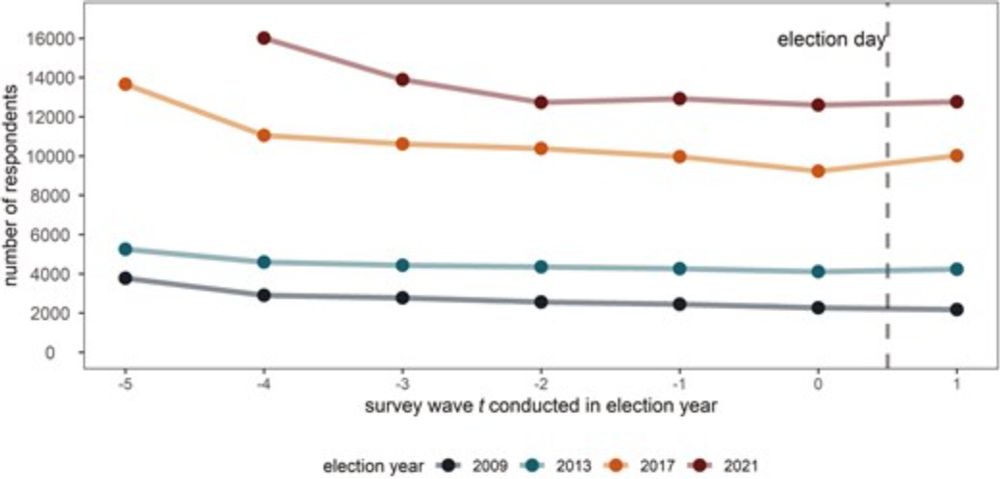
Survey Nonresponse After Elections: Investigating the Role of Winner-Loser Effects in Panel Attrition
Abstract. When and for whom do election outcomes drive survey nonresponse? This paper investigates whether belonging to the winners or losers of an electio
🚨 Excited to see my first solo-authored paper now published in IJPOR! 🚨
Do election outcomes affect participation in post-election surveys? And specifically, do election winners respond more than losers? The short answer: not really.
The slightly longer answer: 🧵👇
academic.oup.com/ijpor/articl...
23.06.2025 08:03
👍 80
🔁 21
💬 4
📌 5
OSF
🚨🚨 NEW PRE-PRINT 🚨🚨
Prominent theories in political psychology argue that threat causes increases in conservatism. Early experimental work supported this idea, but many of these studies were (severely) underpowered, and examined only a few threats and ideological DVs. 1/n osf.io/preprints/ps...
20.05.2025 22:47
👍 61
🔁 22
💬 2
📌 1
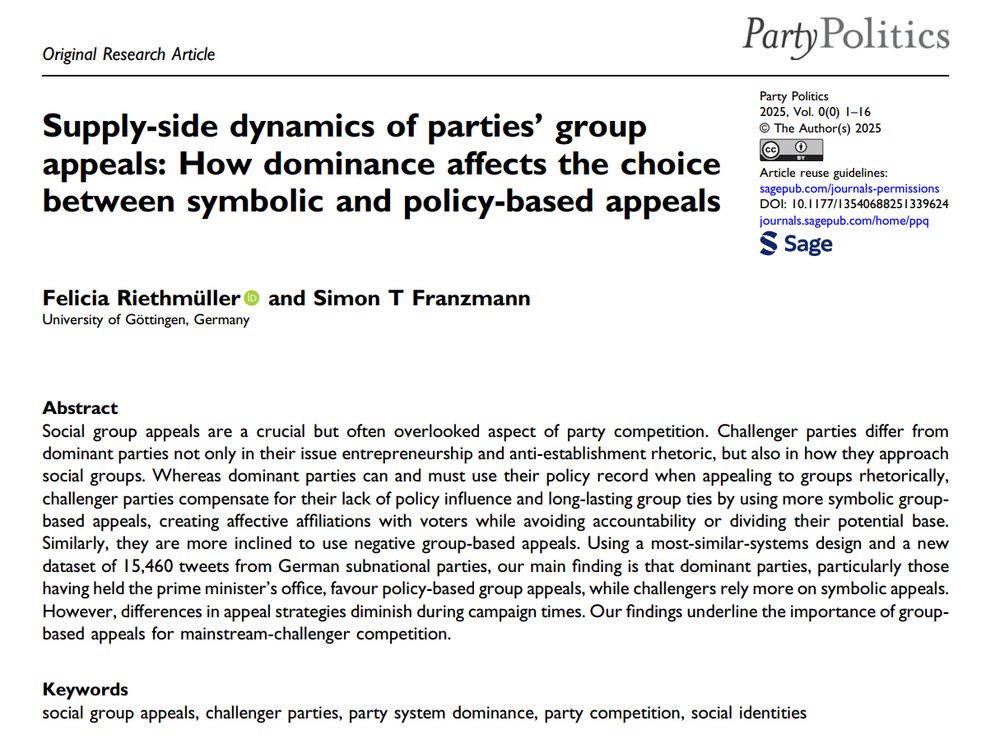
Abstract
Social group appeals are a crucial but often overlooked aspect of party competition. Challenger parties differ from
dominant parties not only in their issue entrepreneurship and anti-establishment rhetoric, but also in how they approach
social groups. Whereas dominant parties can and must use their policy record when appealing to groups rhetorically,
challenger parties compensate for their lack of policy influence and long-lasting group ties by using more symbolic groupbased appeals, creating affective affiliations with voters while avoiding accountability or dividing their potential base.
Similarly, they are more inclined to use negative group-based appeals. Using a most-similar-systems design and a new
dataset of 15,460 tweets from German subnational parties, our main finding is that dominant parties, particularly those
having held the prime minister’s office, favour policy-based group appeals, while challengers rely more on symbolic appeals.
However, differences in appeal strategies diminish during campaign times. Our findings underline the importance of groupbased appeals for mainstream-challenger competition.
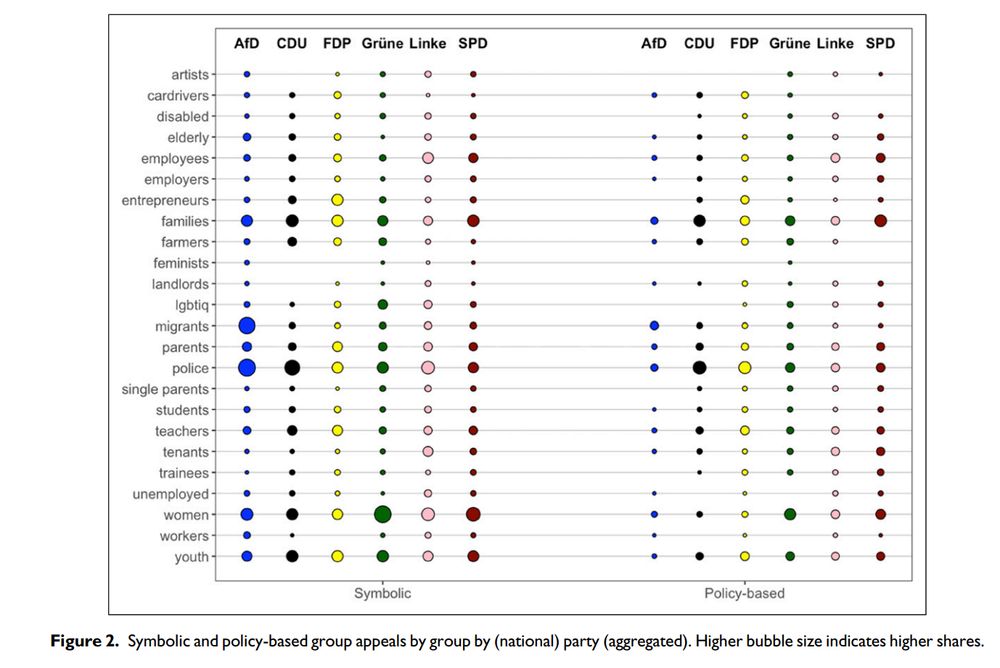
Thrilled to see my 1st PhD paper out in #PartyPolitics! Based on ~15000 posts by 86 German subnat. parties (2015-2019), Simon Franzmann & I show that dominant & challenger parties differ in the use of policy-based vs symbolic & positive vs negative appeals.
🔓:
doi.org/10.1177/1354...
13.05.2025 10:15
👍 107
🔁 26
💬 12
📌 4

The first paper of my dissertation has been published in West European Politics!
@wepsocial.bsky.social
See the thread below:
08.05.2025 07:45
👍 70
🔁 16
💬 8
📌 2
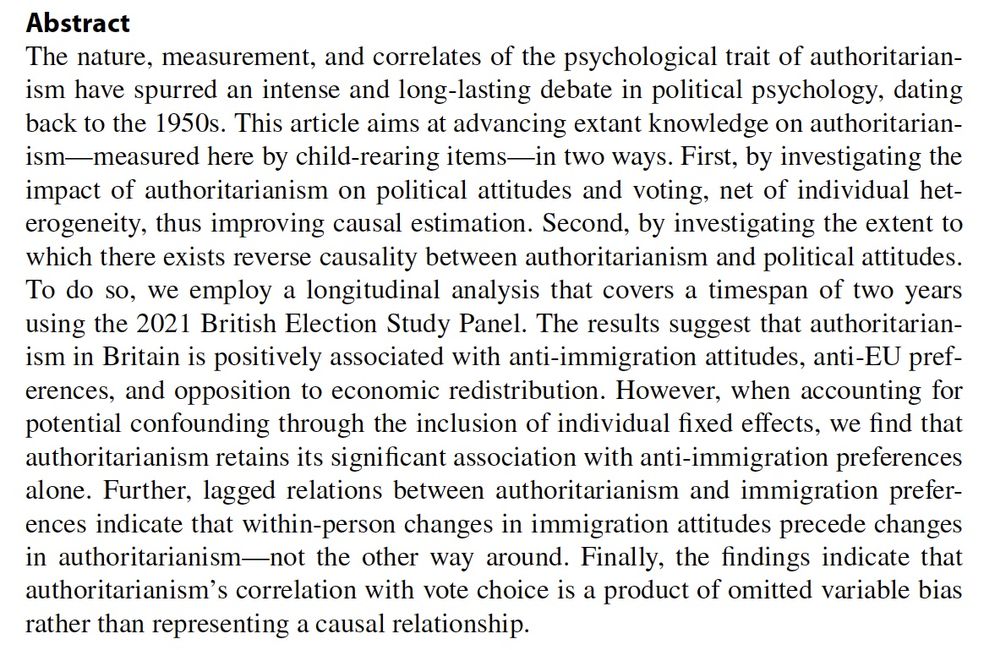
Our article w/Justin Robinson on authoritarianism in 🇬🇧 is published in the new issue of @polbehavior.bsky.social
We employ a longitudinal analysis using the @britishelectionstudy.com to investigate the causal effect of the psychological trait of authoritarianism on political attitudes and voting 🧵
06.05.2025 08:02
👍 26
🔁 12
💬 3
📌 1

New paper on misperceptions out in PNAS @pnas.org
www.pnas.org/doi/10.1073/...
Why do people overestimate the size of politically relevant groups (immigrant, LGBTQ, Jewish) and quantities (% of budget spent on foreign aid, % of refugees that are criminals)?🧵👇
07.04.2025 12:00
👍 269
🔁 96
💬 12
📌 21
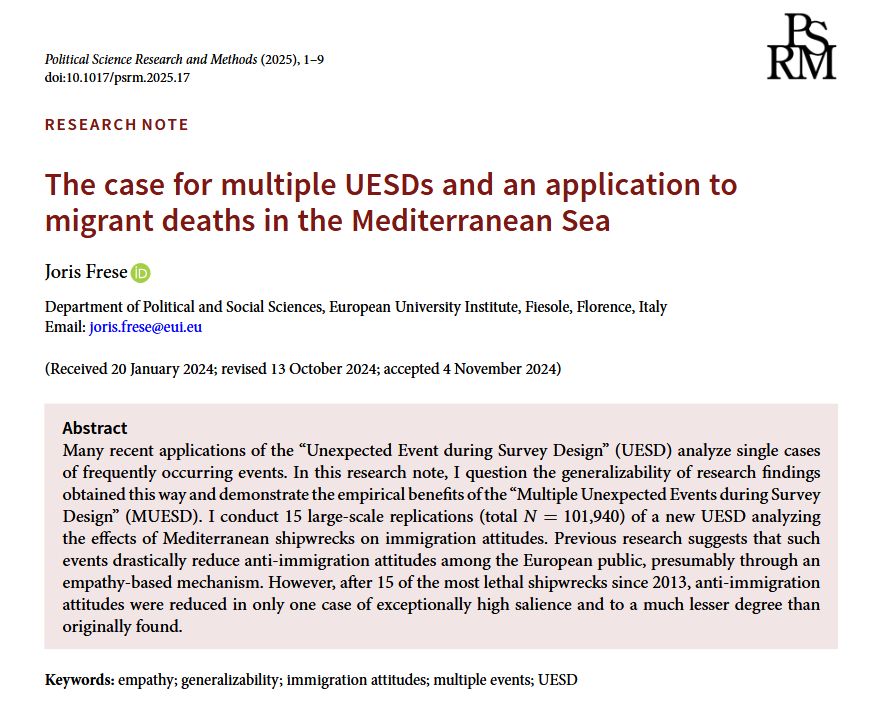
Published Today in PSRM:
Based on a novel “Multiple Unexpected Events during Survey Design” (MUESD), I contextualize previous findings suggesting that Europeans become more empathetic toward migrants when exposed to migrant suffering.
www.cambridge.org/core/journal...
A Summary Thread: 1/15
20.03.2025 10:24
👍 104
🔁 40
💬 7
📌 5
..und noch ein Fall, in dem ein rechsextremer Vierfachmord unter dem medialen Radar läuft. Am 25. März 2024 starben die Eltern und ihre beiden drei Jahre und wenige Monate alten Töchter bei einem Brandanschlag. Erinnert an die Toten. Und die Medien an ihre verdammte demokratische Verantwortung.
13.03.2025 08:33
👍 471
🔁 149
💬 3
📌 3

The "everyone is biased" bias
On the problems with excessive epistemic cynicism
I wrote about what I call the "everyone is biased" bias and the problems with excessive cynicism: www.conspicuouscognition.com/p/the-everyo...
12.03.2025 08:25
👍 21
🔁 4
💬 1
📌 2
Reaching for former employees? I'll try my best.
02.03.2025 16:37
👍 2
🔁 0
💬 0
📌 0
The “Need for Chaos” and Motivations to Share Hostile Political Rumors | American Political Science Review | Cambridge Core
The “Need for Chaos” and Motivations to Share Hostile Political Rumors - Volume 117 Issue 4
Our research on Need for Chaos was focused on how some voters wanted to watch the world burn: www.cambridge.org/core/journal...
With DOGE it now seems to be official government strategy from Trump & Musk
But the goal seems the same: Burning down existing structures for selfish status gain
25.02.2025 11:42
👍 59
🔁 25
💬 0
📌 2
Wir haben gestern lange darüber gesprochen was wir tun würden wenn Autoritäre und Faschisten die Macht übernehmen. Behält man Stellen in Bürokratie und Wissenschaft, wandert man aus, wie würde man Widerstand organisieren? Als Deutscher kennt man diese Fragen. Man hat sie häufig rückblickend ... 1/
23.02.2025 10:34
👍 456
🔁 123
💬 8
📌 7


