Huge thanks to lead author Sz-Wen Liu (@szwenliu.bsky.social)—freshly minted PhD 🎓—for leading this project from start to finish. Also grateful to our colleagues at NYCU, lab members, and reviewers who helped sharpen this study. 10/end
20.02.2026 20:00
👍 4
🔁 0
💬 0
📌 0
We also see a negative correlation between stimulus-locked bursts and outcome responses—an RPE-like signature consistent with prior reports—suggesting BF bursts may transform stimulus-onset RPE into an attention-for-performance amplification signal. 9/n
20.02.2026 20:00
👍 2
🔁 0
💬 1
📌 0


Bimodal and unimodal trials show similar behavior and BF patterns, consistent with prior BF work: bigger bursts → faster reward seeking; suppression → nogo/rapid stopping. Extends a bidirectional gain-control view to selective attention. 8/n
20.02.2026 20:00
👍 2
🔁 0
💬 1
📌 0

BF population activity mirrors behavior trial by trial, tracking attention switches during block transitions as well as spontaneous A↔V shifts, and aligning neural dynamics with the animal’s current attentional set. 7/n
20.02.2026 20:00
👍 3
🔁 0
💬 1
📌 0

Interpretation: selection of the attended modality occurs upstream of BF; BF then provides a modality-common, post-selection/target-detection signal—an amplification that links attended targets to reward-seeking actions. 6/n
20.02.2026 20:00
👍 2
🔁 0
💬 1
📌 0

When A and V oddballs co-occur but only one is attended, BF shows neither divisive normalization nor multisensory synergy. Instead, attended and ignored streams are processed in parallel and summed (near) linearly. 5/n
20.02.2026 20:00
👍 2
🔁 0
💬 1
📌 0

Converge, not diverge: the same BF neurons carry attended A and attended V signals. Across units, amplitudes are tightly correlated (r≈0.8); variability is essentially a single scalar (amplitude), not modality tuning—unlike modality-specific attention signals in corticothalamic circuits. 4/n
20.02.2026 20:00
👍 2
🔁 0
💬 1
📌 0


Single noncholinergic BF "bursting" neurons show strong, short-latency bursts to attended targets and minimal responses to identical stimuli when ignored. BF activity tracks behavior in real time, even during spontaneous shifts of attention. 3/n
20.02.2026 20:00
👍 2
🔁 0
💬 1
📌 0


We built a new cross-modal oddball task in rats that pits auditory (A) vs. visual (V) stimuli simultaneously and allows both instructed and spontaneous attention shifts. Choices are unaffected by the unattended stream—clean behavioral evidence for cross-modal selective attention. 2/n
20.02.2026 20:00
👍 3
🔁 0
💬 1
📌 0

New lab paper in #ScienceAdvances: we identify a modality-common selective-attention signal in noncholinergic #BasalForebrain (BF) “bursting” neurons, distinct from the modality-specific attention signals typically described in corticothalamic circuits. 1/n
www.science.org/doi/full/10....
20.02.2026 19:59
👍 27
🔁 10
💬 1
📌 1
🚨Our preprint is online!🚨
www.biorxiv.org/content/10.1...
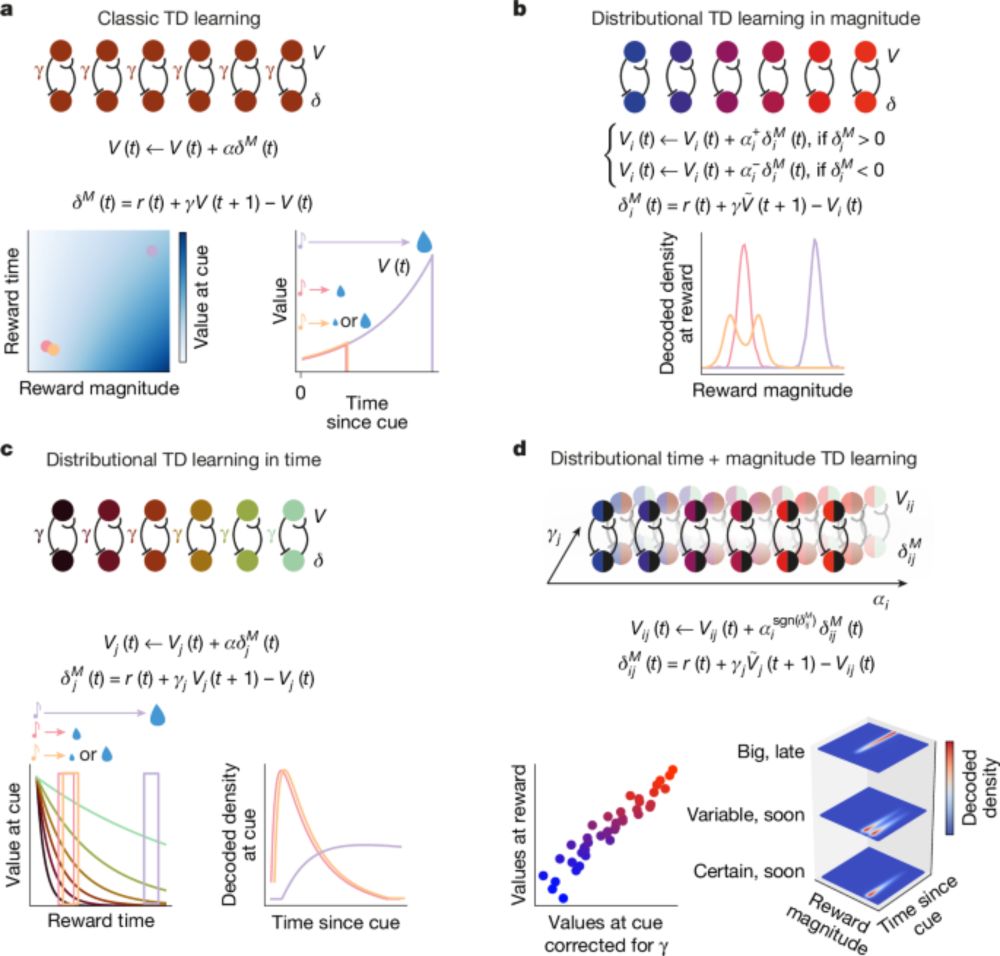
How do #dopamine neurons perform the key calculations in reinforcement #learning?
Read on to find out more! 🧵
19.09.2025 13:05
👍 197
🔁 71
💬 11
📌 4
Congratulations! Really beautiful work!
20.09.2025 14:25
👍 1
🔁 0
💬 1
📌 0
Multi-timescale reinforcement learning in the brain - Nature
Individual dopaminergic neurons encode future rewards over distinct temporal horizons.
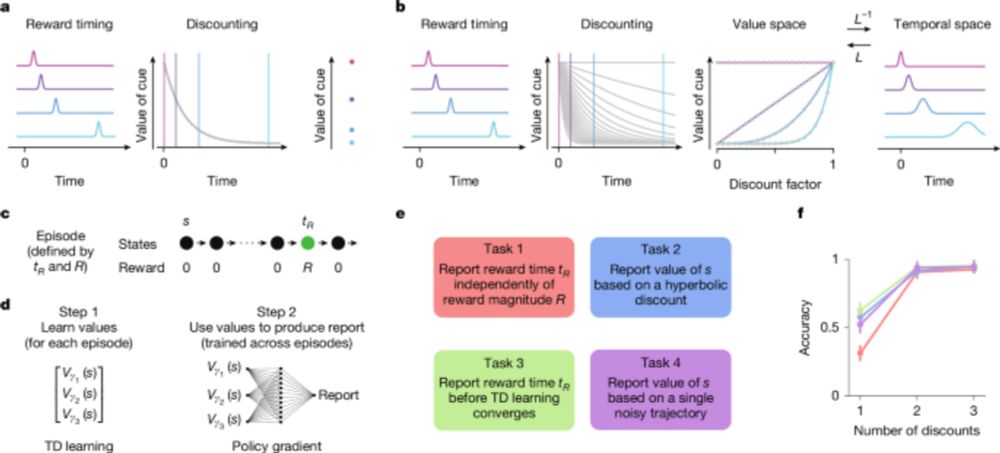
Our work with Pablo Tano, @hyunggoo-kim.bsky.social Athar Malik, Alexandre Pouget and @naoshigeuchida.bsky.social exploring how dopamine neurons could enable multi-timescale reinforcement learning in the brain is out in @nature.com
www.nature.com/articles/s41...
04.06.2025 18:11
👍 111
🔁 45
💬 8
📌 2
Great work from my next door neighbor!
23.05.2025 13:35
👍 2
🔁 0
💬 0
📌 0
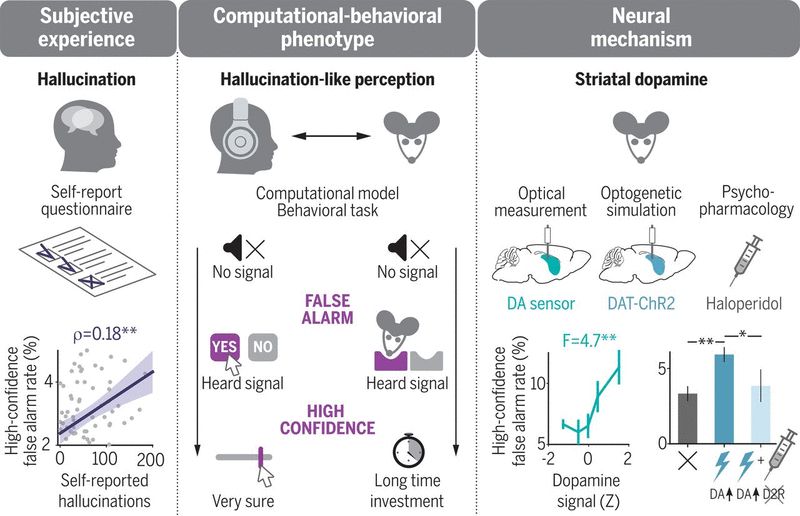
Not sure about the question. Doesn’t hallucination, by definition, mean that the subject is unaware?
I am sure @kepecslab.bsky.social would have a better answer.
23.05.2025 08:36
👍 0
🔁 0
💬 1
📌 0
Individual variability of neural computations underlying flexible decisions - Nature
Behavioural experiments to study decision-making in response to context-dependent accumulation of evidence provide testable models that are consistent with the heterogeneity in neural signatures among...
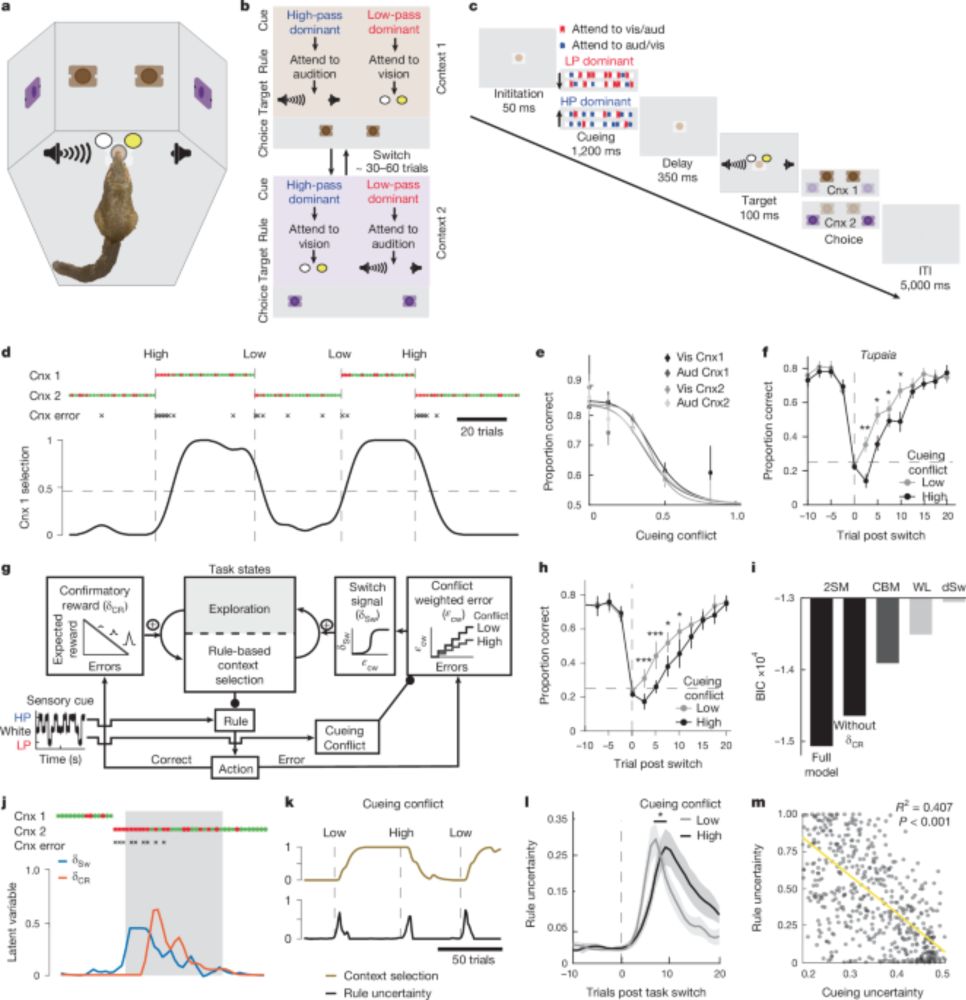
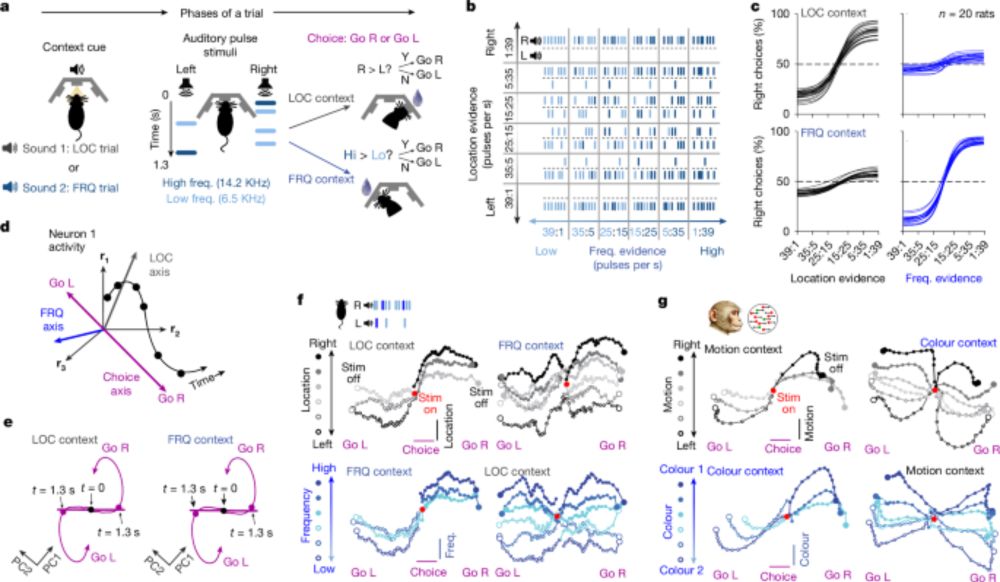
1/7 Our paper on individual variability in decision-making is finally out in @nature.com! Inspired by the classic work by Mante and Sussillo, we trained many rats to solve context-dependent decision-making, and we found that different brains use different neural mechanisms to solve the same task!
21.03.2025 13:28
👍 237
🔁 86
💬 7
📌 5
This looks awesome and very valuable for the study of basal forebrain. Anything in particular you are looking to characterize? We are very interested in GABAergic basal forebrain neurons and would love to know how rodent and human BF are conserved or differ.
17.05.2025 11:17
👍 0
🔁 0
💬 0
📌 0
Congrats to @kepecslab.bsky.social !
11.04.2025 14:28
👍 3
🔁 0
💬 1
📌 0
Beautiful work. Congratulations!
05.03.2025 14:27
👍 1
🔁 0
💬 0
📌 0

a picture of a pikachu with the words " i still have hope " written below it
ALT: a picture of a pikachu with the words " i still have hope " written below it
Some glimmers of hope (but mostly confusion) this morning.
I have heard that no intramural tenure track investigators were supposed to be on the termination list although some folks clearly got termination notices.
I am actively checking into this every way I can.
1/2
16.02.2025 12:44
👍 75
🔁 25
💬 4
📌 0
This is atrocious!
16.02.2025 07:31
👍 0
🔁 0
💬 0
📌 0

A role for proprioceptors in sngception
Proprioceptors mediate acidosis sensation that contributes to acid-induced pain chronicity.
Very interesting paper on a potential role for proprioceptors in sensing muscle acidosis and driving the perception of soreness.
"Sng" is a Taiwanese word for both sour taste and muscle soreness. It also imitates the natural vocalization of humans feeling sore.
www.science.org/doi/10.1126/...
31.01.2025 23:40
👍 17
🔁 5
💬 0
📌 0
Congratulations Dayu!
25.01.2025 11:55
👍 1
🔁 0
💬 0
📌 0