Correction - the Plantago species might actually be P. major (:
05.03.2026 13:13
👍 0
🔁 0
💬 0
📌 0
Correction - the Plantago species might actually be P. major (:

Yes indeed, they sometimes take a while.. this one should work though:
onlinelibrary.wiley.com/doi/10.1002/...
Thanks for the heads up!

A high-alpine Ranunculus glacialis (Glacier buttercup) amidst boulders and scree in SE Switzerland. Photo by Jonathan von Oppen.
*New paper*
What drives the elevational range limits of alpine plants? 🏔️🌿🌼🔝⛔ Our systematic review sums up what we know to date:
📃 doi.org/10.1002/ece3...
Great effort by our @sophieweides.bsky.social and the first paper from her PhD - congratulations! 🎉

Very excited to see the new design of Swiss bank notes (from 2030) prominently featuring both plants 🌿 and mountains 🏔️ 🤩
www.srf.ch/news/wirtsch...
10 - Plantago media 🌱
20 - Pisum sativum 🫛
50 - Fagus sylvatica 🌳
100 - Trisetum flavescens 🌾
200 - Vaccinium myrtillus 🫐
1000 - Ranunculus glacialis 🌼

Congratulations to our PhD candidate Beni Walter who recently won the Best Student Poster award at the International Crop Modelling Conference #ICROPM in Firenze, Italy 🎉🥇
Beni presented his work on improving agricultural land suitability modelling.
Well done Beni! ☺️
*New paper*
Led by our former visiting PhD student Liang Tianchen, we explored shifting alpine treelines and their drivers globally from a remote sensing perspective. 🌲🏔️🛰️
Congrats Tianchen for this publication!
📄 doi.org/10.1016/j.ja...

*Job alert*
We are looking for a research manager in our group, starting from March 2026, with varied tasks ranging from database administration to fieldwork and technical support for other group members.
All details here: shorturl.at/Aygdc
Please repost and share widely!
*New paper*
Species range shifts need to be considered in more dimensions than just along latitude.
See our new study in Nature Climate Change 👇

A warm welcome to Sonja Wipf who has joined our team as a Postdoc!
Sonja brings a lot of experience in alpine plant ecology. She will be working on the #AsMi project to explore assisted migration as a conservation measure for threatened mountain plant species🌼↗️🏔️
It's great to have you in the group!😊

The Uni Basel Ecology group sitting around a table in front of a projected slide, discussing how to identify AI-written text.

An AI-created visualisation of a dataset of bird counts in Sweden. The chart is very confusing and messy and has little to do with the underlying data, so would not recommend using AI blindly for visualising even medium-complex data :)

Ecology group members on a bird-watching platform, with binoculars and spotting scopes, trying to spot birds in the surrounding wetlands of the Petite Camargue Alsacienne in Eastern France.

A common kingfisher (Alcedo atthis) on a branch above a lake in evening light, photographed through a spotting scope.
At our science #retreat yesterday we discussed applications & pitfalls of various #AI tools for our work, from writing to species ID'ing. A great opportunity to learn from each other, develop a common understanding, & connect across the team!
And to go out for some birdwatching during lunch break 🦆
New co-authored paper out!
Even if plant #biodiversity trends seem stable over time, they might not be over shorter timescales and across habitats. What's more, these trends can be detected even without exact resurveys.
Thanks to Gabriele Midolo for leading this effort!

Happy Birthday #GLORIA! 25 years monitoring mountain summit flora, and counting 🏵️🏔️
It was so nice to celebrate together at @imc2025.bsky.social in Innsbruck. Here's to many more decades!
📷 Feline Peters

*Job alert*
We have a 4-year #PhD position open! The project investigates spreading potential & impact of non-native plant species in mountain ecosystems using fieldwork, experimental & data-driven approaches. Starting date: 04/2026.
More info here:
jobs.unibas.ch/offene-stell...
Come work with us!
This position is part of our recently acquired #ERC project 'Global status, trends, drivers and impacts of non-native plant species in mountain ecosystems' (GloNoMo) - more info below and on our website: eco.duw.unibas.ch/en/research/
*Job alert*
We have a 4-year #PhD position open! The project investigates spreading potential & impact of non-native plant species in mountain ecosystems using fieldwork, experimental & data-driven approaches. Starting date: 04/2026.
More info here:
jobs.unibas.ch/offene-stell...
Come work with us!
Although the link above tells you otherwise, applications are still open! New link: jobs.unibas.ch/offene-stell...
Still time to apply for the open #postdoc position in our team!
Note that the link has been updated: jobs.unibas.ch/offene-stell...

A happy Ecology group on top of the "Sphinx", the meteo observatory at Jungfraujoch, Switzerland

Visiting the old, but still running, laboratory at the Jungfraujoch research station.

A plate depicting the surrounding summits with nothing but fog in the background.

The iconic red Jungfrau railway carriages.
We had a great time at #Jungfraujoch during our yearly team outing! Got a fascinating tour of the meteorological & research station (est. 1931), and really enjoyed the trip with the iconic railway (construction finished already in 1912!). We'll have to come back for a better view, though 😉🏔️❄️🧪🚞


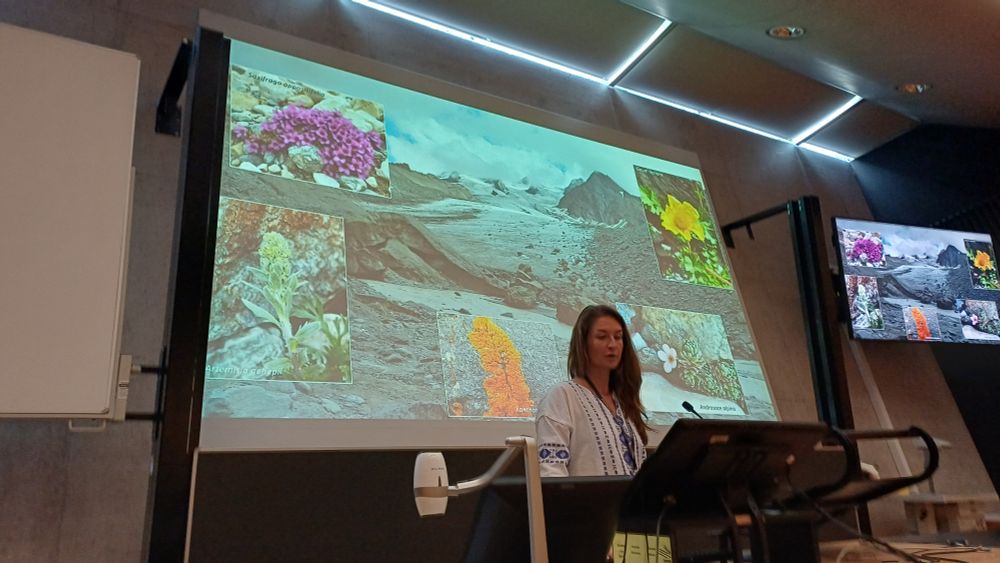

Thank you to everyone who presented in our #microclimate change session today @imc2025.bsky.social! @jlembrechts.bsky.social, @niittynen.bsky.social & I were very happy with the contributions & discussions. Great to see microclimate getting more attention in high-elevation ecosystems 🏔🌡❄️💧
This position is part of our recently acquired #ERC project 'Global status, trends, drivers and impacts of non-native plant species in mountain ecosystems' (GloNoMo) - more info below and on our website: eco.duw.unibas.ch/en/research/
*Job alert*
We have a 5-year postdoc position on #mountain non-native species & #macroecology in our group @unibas.ch. Great opportunity to join us!
Details here: jobs.unibas.ch/offene-stellen/postdoc-position-in-mountain-macroecology/6c5a8906-354f-43c6-bc9b-1156d21725a5
Please share!

New paper!
Want to measure #mountain #microclimate during wintertime but loggers keep breaking? Here's an easy, cost-effective method to help loggers survive snow & visits by curious animals🏔️❄️🦌🌡️💧
Nicely led by Raphael von Büren & @mizeh.bsky.social.
📄 doi.org/10.1111/jvs....
@slfdavos.bsky.social
We cannot wait to get started!
If you want to join us on this endeavour, watch this space for upcoming #PhD & #Postdoc job opportunities :)
#GloNoMo will provide the first global quantification of the status, trends, drivers & impacts of non-native plant species in mountains, by combining large existing datasets with experiments and new monitoring. The outcomes will be essential for the conservation of the world's #biodiversity.

Yellow whitlow-grass (Draba aizoides) within a glacier-shaped alpine landscape. (c) Jonathan von Oppen
Yet, we do not know to what degree non-native species are already present in undisturbed habitats, which species & drivers pose the largest threats, and how natural mountain ecosystems are already impacted by non-native plant species that have become invasive.

Native alpine spring gentian (Gentiana verna) in central Switzerland. (c) Jonathan von Oppen
#Mountain ecosystems to date remain relatively untouched and are home to a large diversity of specialised plant species. However, this unique biodiversity could be threatened by the arrival of #non-native species, which are already becoming increasingly common in disturbed sites such as along roads.
We are very excited to announce that our group leader Sabine Rumpf has been awarded an ERC Starting Grant for her #GloNoMo project to investigate the global status, trends, drivers and impacts of non-native plant species in mountain ecosystems 🎉
@unibas.ch
Details on the project 👇🧵
Native yellow whitlow-grass (Draba aizoides) in the high Swiss Alps in front of a glacier-shaped landscape. (c) Jonathan von Oppen
Yet, we do not know to what degree non-native plants are already present in undisturbed habitats, which species & drivers pose the largest threats, and how natural mountain ecosystems are already impacted by non-native plant species that have become invasive.

Non-native scotch broom (Cytisus scoparius) along a mountain road. (c) https://www.mercurynews.com/2014/10/15/avoiding-invasive-plants/
#Mountain ecosystems to date remain relatively untouched and are home to a large diversity of specialised plant species. However, this unique biodiversity could be threatened by the arrival of #non-native species, which are already becoming increasingly common in disturbed sites such as along roads.
*Job alert*
Come work with us! We have a fully funded 4yr #PhD position in #alpine & #Arctic plant #ecology available in our group @unibas.ch. The project includes fieldwork & connects to other ongoing projects on species range shifts & microclimate.
jobs.unibas.ch/offene-stell...
Please repost!
🌐🧪