So I gave this workshop today and I think it went pretty well. The best comment afterwards was "thanks for presenting statistics as someone who is not dead inside".
I will aim to write this up as a blog post or preprint when I get some time (after teaching finishes later this month).
04.03.2026 16:50
👍 84
🔁 6
💬 0
📌 0


February 21, 1993, died on this day aged 105 years, Danish seismologist Inge Lehman.
She discovered that the Earth has a inner core announcing it in 1936 with the shortest title for a paper ever: P' - after the seismic discontinuity between core and mantle shown by the P-waves
21.02.2026 14:04
👍 180
🔁 58
💬 3
📌 3
The dream dplyr update for my data cleaning pipelines 😍
filter_out() is going to be SO nice, no longer will I need to wrangle with annoying is.na() conditions
replace_values() and recode_values() also going to be a dream too, go read the post!
#rstats
04.02.2026 20:25
👍 31
🔁 9
💬 1
📌 2
Very useful ressource for teaching!
08.02.2026 08:30
👍 0
🔁 0
💬 0
📌 0
APA PsycNet
Nice sunday morning reading on why we should consider generative models in #cogpsy :
"the use of descriptive summary statistics such as mean differences limits inferences about mechanisms underlying various patterns of behavior produced by a given task"
psycnet.apa.org/fulltext/202...
08.02.2026 08:29
👍 0
🔁 0
💬 1
📌 0

**Part 1: From Bayesian inference to Bayesian workflow**
1. Bayesian theory and Bayesian practice
2. Statistical modeling and workflow
3. Computational tools
4. Introduction to workflow: Modeling performance on a multiple choice exam
**Part 2: Statistical workflow**
5. Building statistical models
6. Using simulations to capture uncertainty
7. Prediction, generalization, and causal inference
8. Visualizing and checking fitted models
9. Comparing and improving models
10. Statistical inference and scientific inference
**Part 3: Computational workflow**
11. Fitting statistical models
12. Diagnosing and fixing problems with fitting
13. Approximate algorithms and approximate models
14. Simulation-based calibration checking
15. Statistical modeling as software development

**4. Case studies**
16. Coding a series of models: Simulated data of movie ratings
17. Prior specification for regression models: Reanalysis of a sleep study
18. Predictive model checking and comparison: Clinical trial
19. Building up to a hierarchical model: Coronavirus testing
20. Using a fitted model for decision analysis: Mixture model for time series competition
21. Posterior predictive checking: Stochastic learning in dogs
22. Incremental development and testing: Black cat adoptions
23. Debugging a model: World Cup football
24. Leave-one-out cross validation model checking and comparison: Roaches
25. Model building and expansion: Golf putting
26. Model building with latent variables: Markov models for animal movement
27. Model building: Time-series decomposition for birthdays
28. Models for regression coefficients and variable selection: Student grades
29. Sampling problems with latent variables: No vehicles in the park
30. Challenge of multimodality: Differential equation for planetary motion
31. Simulation-based calibration checking in model development workflow
**Appendices**
A. Statistical and computational workflow for Bayesians and non-Bayesians
B. How to get the most out of Bayesian Data Analysis
Bayesian Workflow by
Andrew Gelman, Aki Vehtari, @rmcelreath.bsky.social with @danpsimpson.bsky.social, @charlesm993.bsky.social, @yulingy.bsky.social, Lauren Kennedy, Jonah Gabry, @paulbuerkner.com, @modrakm.bsky.social, @vianeylb.bsky.social
(in production, estimated copy-editing time 6 weeks)
26.01.2026 08:18
👍 159
🔁 31
💬 3
📌 4
With some trepidation, I'm putting this out into the world:
gershmanlab.com/textbook.html
It's a textbook called Computational Foundations of Cognitive Neuroscience, which I wrote for my class.
My hope is that this will be a living document, continuously improved as I get feedback.
09.01.2026 01:27
👍 585
🔁 237
💬 16
📌 10
I think the options help people to feel a bit more in control, a rare feeling as a novice in R. It could encourage people rather than let them stop using the package out of frustration (a internal counter is hard to figure out... its more of a "why did it stop working, I did the same as yesterday!")
08.01.2026 18:26
👍 0
🔁 0
💬 0
📌 0

We Need to Talk About How We Talk About 'AI' | TechPolicy.Press
We share a responsibility to create and use empowering metaphors rather than misleading language, write Emily M. Bender and Nanna Inie.
Anthropomorphizing language can be cute when applied to your favorite car, but it helps to muddy the discourse when applied to tech sold as "AI". New from me & @nannainie.bsky.social on @techpolicypress.bsky.social -- how to spot & revise away from anthropomorphizing language applied to "AI"
07.01.2026 14:38
👍 307
🔁 117
💬 11
📌 14

course schedule as a table. Available at the link in the post.
I'm teaching Statistical Rethinking again starting Jan 2026. This time with live lectures, divided into Beginner and Experienced sections. Will be a lot more work for me, but I hope much better for students.
I will record lectures & all will be found at this link: github.com/rmcelreath/s...
09.12.2025 13:58
👍 659
🔁 235
💬 12
📌 20
I always tell students they should do the *most appropriate analysis which they (still) understand* or to adapt the question they ask. And-most of the time-I try to listen to my advice as well. But this is not something which is rewarded by the current publishing system and AI surely doesn't help.
20.12.2025 19:40
👍 4
🔁 0
💬 0
📌 0
Working on my first review, #rstats people: what is the best R package for cleaning and deduplicating? Thanks for your help!
06.12.2025 17:10
👍 1
🔁 0
💬 1
📌 0

Screenshot from a flyer that reads:
Public Lecture on Scientific Integrity
Dr. Elisabeth Bik
Errors and Misconduct in
Biomedical Research
Images
Science builds upon science. Even after peer-review and publication, science papers could still contain
images or other data of concern. If not addressed, papers containing incorrect or even falsified data
could lead to wasted time and money spent by other researchers trying to reproduce those results.
Several high-profile cases of science misconduct have been reported, but many more remain
undetected. Elisabeth Bik is an image forensics detective who left her paid job in industry to search for
and report biomedical articles that contain errors or data of concern. She has conducted a systematic
review of 20,000 papers across 40 journals and found that approximately 4% of these contained
inappropriately duplicated images. In her talk, she will present her work and show several types of
inappropriately duplicated images and other examples of research misconduct. In addition, she will
discuss how Artificial Intelligence can both help identify cases of misconduct and also create them, as
well as the growing threat of scientific paper mills.
On the occasion of the Dies academicus of the University of Bern on 6th December 2025,
Elisabeth Bik will receive an honorary doctorate from the Faculty of Science for her
groundbreaking work and untiring commitment to scientific integrity.
Friday 5th December 2025, 4pm
Aula, 2nd floor, Main Building, Hochschulstrasse 4.
Also see this link: https://www.vetsuisse.unibe.ch/e58/e1479157/e1624857/e1753357/Elisabeth_Bik_flyer_2025_A3_20251104_ger.pdf
This afternoon, I will give a public lecture about #ResearchIntegrity and #ImageForensics, at the University of Bern, CH, where I will receive an honorary doctorate from the Faculty of Science tomorrow.
Thank you for your support ❤️
05.12.2025 12:07
👍 183
🔁 21
💬 21
📌 5
If you’re still hunting for color tools, I’m working on a more user-friendly version of meodai.github.io/poline/ keeping you huedrated
23.11.2025 00:42
👍 1934
🔁 396
💬 46
📌 8
All we hear about now is LLMs and AI but the most frequently clicked links in the RDM Weekly newsletter are about basic data management (naming files, documentation, organizing code, etc.). So if you feel behind by what you see posted, please don't. These foundational skills still matter.
21.10.2025 17:05
👍 71
🔁 9
💬 1
📌 1
For me this is a hard red line in psychological science. If you advocate the use of "silicon samples" you do not understand what it is we're supposed to be doing (and likely don't understand LLMs, or are a grifter). Luckily I haven't seen much of this among people I'd consider my peer group.
04.10.2025 08:27
👍 61
🔁 13
💬 1
📌 2
I agree. And it all comes down to how productivity is defined... As soon as quality matters, growth just takes time - we may be able to produce more pages but not more meaning.
30.09.2025 21:30
👍 1
🔁 0
💬 1
📌 0

The best evidence Tylenol causes autism isn't great
On Monday, RFK Jr announced Tylenol ‘causes’ autism referencing three studies as evidence. Let's dive in.
If you’ve been following the RFK Jr autism news, then you’ve probably heard that there’s a systematic review “proving” Tylenol causes autism.
Here’s my review of that paper👇🏼
open.substack.com/pub/epiellie...
25.09.2025 20:20
👍 574
🔁 170
💬 43
📌 13

Whoa—my book is up for pre-order!
𝐌𝐨𝐝𝐞𝐥 𝐭𝐨 𝐌𝐞𝐚𝐧𝐢𝐧𝐠: 𝐇𝐨𝐰 𝐭𝐨 𝐈𝐧𝐭𝐞𝐫𝐩𝐫𝐞𝐭 𝐒𝐭𝐚𝐭 & 𝐌𝐋 𝐌𝐨𝐝𝐞𝐥𝐬 𝐢𝐧 #Rstats 𝐚𝐧𝐝 #PyData
The book presents an ultra-simple and powerful workflow to make sense of ± any model you fit
The web version will stay free forever and my proceeds go to charity.
tinyurl.com/4fk56fc8
17.09.2025 19:49
👍 292
🔁 88
💬 11
📌 4
Launched in 2023, Imaging Neuroscience is now firmly established, with full indexing (PubMed, etc.) and 700 papers to date.
We're very happy to announce that we are able to reduce the APC to $1400.
Huge thanks to all authors, reviewers, editorial team+board, and MIT Press.
05.09.2025 02:59
👍 233
🔁 80
💬 2
📌 6
While being pregnant I learned that I could actually feel quite well which food gives steep rises/falls. White rice for example was a surprise for me then but I learned that one really fast (blood level changes correlated highly with nausea).
15.09.2025 20:33
👍 2
🔁 0
💬 1
📌 0
Welcome to the Psychology Department. It has been 0 days since we discovered something existentially horryfing about bugs in our/their code that lets us question our whole reality... ;-)
11.09.2025 21:49
👍 1
🔁 0
💬 0
📌 0
The Art of Data Visualization with ggplot2
A shout out for @nrennie.bsky.social fab book on data viz! nrennie.rbind.io/art-of-viz/
05.09.2025 11:17
👍 34
🔁 10
💬 2
📌 0
Is your preprint still pending moderation? See our recent post about how to make sure getting it approved is a smooth process:
bsky.app/profile/impr...
(pro tip: you can make edits even while it's in the moderation queue!)
30.08.2025 22:02
👍 2
🔁 3
💬 0
📌 0

Cover matter: Navigating Open Research A Guide for Early Career Researchers
From CONUL - consortium of national and university libraries #openResearch #irishResearch
Navigating Open Research: A Guide for Early Career Researchers. Great work from the CONUL Research Group. Free to download zenodo.org/records/1702... #irishResearch #openResearch
02.09.2025 09:35
👍 37
🔁 18
💬 0
📌 1
"If someone wants to be part of a group, they have to (silently) accept the violence generally experienced by this group" is a hell of a take! Trans women have a very, very valuable and revealing voice in calling out violence directed at women because they often have a comparison which others don't!
23.08.2025 12:48
👍 1
🔁 0
💬 0
📌 0
Steve Shirley escaped the Holocaust as a child & went on to found one of the earliest software startups. The really impressive part? She employed women programmers who had been pushed out of the workforce after having kids, & allowed them flexible, family friendly, work from home jobs—in the 1960s!
22.08.2025 10:18
👍 1530
🔁 577
💬 21
📌 19
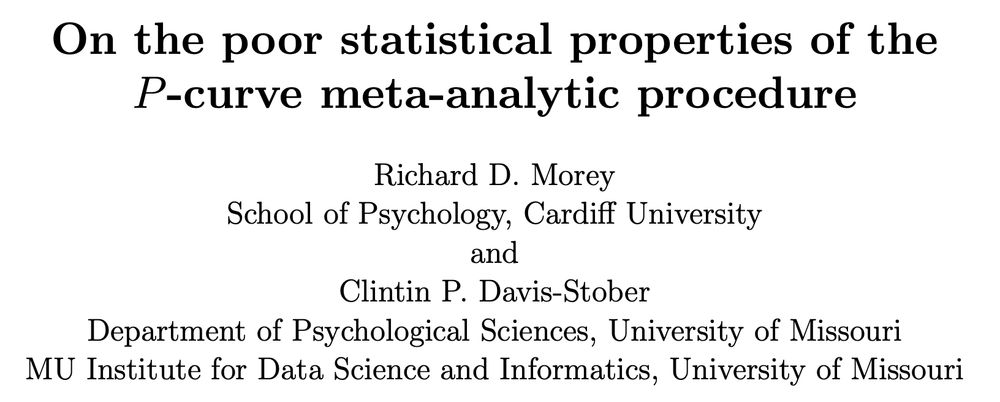
Cover page for the manuscript: Morey, R. D., & Davis-Stober, C. P. (2025). On the poor statistical properties of the P-curve meta-analytic procedure. Journal of the American Statistical Association, 1–19. https://doi.org/10.1080/01621459.2025.2544397
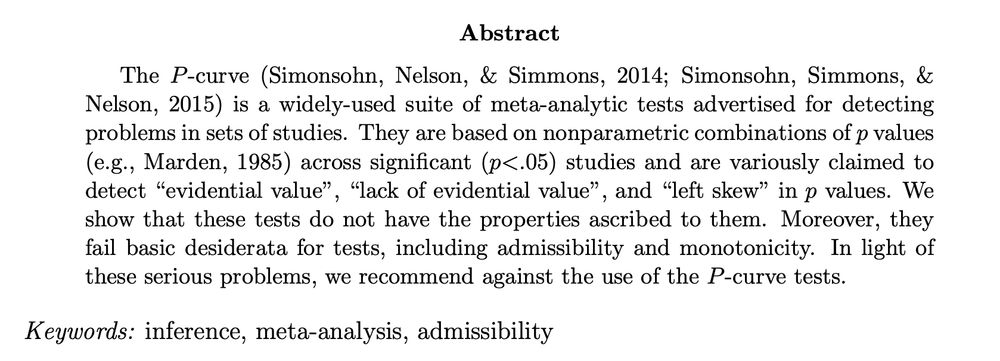
Abstract for the paper: The P-curve (Simonsohn, Nelson, & Simmons, 2014; Simonsohn, Simmons, & Nelson, 2015) is a widely-used suite of meta-analytic tests advertised for detecting problems in sets of studies. They are based on nonparametric combinations of p values (e.g., Marden, 1985) across significant (p < .05) studies and are variously claimed to detect “evidential value”, “lack of evidential value”, and “left skew” in p values. We show that these tests do not have the properties ascribed to them. Moreover, they fail basic desiderata for tests, including admissibility and monotonicity. In light of these serious problems, we recommend against the use of the P-curve tests.
Paper drop, for anyone interested in #metascience, #statistics, or #metaanalysis! @clintin.bsky.social and I show in a new paper in JASA that the P-curve, a popular forensic meta-analysis method, has deeply undesirable statistical properties. www.tandfonline.com/doi/full/10.... 1/?
08.08.2025 18:55
👍 290
🔁 122
💬 17
📌 27
Psychologists & related fields: what is a big methods question that you believe remains somewhat unanswered & that you'd love to see adressed? There may be an opportunity for a large-scale meta-science project with many teams trying to figure out a question.
Any thoughts welcome! #psychscisky
30.07.2025 14:03
👍 146
🔁 57
💬 37
📌 7