

Answering the most popular question in a PhD methods course
datacolada.org/133
02.03.2026 19:03
👍 24
🔁 9
💬 1
📌 2
Answering the most popular question in a PhD methods course
datacolada.org/133

The South Bronx bandleader took the Latin genre to new heights while recording for Fania Records. n.pr/4kLTCKV
late to the party, but congrats, Felix!

PIano being dropped on car in car testing facility
Would p-curve work if you dropped a piano on it?
datacolada.org/129
Completely agree. Averages can hide weird patterns. We make a related point about stimuli in psych experiments and propose a visualization here: psycnet.apa.org/record/2026-... (or datacolada.org/126 for a summary)

Colada[128] The Best Audit Study and its interesting shortcoming
datacolada.org/128
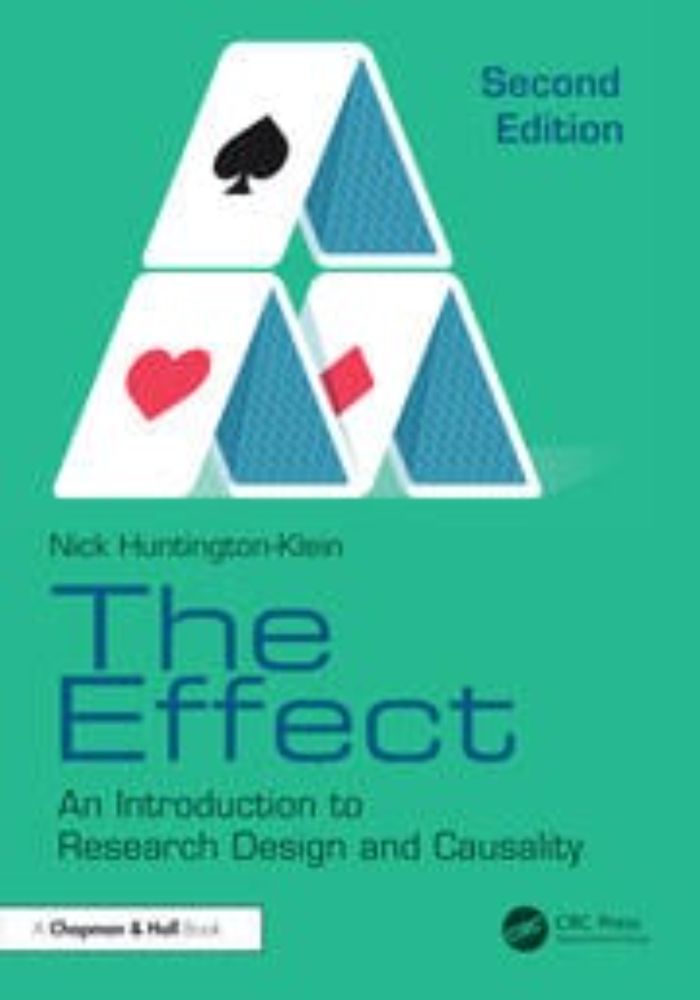
The second edition of The Effect has been delayed a bit... because there were so many orders they had to switch to a bigger print run! Thank you everyone for your support, and check out the second edition here: www.routledge.com/The-Effect-A...
Thank you!!
Completely agree!
In those cases, it can feel like the kind thing to do is to either not mention them at all or to soften them so much that they become obscured. And that’s where I think there is an inevitable tension between kindness and truth-seeking
…
I largely agree with this, and I think it’s something that some critically minded people tend to underweigh. The biggest challenge in practice, I think, is that certain criticisms-no matter how carefully you frame them-will still be perceived as unkind
…

Don't assume, plot
datacolada.org/126
Same (except with base r). I find it quite enjoyable, and it has made me more fastidious with figures.
It could work. I'm particularly interested in confounds and causal identification, because so called 'conservative confounds' could create other unintended problems. But my concern might apply to this as well.
Interesting, I was thinking about this in the context of causal identification rather than statistical significance. I was curious about counterarguments like "what seems like a 'conservative confound' that goes against the observed effect may actually change how the other mechanisms work."
thanks!
Does anybody know of a paper or blog discussing arguments of the form "we found our results despite this confound that works against our effect"? Essentially, how to think about confounds that go against the hypothesized or observed effect.

Parts of this book would probably work: press.princeton.edu/books/paperb...

Really proud of this new work out @psychscience.bsky.social. Led by the amazing but bluesky-less Amanda Geiser and with @deborahsmall.bsky.social.
We show that when comparing moral wrongs, people are (much) more willing to “scale up” than to “scale down” condemnation and punishment…
Measurement error, Nobel Prize winning research, friendly disagreements, and more....
datacolada.org/124

🏆 Research integrity consultant and image forensics expert @elisabethbik.bsky.social has uncovered fraudulent data in over 7,600 scientific papers and exposed the practices of ‘paper mills’ that produce counterfeit scientific articles. She is honoured with the €200K Individual Award. Congrats!

The vibraphonist, composer and jazz-funk pioneer helped inspire the neo-soul movement, and his best-known song was sampled over 100 times.

Delving into a disagreement with prominent political scientists on a fundamental data-analysis question: what do you want to learn from a regression interaction?
datacolada.org/123

Today in @worksinprogress.bsky.social, I reflect on Donald Shoup's legacy. Perhaps the most interesting question: how did the most unlikely professor kick off an international parking reform movement?
substack.com/home/post/p-...

How to use excel safely to avoid errors: www.tandfonline.com/doi/full/10....
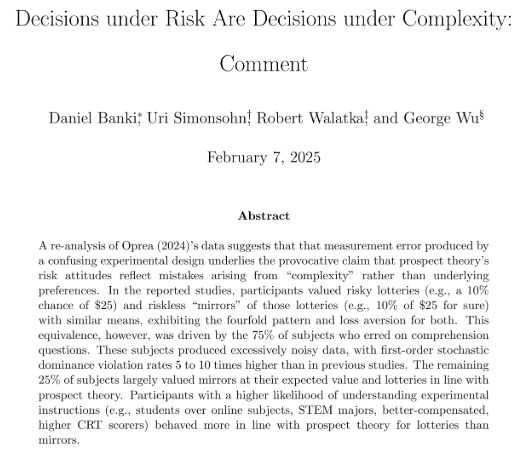
Title Authors Abstract (Decision under Risk are Decisions Under Complexity: Comment)
A new working paper with Daniel Banki, @urisohn.bsky.social and Robert Walatka, just submitted to SSRN.
The paper is comment on Ryan Oprea's recent AER paper.
The paper is processing, but you, my friends, get early entry.
papers.ssrn.com/sol3/papers....

Yeah, I have a different read of the evidence that aligns more with this (parentdata.org/alcohol-and-...) and hence why I find the causality statement too strong. But we can agree to disagree. Thanks for engaging.
Thanks! Though given the absence of causal evidence in humans, I’m not sure I would refer to this as causal. The key issue of what level of dosage is harmful in humans is particularly hard to learn from observational studies.
What is the best available evidence that alcohol *causes* cancer? So far the evidence I have seen comes from observational studies