
🚨 Now out in the Economic Journal:
“Patience and Subnational Differences in Human Capital:
Regional Analysis with Facebook Interests”
w/ Hanushek, @kinnelavinia.bsky.social & Sancassani
💡 Patience accounts for ¾ of regional achievement diffs in Italy, ⅓ US
👉 doi.org/10.1093/ej/u...
30.01.2026 06:02
👍 21
🔁 8
💬 0
📌 0

Paper Title: Information Framing and Student Decisions: Evidence from an Opportunity Cost Intervention
Authors: Lars Behlen, Raphael Brade, Oliver Himmler, Robert Jäckle
Abstract: Opportunity costs are central to economic decision-making but often neglected. In a pre-registered experiment with 2,222 German university freshmen, one treatment provides salary information; another additionally frames it as the opportunity cost of delayed graduation. Only the opportunity cost framing causes students to update salary expectations. We find no effect on academic progress but a 2.8 percentage points increase in first-semester dropout (p=0.080), concentrated among high-dropout-probability students (5.9 pp, p=0.025). For these marginal students, dropping out instead of progressing faster is the actionable margin. By semester three, dropout rates converge, suggesting acceleration of eventual exits rather than additional dropouts.
Keywords: natural field experiment, opportunity cost neglect, earnings expectations, academic achievement
JEL Codes: C93, D84, D91, I21, I23
New WP!
We study whether telling first-year students about the earnings they forgo by delaying graduation changes their choices. Framing salaries as opportunity costs does not speed up progress but increases early dropout among students who are likely to exit eventually.
www.ifo.de/DocDL/cesifo...
13.02.2026 11:23
👍 9
🔁 4
💬 0
📌 0

📢 Call for papers:
CESifo Area Conference on Economics of Education
co-organized w/ Eric Hanushek (Stanford)
🏛️ 11-12 Sept 2026, Munich
🧑🏫 Keynote: John List (Chicago) @johnlist.bsky.social
👉 www.ifo.de/en/cesifo/ev...
⏰ Deadline: 11 May 2026
🖼️ Past programs:
sites.google.com/view/woessma...
26.01.2026 06:00
👍 39
🔁 27
💬 1
📌 3

📣 Thrilled to announce our 5th Workshop on Field Experiments in Economics and Business, 7-8 Sept 2026, @tum.de, Campus Heilbronn.
Keynotes: @peterbergman.bsky.social (University of Texas at Austin) & Esther Duflo (@mit.edu, University of Zurich) 🫶🏻
Submission deadline May 15, 2026 🚨
#EconSky
28.01.2026 09:51
👍 33
🔁 17
💬 1
📌 2


🚀 KICK-OFF 🚀
Over the next five years, I’ll be working jointly with ROCK YOUR LIFE on a large randomized-controlled trial with disadvantaged adolescents to generate robust, policy-relevant evidence on how mentoring can be effectively scaled. [1/2]
02.02.2026 08:38
👍 11
🔁 2
💬 1
📌 0

📣SAVE-THE-DATE 📣
Our Workshop on Field Experiments in Economics and Business celebrates its 5th anniversary with FANTASTIC keynote speakers: @peterbergman.bsky.social (UT Austin) and Esther Duflo (MIT) 🎉🙌
📍 Sept 7–8, 2026 at TUM Campus Heilbronn (pre-workshop get-together Sept 6).
23.12.2025 14:34
👍 18
🔁 5
💬 1
📌 0
🚨 Deadline on Sunday:
🚀 4th CESifo Junior Workshop on the Economics of Education 🤩
👇
07.01.2026 05:59
👍 10
🔁 9
💬 1
📌 1

Strong Public Support To Restrict Social Media for Children in Germany
A huge majority of adults favors a minimum age for social media – and even adolescents themselves see harm from social media.
📢Our piece on @jonathanhaidt.bsky.social's "After Babel" Substack:
Strong public support to restrict social media for children in Germany
www.afterbabel.com/p/strong-pub...
A huge majority of adults favors a minimum age for social media – and even adolescents themselves see harm from social media
16.12.2025 16:05
👍 12
🔁 5
💬 1
📌 0


🚨 Unsere neue Studie zeigt:
👉 Das Erreichen der Ziele „Bessere Bildung 2035“ würde rund 21 Billionen Euro an zusätzlicher Wirtschaftsleistung bringen
"Volkswirtschaftliche Erträge besserer Bildung"
mit Katia Werkmeister für die @bertelsmannst.bsky.social
www.ifo.de/publikatione...
1/3
15.12.2025 11:20
👍 14
🔁 12
💬 1
📌 2
Wish to stay up to date with our work? Subscribe to the ifo Education Newsletter 📨
👉 www.ifo.de/en/research/...
19.12.2025 14:10
👍 0
🔁 0
💬 0
📌 0

🎅🎁Our last newsletter of 2025 is out!
✨What Facebook data reveal about patience & educational achievement
✨Religious education has long-term effects
✨Good schools help disadvantaged children
...& more!
👉 sendlx.com/display.php?M=111332033&C=ff6ce63f422bb23d840c4ce5648c1c70&S=201333&L=1198&N=111605
19.12.2025 14:10
👍 4
🔁 2
💬 1
📌 0

I'm very happy that this paper has found a home and has been published just in time for the holidays. Free access for 50 days: authors.elsevier.com/a/1mI6Bc24bB...
18.12.2025 14:00
👍 9
🔁 4
💬 0
📌 0
Absolutely thrilled to be joining this fantastic group of researchers 🤩 🥳 🤓
@ifoeducation.bsky.social
@cesifo.org
11.12.2025 09:58
👍 7
🔁 1
💬 1
📌 0

1/ 📣 BIG News!
It’s finally official: I’m starting a new job – and it’s the BEST! 🥳
I’ve joined the ifo Institute Munich as Deputy Director of the @ifoeducation.bsky.social (tenured) and have been appointed Associate Professor (tenure-track) at @lmumuenchen.bsky.social / @econmunich.bsky.social.
10.12.2025 12:51
👍 58
🔁 2
💬 11
📌 2

Can Schools Change Religious Attitudes? Evidence from German State Reforms of Compulsory Religious Education
Benjamin W. Arold, Ludger Woessmann and Larissa Zierow
We study whether compulsory religious education in schools affects students’ religiosity as adults. We exploit the staggered termination of compulsory religious education across German states in models with state and cohort fixed effects. Using three different datasets, we find that a reform abolishing compulsory religious education significantly reduced the religiosity of affected students in adulthood. It also reduced the religious actions of personal prayer, church-going, and church membership. Beyond religious attitudes, and consistent with a shift towards worldly norms and economic activities, the reform led to higher labor-market participation and earnings. By contrast, the reform did not affect ethical and political values or non-religious school outcomes.
Can schools change faith? Benjamin Arold, @woessmann.bsky.social & Larissa Zierow find that ending mandatory #ReligiousEducation reduces adult #religiosity by 7%. Students earn more, work longer hours, but pray less and skip church.
doi.org/10.3368/jhr....
29.10.2025 14:08
👍 6
🔁 5
💬 0
📌 0
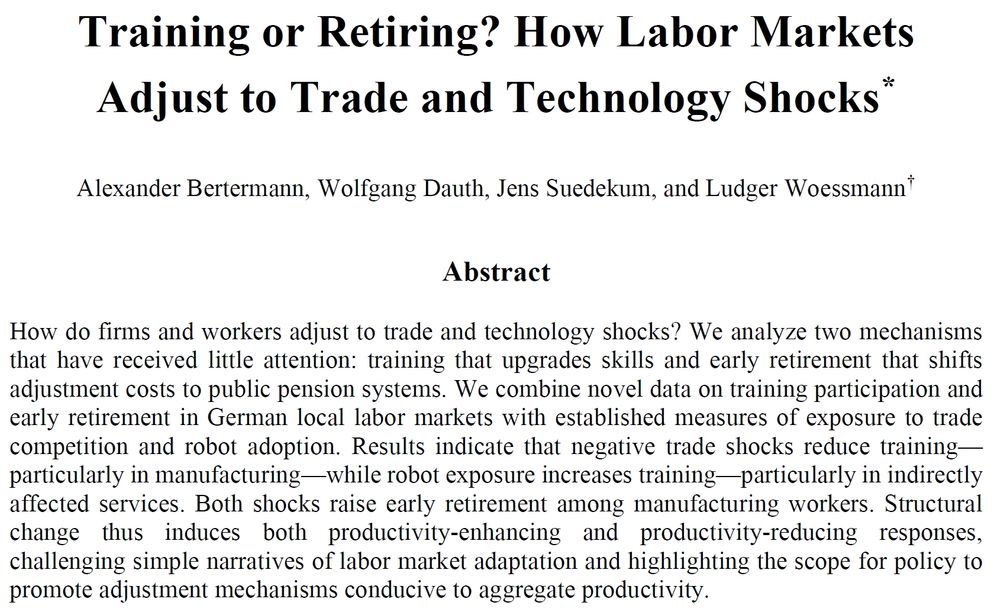
🆕Working Paper🚨
Training or Retiring? How Labor Markets Adjust to Trade and Technology Shocks📒
w/ A.Bertermann, @dauthecon.bsky.social & @suedekum.bsky.social
🤖 Robots ➡️ ⬆️training & ⬆️early retirement
🌏 Imports ➡️ ⬇️training & ⬆️early r.
🌎 Exports ➡️ ⬆️training & ⬇️e.r.
www.ifo.de/DocDL/cesifo...
🧵1/9
11.11.2025 05:59
👍 30
🔁 13
💬 1
📌 1

🎙️ Check out the ifo podcast on childcare shortages in Germany, where I was a guest.
Grateful to research this topic with Marina Krauß, @lergetporer.bsky.social, @fpeter.bsky.social, @simonwiederhold.bsky.social, Fabian Mierisch & Guido Schwerdt.
Link 👇
1/2
10.11.2025 08:58
👍 7
🔁 3
💬 1
📌 0
📢 New working paper alert! 📢
Super happy to share our new working paper, „The Demand for Economic Narratives“, with my great co-authors Sebastian Blesse, Klaus Gründler, and @philippheil.bsky.social.
Check out the summary thread by Philipp below👇🏻🧵
@ifoeducation.bsky.social
@cesifo.org
24.10.2025 10:20
👍 12
🔁 3
💬 0
📌 0

Wohlstand durch Bildung
Wissen ist die Grundlage unseres Wohlstands. Wie Nationen dieses Kapital vermehren können, stellte Wirtschaftswissenschaftler Ludger Wößmann im Rahmen einer gemeinsamen Vorlesung von ÖAW und Statistik...
Bildung ist die Grundlage unseres Wohlstands. Wie Nationen dieses Kapital vermehren können:
Mein Interview zu meinem Vortrag bei der Österreichischen Akademie der Wissenschaften @oeaw.bsky.social (ÖAW-/Statistik Austria-Lecture)
www.oeaw.ac.at/news/wie-hae...
16.10.2025 15:47
👍 7
🔁 2
💬 0
📌 0

🚨 Now out in Journal of Human Resources:
⛪️ Can Schools Change Religious Attitudes?
Evidence from German State Reforms of Compulsory Religious Education
w/ @benjaminarold.bsky.social & Larissa Zierow
👉 Religious education in school affects adult lives
🔗 jhr.uwpress.org/content/earl...
A 🧵 1/6
10.10.2025 05:00
👍 50
🔁 17
💬 1
📌 3

📢 Call for papers:
🚀 4th CESifo Junior Workshop on the Economics of Education 🤩
30-31 March 2026, Munich
Keynote: Michela Carlana (Harvard)
PhD students & early postdocs, please apply!
www.ifo.de/en/cesifo/ev...
Deadline: 11 Jan 2026
@caterinapavese.bsky.social @mtotarelli.bsky.social
07.10.2025 08:05
👍 24
🔁 28
💬 1
📌 5

Check out the current edition of our newsletter.
Topics:
🔷What adolescents and adults think about social media
🔷Socioeconomic gap in child care
🔷Peers at college entry improve performance
...
👉http://sendlx.com/display.php?M=111124773&C=71415e53f9fcb9e9f5c8facfea005ae8&S=198827&L=2481&N=109616
09.10.2025 11:50
👍 2
🔁 1
💬 0
📌 0

Group picture from the Workshop on Field Experiments in Economics and Business 2025 at TUM Campus Heilbronn
Looking back to a wonderful 4th edition of our Workshop on Field Experiments earlier this week – what an amazing crowd 😍
Thank you all for coming and making this event possible – special shoutout to our keynotes, Ulrike Malmendier & Noam Yuchtman 🙏
To a 5th edition in 2026! 🚀
12.09.2025 06:17
👍 31
🔁 3
💬 1
📌 4
LERNBPF25 - Bildung in Zeiten von Transformation und beruflichem Wandel - Prof. Dr. Ludger Wößmann
YouTube video by Leibniz-Forschungsnetzwerk Bildungspotenziale
Ich freue mich schon riesig auf das
🚨Bildungspolitische Forum 2025🚨
in das ich in diesem Jahr einführen darf!
Es geht um
➡️Bildung in Zeiten von Transformation und beruflichem Wandel⬅️
Im Video reiße ich schon mal die Themen an, um die es geht:
👉 www.youtube.com/watch?v=yfuA...
1/2
11.09.2025 06:03
👍 7
🔁 4
💬 1
📌 0

Digitale Welt, geteilte Meinungen
Das ifo-Bildungsbarometer zeigt: Erwachsene wollen strenge Regeln, Jugendliche sind gespalten. Politik und Wissenschaft suchen derweil nach einer Balance zwischen Schutz und Chancen. Im Wiarda-Blog: www.jmwiarda.de/blog/2025/09...
09.09.2025 09:33
👍 8
🔁 5
💬 0
📌 0
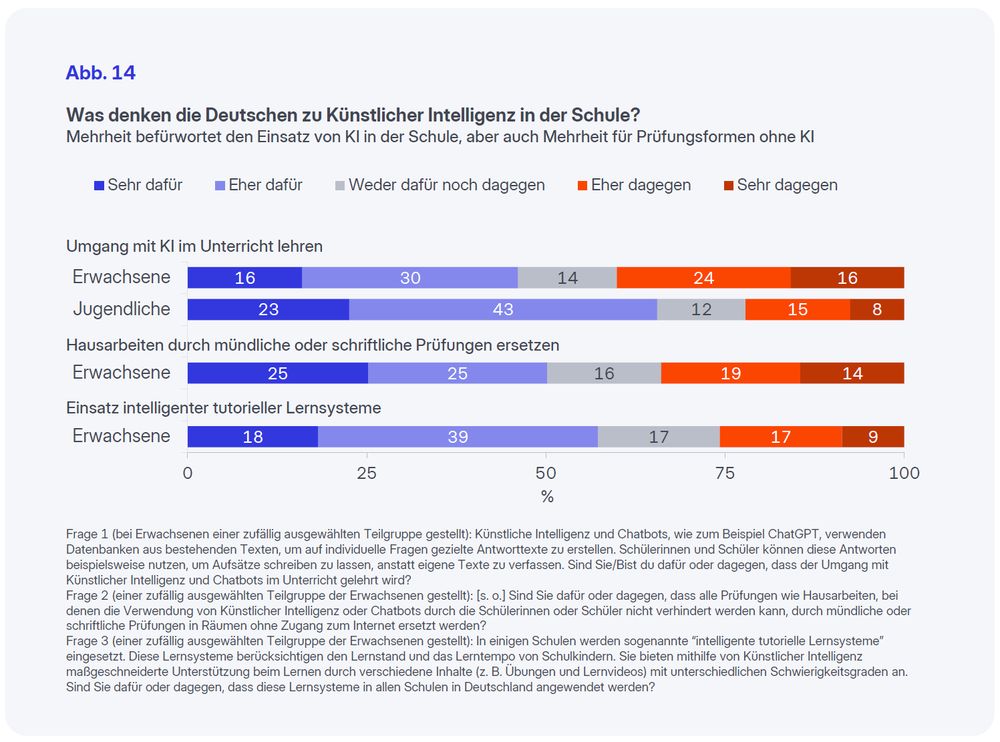
66% der Jugendlichen und 46% der Erwachsenen sind dafür, dass der Umgang mit KI im Unterricht gelehrt wird.
7/7
09.09.2025 08:00
👍 3
🔁 1
💬 0
📌 1

82% der Jugendlichen und 50% der Erwachsenen nutzen Künstliche Intelligenz für schulische bzw. berufliche Zwecke.
6/7
09.09.2025 08:00
👍 3
🔁 1
💬 1
📌 0


