Our paper is out in @Science! The Atlantic silverside spans Earth's steepest latitudinal gradient in coastal sea-surface temperature. Despite high gene flow, populations show clinal genetic variation in multiple locally adapted traits. doi.org/10.1126/scie...
05.03.2026 19:05
👍 48
🔁 20
💬 6
📌 1

MBE | Genomic comparisons and the adaptive basis of brain size plasticity and chromosomal instability in the Eurasian common shrew
Thomas et al. reveal that positively selected and differentially expressed hippocampal genes cluster near breakpoints in shrews, tying chromosomal rearrangements and accessible chromatin to adaptation and brain size plasticity.
🔗 doi.org/10.1093/molbev/msag006
📷 Christian Ziegler
#evobio #molbio
11.02.2026 18:16
👍 4
🔁 3
💬 1
📌 1
The neo-Ys are heavily rearranged and have unique gene losses. The neo-Xs are surprisingly colinear but are distinguished by Y-haplogroup specific inversions. The neo-Xs consist of an ancestral-X and three autosomal fusions.
02.02.2026 14:51
👍 1
🔁 0
💬 0
📌 0
Check out our paper on the neo-sex chromosomes in mountain pine beetle! We assembled THREE neo-Ys that are quite distinct and their corresponding neo-Xs .
02.02.2026 14:51
👍 9
🔁 5
💬 1
📌 0
Lethal epistasis maintains strong linkage disequilibrium between unlinked supergenes https://www.biorxiv.org/content/10.64898/2026.01.08.698410v1
09.01.2026 03:32
👍 14
🔁 7
💬 0
📌 0

New work from @miyapan.bsky.social and our team, bringing ant, bee, and wasp labs together. @chuanxinyu.bsky.social shows that the ANTSR locus we discovered in ants has determined sex for 150+ My across bees and stinging wasps 🐜🐝, despite virtually no sequence conservation 😮 doi.org/10.1073/pnas...
06.01.2026 03:01
👍 89
🔁 37
💬 2
📌 6

Genomic evidence of a complex supergene system linking dispersal to social polymorphism
Mona et al. report a complex supergene system in the ant Myrmecina graminicola characterized
by three alleles determining both the number of queens in a colony (monogyne vs. polygyne)
and the presence...
New in @currentbiology.bsky.social
"Genomic evidence of a complex supergene system linking dispersal to social polymorphism"
#Myrmecina_graminicola
Mona,S., Gay,E.J., Ducancel,J., Laso-Jadart,R., Chifflet-Belle, P., Doums,C. @isyeb.mnhn.fr @ephe-psl.bsky.social et al.
🐜 www.cell.com/current-biol...
21.11.2025 09:55
👍 10
🔁 8
💬 0
📌 0

Complementary sex determination (CSD) in bees and ants. Top left: Single-locus CSD is likely to be the predominant mode of sex determination in Hymenoptera. CSD loci have been identified in two species: the honeybee Apis mellifera and the invasive ant Linepithema humile. The tree shows evolutionary relationships between these species and Osmia bicornis, the main subject of this study. The origin of Hymenoptera is estimated as 386 million years ago and the common ancestor of Apoidea and Formicoidea is estimated as 153 million years ago. Top right: Under single-locus CSD, females are heterozygous at the CSD locus, whereas males are haploid and therefore hemizygous. A large number of CSD alleles are expected to segregate in outbred populations. A small proportion of homozygotes at the CSD locus are produced by chance, when parents share an allele, which results in the production of sterile diploid males. Middle: An O. bicornis nest consists of a row of cocoons in a tube. The mother lays fertilized diploid eggs deepest in the nest and unfertilized haploid eggs closer to the entrance. Eggs develop into adults inside cocoons. Diploid eggs typically develop into females whereas haploid eggs become male. A small proportion of diploids that are homozygous at the CSD locus develop into diploid males, which occur amongst females and are larger than haploid males. Bottom: A male and female red mason bee mating. Photo by Marie Louise Huskens.
#Haplodiploid inheritance is found in all species of #Hymenoptera. @mwbstr.bsky.social &co map the #sex determining #gene of the red mason #bee to the ANTSR gene region, suggesting a shared, ancient origin of #SexDetermination in bees & ants >150 Mya ago @plosbiology.org 🧪 plos.io/47COEtH
04.11.2025 13:58
👍 11
🔁 3
💬 0
📌 0

2 year postdoc position in evolutionary genomics available at the University of California, Riverside in the Purcell Lab
2 year postdoc position in evolutionary genomics at University of California, Riverside in the Purcell Lab! 🧬🐜
17.10.2025 21:58
👍 0
🔁 0
💬 0
📌 0

Constraints on chromosome evolution revealed by the 229 chromosome pairs of the Atlas blue butterfly
The genome of the Atlas blue butterfly contains ten times more chromosomes than most
butterflies, and more than any other known diploid animal. Wright et al. show that
this extraordinary karyotype is ...
How many chromosomes can an animal have?
In our paper out now in @currentbiology.bsky.social we show that the Atlas blue butterfly has 229 chromosome pairs- the highest in diploid Metazoa! These arose by rapid autosome fragmentation while sex chromosomes stayed intact.
www.cell.com/current-biol...
11.09.2025 15:21
👍 214
🔁 99
💬 4
📌 6
ggplot2 ethusiasts, new update just dropped! 🔥🔥🔥
11.09.2025 13:33
👍 1
🔁 0
💬 0
📌 0

ggplot2 4.0.0
A new major version of ggplot2 has been released on CRAN. Find out what is new here.
I am beyond excited to announce that ggplot2 4.0.0 has just landed on CRAN.
It's not every day we have a new major #ggplot2 release but it is a fitting 18 year birthday present for the package.
Get an overview of the release in this blog post and be on the lookout for more in-depth posts #rstats
11.09.2025 11:20
👍 850
🔁 281
💬 9
📌 51
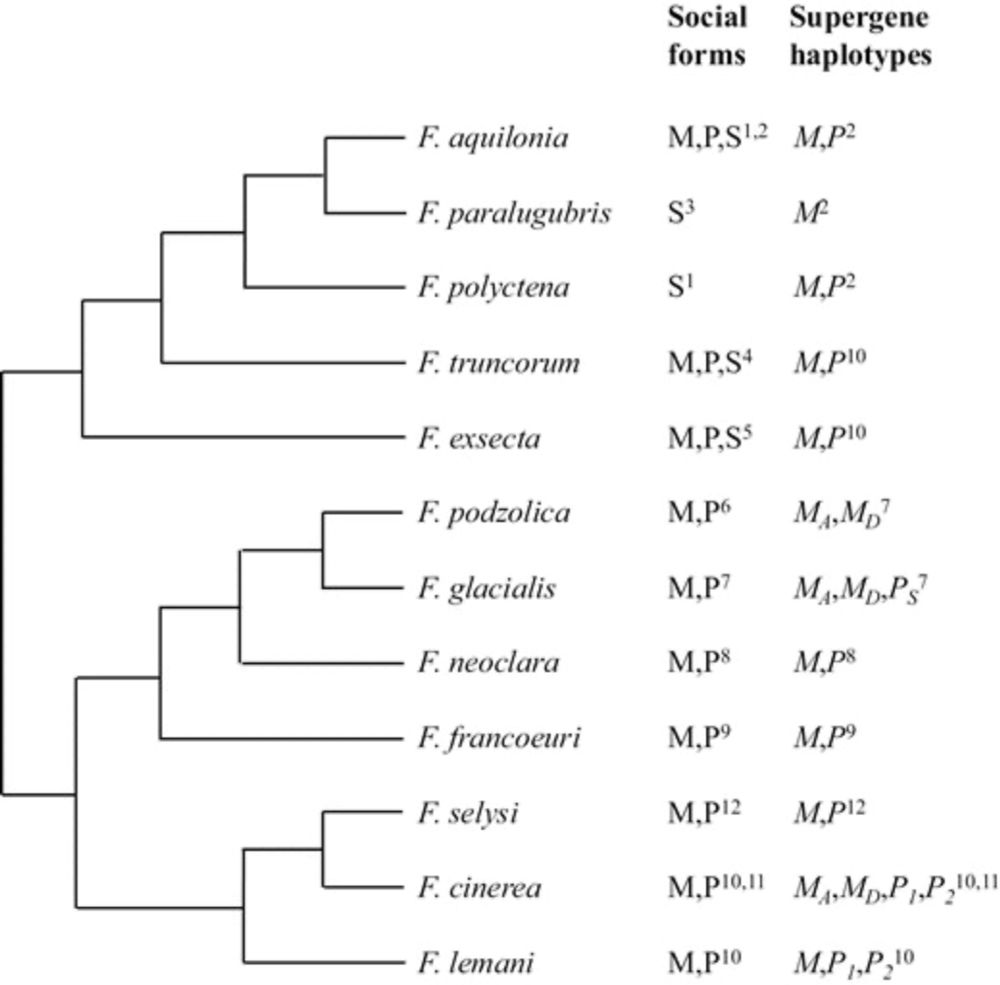
Check out our latest preprint in Formica ants! We investigate how the sex ratio supergene evolved. We find that a colony-level sex ratio supergene evolved twice! This likely occurred as a result of recombination between the the ancestral queen number supergenes present in Formica. 🧬🐜🧬🐜🧬🐜
02.09.2025 14:32
👍 3
🔁 0
💬 0
📌 0
Led by Jessica Purcell. The team included @giuliascarparo.bsky.social , Madison Sankovitz, Mari West, Zul Alam, and Alan Brelsford.
24.07.2025 14:10
👍 1
🔁 1
💬 0
📌 0
There were ~10% of colonies showing mismatches between supergene genotype and phenotype, but we only observed this at one site. This raised the possibility that environment may override supergene control of colony queen number.
24.07.2025 13:39
👍 1
🔁 0
💬 1
📌 0
Colonies with single queens were more common in the north, but the queen number polymorphism was present throughout the gradient. The supergene haplotype frequency reflected this as the frequency also varied with latitude.
24.07.2025 13:39
👍 0
🔁 0
💬 1
📌 0
We sampled Formica podzolica colonies across a latitudinal gradient between Alaska and New Mexico. Surprisingly, Formica podzolica has SIX(!) common supergene variants that are differentiated by three distinct cassettes.
24.07.2025 13:39
👍 0
🔁 0
💬 1
📌 0
Very pleased to see this officially out - Genome Architecture and Speciation in Plants and Animals. With @siluwang.bsky.social, @dortizba.bsky.social and Loren Rieseberg. onlinelibrary.wiley.com/doi/10.1111/...
27.06.2025 13:22
👍 47
🔁 30
💬 0
📌 0
Thanks to Zul Alam and Alan Brelsford for their work on this! (4/n)
09.04.2025 14:02
👍 0
🔁 0
💬 0
📌 0
Taken together, these results suggest that supercoloniality isn't as simple as having the multi-queen supergene haplotype. (3/n)
09.04.2025 14:02
👍 0
🔁 0
💬 1
📌 0
We find that the multi-queen haplotype is missing from a supercolonial population. Additionally, we find a similar pattern with the multi-queen haplotype being absent in one supercolonial species, but present in another. (2/n)
09.04.2025 14:01
👍 1
🔁 0
💬 1
📌 0
Is supercoloniality a simple extension of polygyny?Supercolonies, networks of interconnected nests with many queens, have been proposed as a natural extension of multi-queen nests. In many Formica ants, a supergene determines whether a colony has a single queen or many queens. (1/n)
09.04.2025 14:01
👍 2
🔁 2
💬 2
📌 0
Thanks to Zul Alam and Alan Brelsford for their work on this! (4/n)
09.04.2025 13:54
👍 0
🔁 0
💬 0
📌 0
Taken together, these results suggest that supercoloniality isn't as simple as having the multi-queen supergene haplotype. (3/n)
09.04.2025 13:51
👍 0
🔁 0
💬 1
📌 0