Trump just signed an executive order preventing states from regulating AI. Our latest National AI Opinion Monitor survey shows that very few Americans from either party favor federal-only AI regulation.
13.12.2025 14:04
👍 2
🔁 0
💬 0
📌 0

How Trump and the White House use AI on social media
President Donald Trump has normalized sharing AI-generated content, largely without disclaimers. His posts glorify himself and attack his opponents.
Talked to @politifact.bsky.social about Trump & AI. Deepfakes from the Oval Office create: 1) higher epistemic uncertainty, tough to know what’s true; 2) tacit permission for others to use deepfakes in public comms; 3) excuse for liar’s dividend: public figures dismiss stuff they don't like as fake
24.10.2025 05:07
👍 5
🔁 0
💬 0
📌 1

American Higher Education Barometer
Measuring American Attitudes Towards Higher Education
We just launched a new project tracking public attitudes to higher ed. First report is out: we find the public trusts universities and opposes funding cuts, but worries about tuition costs and free speech on campus. With @davidlazer.bsky.social, M. Baum, J. Druckman, & M. Santillana edbarometer.org
15.10.2025 15:10
👍 8
🔁 3
💬 1
📌 1

Happy to release the first report from the American Higher Education Barometer (edbarometer.org), a 50 state survey re opinion on higher education. Key takeaways:
1) Generally, people see a universities as important to various high priority domains (economic growth, health, etc)
15.10.2025 14:34
👍 3
🔁 1
💬 1
📌 0
ICA@75 ANNIVERSARY SPECIAL SESSION: Generative AI: Transforming Disrupting Communication Scho
YouTube video by ICA
Video of our conversation at ICA's special anniversary session on Generative AI. Many thanks to @noshir.bsky.social for organizing! With @claesdevreese.bsky.social, @teachguz.bsky.social, Winson Peng, Yingdan Lu, and Jörg Matthes #GenerativeAI #LLM -- at @icahdq.bsky.social
21.09.2025 01:42
👍 7
🔁 0
💬 0
📌 1

“If your work speaks to challenges that go beyond a single field, this is the place for it.” – Katherine Ognyanova, PNAS Nexus Reviewing Editor
Discover what members of the Editorial Board have to say about PNAS Nexus as an interdisciplinary journal.
“If your work speaks to challenges that go beyond a single field, this is the place for it.” – Katherine Ognyanova, PNAS Nexus Reviewing Editor 🌍 @pnasnexus.org is open access & interdisciplinary, connecting rigorous research with broad audiences.
Publish with us: academic.oup.com/pnasnexus/pa...
29.08.2025 17:02
👍 7
🔁 3
💬 0
📌 0
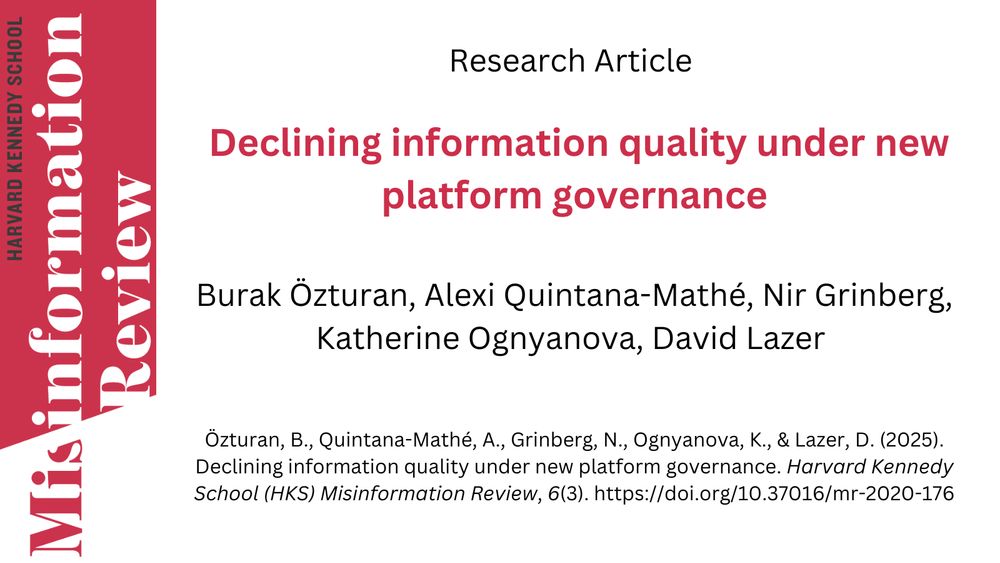
Now live: “Declining information quality under new platform governance” by Burak Özturan, Alexi Quintana-Mathé, Nir Grinberg, Katherine Ognyanova, and David Lazer. misinforeview.hks.harvard.edu/article/decl...
11.07.2025 16:32
👍 5
🔁 2
💬 0
📌 0

Yeah, I'm just watching OpenAI's newly released ChatGPT Agent power through my Qualtrics survey. I have thoughts about the future of human subject research.
25.07.2025 22:45
👍 2
🔁 0
💬 0
📌 0
New paper from our team, with @davidlazer.bsky.social @jonathanschulman.bsky.social @royperlis.bsky.social and other smart people who keep off social media.
15.07.2025 16:05
👍 11
🔁 3
💬 0
📌 0

Federal investment in Scientific + Medical Research by D, R, and Independent via CHIP50 - https://www.chip50.org/reports/american-attitudes-toward-government-interventions-in-science
Support for maintaining or increasing research support remains largely bipartisan. Which raises the question: what exactly is the WH and Congress doing here?
Source, CHIP50:
www.chip50.org/reports/amer...
Led by @ognyanova.bsky.social, @davidlazer.bsky.social, @royperlis.bsky.social + more.
03.07.2025 15:50
👍 5
🔁 1
💬 1
📌 0
This report comes from the Civic Health and Institutions Project (CHIP50), which recently won an @aapor.bsky.social survey methodology award. With @davidlazer.bsky.social @royperlis.bsky.social and others.
01.07.2025 00:11
👍 0
🔁 1
💬 0
📌 0


A majority of Americans support greater government investment in research: 57% favor increased medical research funding and 42% support increased scientific research funding. Relatively few want funding cuts: only 10% for medical research and 16% for science.
01.07.2025 00:04
👍 4
🔁 4
💬 0
📌 0


Average approval of science-related government actions is highest among Republicans (42%), men (28%), graduate degree holders (30%), and high-income respondents (31%). Disapproval is strongest among Democrats (74%), African Americans (56%), women (53%), and those aged 65 and older (55%).
01.07.2025 00:01
👍 1
🔁 0
💬 0
📌 0

American Attitudes Toward Government Interventions in Science | The COVID States Project
Report #115
New CHIP50 report on public approval of government interventions in science -- funding cuts, mass layoffs, etc. On average, twice as many Americans disapprove of these actions as approve #science @aaas.org @science.org @sciam.bsky.social @icahdq.bsky.social @sciencenews.bsky.social
30.06.2025 23:59
👍 3
🔁 0
💬 3
📌 1

Whose approval/disapproval of Trump has shifted the most?
We just posted an interactive on changes in approval for Trump from right before he was inaugurated to the present. We have very large samples (30k), and the interactive allows you to look at changes within very small slices of the public.
www.chip50.org/blog/whose-a...
23.06.2025 13:15
👍 63
🔁 29
💬 4
📌 5

How does generative AI transform/ disrupt communication scholarship?
Happy to be part of this great #ica25 panel. With answers and many more questions
@noshir.bsky.social @teachguz.bsky.social @ognyanova.bsky.social and Peng, Lu, Matthes and 🙋
15.06.2025 13:56
👍 7
🔁 3
💬 0
📌 0

📣 Calling all #CHI2025 attendees who work with human participants: Join our panel discussion on #LLM, #simulation, #syntheticdata, and the future of human subjects research on Apr 30 (Wed), 2:10 - 3:40 PM (JP Time)
Post your questions for panelists here: forms.gle/m2mXY3xFafAX...
22.04.2025 14:12
👍 17
🔁 5
💬 2
📌 2
LAST CHANCE for early registration to #WebSci25! Early reg closes TODAY, April 21!
We hope you'll join us at #Rutgers this May for this interdisciplinary conference!
Register at: www.websci25.org
cc:
@websciencetrust.bsky.social, @noshir.bsky.social
21.04.2025 11:47
👍 7
🔁 3
💬 0
📌 1

Next week, @rutgerscomminfo.bsky.social Associate Professor @ognyanova.bsky.social will be presenting on "False beliefs in unusual times: The role of trust, technology, and social ties" at LSC's #Scicomm Colloquium! #UWLSC700
Learn more at: lsc.wisc.edu/2025/01/17/l...
10.04.2025 15:29
👍 7
🔁 1
💬 0
📌 0

Poster for the 2025 Political Networks and Computational Social Science Conference.

Workshop information for the PolNet-PaCSS conference.
The workshops will be August 11 and August 12, 2025. There are four sessions: Introduction to Network Analysis in R taught by Michael Heaney; Network Visualization with R taught by Katya Ognyanova; Introduction to Latent Variable Models for Networks taught by Shahryar Minhas; and Introduction to Exponential Random Graph Models (ERGMs) taught by Cassie McMillan.
More information: https://sites.google.com/view/confpolinetworks/political-networks-conference/2025-polnet-workshops
Reminder! CFP and workshop registration for the Political Networks and Computational Social Science Conference.
We have a great lineup of network analysis workshop instructors: @michaeltheaney.bsky.social, @ognyanova.bsky.social, Shahryar Minhas, & Cassie McMillan.
sites.google.com/view/confpol...
21.03.2025 13:13
👍 5
🔁 3
💬 0
📌 1
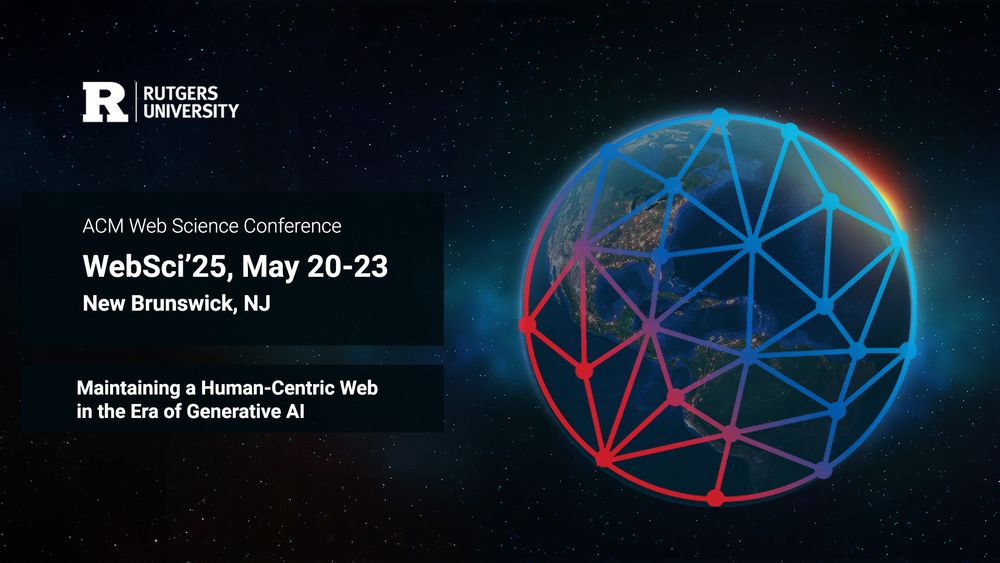
Friends, the 2025 ACM Web Science conference is coming up at #Rutgers this May. We have fantastic presenters and keynote speakers lined up. The schedule and registration just went live on www.websci25.org. Do come and join us! cc @websciencetrust.bsky.social @shugars.bsky.social
20.03.2025 18:06
👍 5
🔁 3
💬 0
📌 0
Join us for the 2025 Political Networks & Computational Social Science Conference (sites.google.com/view/confpol...), Aug 11-14 at Harvard & Northeastern, with Duncan Watts delivering the keynote. Workshops: Aug 11-12; panels: Aug 13-14. Submit by March 28:
04.03.2025 19:27
👍 15
🔁 7
💬 1
📌 1
New Jersey bookstore, but I'm sure they sell them online!
27.02.2025 22:21
👍 1
🔁 0
💬 1
📌 0

How it's going.
27.02.2025 22:19
👍 5
🔁 0
💬 1
📌 0
Save the date! PolNet & PaCSS 2025 are joining forces at Harvard and Northeastern on August 11–14, 2025—workshops on Aug 11–12, conference on Aug 13–14. Stay tuned for details on CFP, registration, and more. See you at #PolNetPaCSS2025!
26.02.2025 18:21
👍 5
🔁 8
💬 0
📌 1

The mood is ‘uncertain, anxious’ at 2025’s first big U.S. science meeting
Scientists are losing funding and even their jobs under the new Trump administration. Researchers at the AAAS meeting shared fears and coping strategies.
U.S. scientists are losing funding and even their jobs under the new Trump administration. Researchers gathering at the 2025 meeting of the American Association for the Advancement of Science shared their fears and hopes for the future.
16.02.2025 19:00
👍 37
🔁 6
💬 1
📌 1


Many of us have had a very rough few weeks. But I am told, in no uncertain terms, that nobody has suffered more than this good boy who had to endure a haircut today. #dogsky #dogsofbluesky
11.02.2025 02:47
👍 16
🔁 0
💬 0
📌 0

Trust in AI is highest among those with moderate knowledge (57%) but lower among those with very high or very low knowledge (38%).
Novices and experts are skeptical, while those with some knowledge might be overconfident. (🧵6 of 6)
10.02.2025 07:09
👍 0
🔁 0
💬 0
📌 0