Killer tortoises! I showed this in my island biology lecture yesterday and it shocked the students 😱 Here's the paper describing the behaviour: www.cell.com/current-biol... 🧪🌏
18.02.2026 12:57
👍 25
🔁 14
💬 5
📌 0

Fun to share a bit about the last 4 years of undergrad led research at the #SSB2026 meeting! @systbiol.bsky.social
13.01.2026 21:54
👍 4
🔁 1
💬 0
📌 1

Summer fish class at Friday Harbor Labs 🐟
5 weeks, field + lab, real projects.
Open to grads, postdocs, and undergrads. Financial aid available.
Apply: February 16, 2026
Reach out to @cmdonatelli.bsky.social @fishguy.bsky.social or @karlycohen.bsky.social with questions!
Details in the flyer ⬇️
12.01.2026 18:39
👍 20
🔁 12
💬 0
📌 3


Students had a blast at #SICB2026!
07.01.2026 16:05
👍 8
🔁 2
💬 0
📌 0


Come check out back-to-back Law lab talks today in the Shape and Climate session (room B112)!
10:15am - Long fuse evolution of carnivoran skeletal phenomes
13:30am - Endocranial shape variation in relation to climate in primates
#SICB2026 @sicb-dcb-dvm.bsky.social
04.01.2026 14:41
👍 5
🔁 3
💬 1
📌 0
Brawn before bite in endemic Asian mammals after the end-Cretaceous extinction
Our reviewed preprint @elife.bsky.social: Brawn before bite in endemic Asian mammals after the end-Cretaceous extinction doi.org/10.7554/eLif...
The research team will undertake revisions based on the initial reviews to further strengthen the evidence underlying our work! #paleontology #mammals
18.12.2025 23:17
👍 5
🔁 2
💬 0
📌 0
Very excited for this incredible lineup of talks at #SSB2026!
ssb2026.github.io/talks.html
For those giving talks, more instructions will be sent shortly.
@systbiol.bsky.social
17.12.2025 16:26
👍 26
🔁 12
💬 1
📌 4
And here's a Q&A of the paper with @iampotassium.bsky.social
www.washington.edu/news/2025/12...
17.12.2025 17:48
👍 1
🔁 1
💬 0
📌 0

We are grateful to the staff and collections all these museums and support from NSF (DBI-2128146), a University of Texas Early Career Provost Fellowship, Paleontological Society, Burke Museum, & the European Research Council (ERC-2021-ADG).
17.12.2025 16:08
👍 1
🔁 0
💬 0
📌 0
We posit that climatic and environmental changes from the Eocene-Oligocene Transition facilitated skeletal diversification among carnivoran families, whereas changes from the Mid-Miocene Climate Transition 20 My later facilitated skeletal diversification within families.
🧵 6/n
17.12.2025 16:08
👍 2
🔁 0
💬 1
📌 0

We found nearly equal support for the two release and radiate models, where the evolution of skeletal phenomes transitions from a constrained adaptive zone under a Ornstein–Uhlenbeck process to skeletal diversification under Brownian motion at the EOT 34 Ma and at the MMCT 14 Ma.
🧵 5/n
17.12.2025 16:08
👍 2
🔁 0
💬 1
📌 0

We then tested 16 alternative hypotheses that could explain the disparity of carnivoran skeletal phenome by fitting a series of macroevolutionary models.
🧵 4/n
17.12.2025 16:08
👍 1
🔁 0
💬 1
📌 0

DTT revealed higher subclade disparity than expected during two time intervals. The 1st occurs 39-37 Ma, right between the Middle Eocene Climatic Optimum & the Eocene-Oligocene Transition (EOT). The 2nd occurs 14-1 Ma, coinciding with the end of the Mid-Miocene Climate Transition (MMCT).
🧵 3/n
17.12.2025 16:08
👍 1
🔁 0
💬 1
📌 0

We first quantified skeletal phenomes using 103 linear measurements from 118 extant species & 81 extinct species. We measured 854 specimens held at 17 museums!
🧵 2/n
17.12.2025 16:08
👍 2
🔁 0
💬 1
📌 0

Our manuscript is now out in @royalsocietypublishing.org! We tested hypotheses that Cenozoic climatic change influenced the evolution of the cranial, appendicular, & axial skeleton in carnivorans. @tsengzj.bsky.social @hlusko.bsky.social
🧵 1/n
royalsocietypublishing.org/rspb/article...
17.12.2025 16:08
👍 18
🔁 6
💬 1
📌 2
Apply - Interfolio
{{$ctrl.$state.data.pageTitle}} - Apply - Interfolio
🧪🐠 I am hiring a postdoc! Work will be on patterns of biodiversity across phylogenetic scales using teleost fishes as a model. Apply by end of Jan 2026 for full consideration apply.interfolio.com/179070 I encourage folks to reach out with any questions. Please Share!
15.12.2025 16:02
👍 54
🔁 75
💬 2
📌 3

"NEST" logo for the Natural history Exploration Student Training Program. Logo contains a weasel inside a nest.
Finally made a logo and acronym for my mentorship program! Check it out chrisjlaw.github.io/NEST.html
11.12.2025 23:33
👍 5
🔁 1
💬 0
📌 0

Adaptive landscape and the evolution of flight in mammals
A big review of the evolution of bats:
www.annualreviews.org/content/jour...
🧪 ⚒️ #Paleobio #EvoBio
09.11.2025 21:56
👍 46
🔁 18
💬 2
📌 1
Wonder why this scene looks so familiar...
#WildlifeWednesday 🐦🐕
05.11.2025 06:57
👍 3346
🔁 1114
💬 99
📌 196
EMERGE Alaska | College of Fisheries and Ocean Sciences
🚨 Recruiting 12 PhD students for a new NSF-funded program at the University of Alaska Fairbanks College of Fisheries and Ocean Sciences! This program is for U.S. students who received an Honorable Mention on the NSF GRFP within the last 3 years. @uafairbanks.bsky.social
www.uaf.edu/cfos/academi...
24.10.2025 20:04
👍 31
🔁 35
💬 2
📌 2
Done
22.10.2025 15:17
👍 0
🔁 0
💬 0
📌 0

🦎THREAD: We just published something wild in @asn-amnat.bsky.social - lizards missing entire limbs not only survive, but some appear to actually thrive in the wild?!
Let me tell you about the "three-legged pirate" lizards 🏴☠️
[Paper: www.journals.uchicago.edu/doi/10.1086/... ]
(1/n)
14.10.2025 13:51
👍 102
🔁 41
💬 1
📌 8

Image of three brown and black fossil jaw fragments of extinct weasel relatives, Leptarctus, with short but sharp cusps. Open access paper at https://doi.org/10.5070/P9.48360
Celebrating #NationalFossilDay with a new paper describing specimens of the most whimsical of weasel relatives, leptarctine ("slender bear") mustelids, from the collections of @ucmpberkeley.bsky.social.
Their teeth are so much fun to look at! 🦷
doi.org/10.5070/P9.4...
(Cover image by P. Holroyd)
15.10.2025 21:35
👍 30
🔁 7
💬 1
📌 0


My lab is hiring a 2-yr hummingbird evolution and genomics postdoc and a 1-yr salaried research and lab tech. Both with full U. Wyoming benefits. Please spread the word! Info below. Best consideration date Nov 1, start dates early Spring 2026.
14.10.2025 20:08
👍 96
🔁 85
💬 0
📌 5

New in @science.org, meet Acronichthys maccagnoi, a new species from Late Creatacous Canada that changes what we know about the origins and evolution of one of the most successful fish groups on Earth.
02.10.2025 18:18
👍 87
🔁 32
💬 2
📌 7
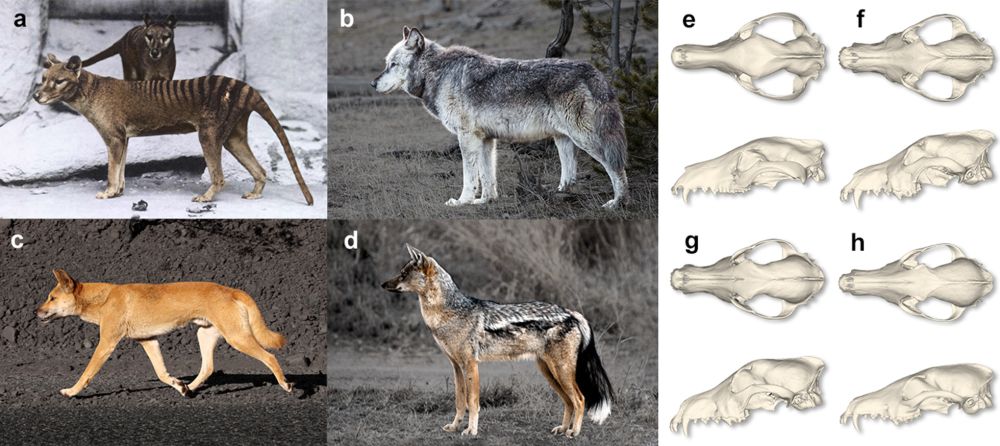
Functional ecological convergence between the thylacine and small prey-focused canids - BMC Ecology and Evolution
Background Morphological convergence is a fundamental aspect of evolution, allowing for inference of the biology and ecology of extinct species by comparison with the form and function of living species as analogues. The thylacine (Thylacinus cynocephalus), the iconic recently extinct marsupial, is considered a classic example of convergent evolution with the distantly related placental wolf or dog, though almost nothing is actually known regarding its ecology. This lack of data leads to questions regarding the degree of convergence with, and the similarity of, the functional ecology of the thylacine and the wolf/dog. Here, we examined the cranium of the thylacine using 3D geometric morphometrics and two quantitative tests of convergence to more precisely determine convergent analogues, within a phylogenetically informed dataset of 56 comparative species across 12 families of marsupial and placental faunivorous mammals. Using this dataset, we investigated patterns of correlation between cranial shape and diet, phylogeny, and relative prey size across these terrestrial faunivores. Results We find a correlation between cranial, facial, and neurocranial shape and the ratio of prey-to-predator body mass, though neurocranial shape may not correlate with prey size within marsupials. The thylacine was found to group with predators that routinely take prey smaller than 45% of their own body mass, not with predators that take subequal-sized or larger prey. Both convergence tests find significant levels of convergence between the thylacine and the African jackals and South American ‘foxes’, with lesser support for the coyote and red fox. We find little support for convergence between the thylacine and the wolf or dog. Conclusions Our study finds little support for a wolf/dog-like functional ecology in the thylacine, with it instead being most similar to mid-sized canids such as African jackals and South American ‘foxes’ that mainly take prey less than half their size. This work suggests that concepts of convergence should extend beyond superficial similarity, and broader comparisons can lead to false interpretations of functional ecology. The thylacine was a predator of small to mid-sized prey, not a big-game specialist like the placental wolf.
My final paper out of my PhD was published 5 years ago:
bmcecolevol.biomedcentral.com/articles/10....
Let's take a 🧪🧵 look back at convergent #evolution using the #thylacine and canid #mammals
1/n
01.10.2025 02:11
👍 37
🔁 11
💬 2
📌 0

Crates of bones

Wrapped up crates of bones
Loans of skeletal material get returned in crates. Had to work on my gift wrapping skills.
Thanks @amnh.org and the Field Museum for the loans!
04.09.2025 15:48
👍 2
🔁 0
💬 0
📌 0